























The Delhi government has allocated ₹19,148 crore to the education sector in its 2026–27 budget, reaffirming its continued prioritisation of public education even as the focus shifts toward quality and outcomes.
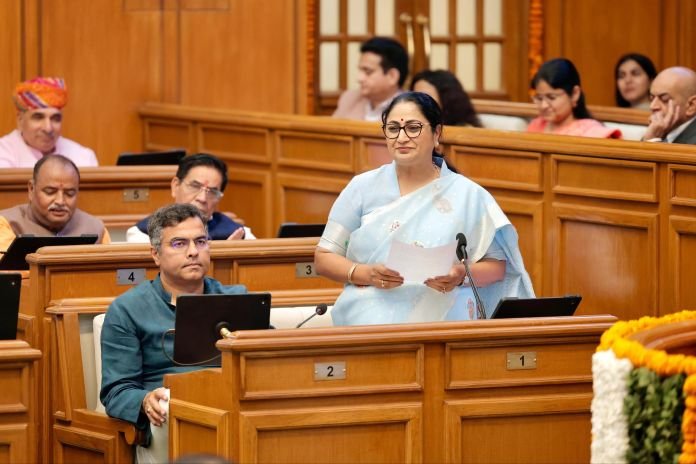
With a total outlay of about ₹1.03 lakh crore, education accounts for roughly 18.6% of the budget, retaining its position as the single largest sectoral allocation. Presented by Chief Minister and Finance Minister Rekha Gupta in the Assembly on March 24, the budget reflects a 3.7% increase over the previous financial year. This share places Delhi well above the all-India average of around 14–15% spent by states on education, underlining its sustained emphasis on human capital development.
However, while Delhi ranks among the highest in proportional spending, its absolute allocation remains modest due to its smaller budget size. By comparison, states like Bihar—allocating nearly 20% of its budget to education—and Gujarat, with significantly higher total outlays, are investing heavily in teacher recruitment, skill development, and systemic expansion. These states are at a different stage of educational evolution, whereas Delhi must now demonstrate depth over breadth, improving quality within an already built system.
Over the past decade, Delhi’s education model has been defined by visible investments in school infrastructure, classroom expansion, and governance reforms. The near-flat allocation this year—hovering around ₹19,000 crore—suggests the government is entering a second-generation reform phase, focused less on expansion and more on optimisation.
The 2026–27 budget signals three key priorities: digital transformation through smart classrooms and technology-enabled learning; student-centric schemes aimed at improving access, welfare, and retention; and greater system efficiency through better utilisation of existing infrastructure.
A notable highlight is the provision of free bicycles to around 1.3 lakh Class IX girls in government schools, backed by an allocation of about ₹90 crore. The scheme addresses a critical barrier—safe and reliable access to schools—which has historically contributed to dropout rates among adolescent girls. Similar interventions in states like Bihar and Chhattisgarh have shown measurable improvements in enrolment and attendance, and Delhi’s move reflects recognition that urban access challenges—distance, safety, and affordability—persist despite infrastructure gains.
The budget also places emphasis on digital inclusion, with laptops proposed for meritorious students, particularly girls in higher classes, to bridge the digital divide and support academic performance. In parallel, the government plans to upgrade classrooms with smart boards and related infrastructure, reinforcing the shift toward technology-enabled learning.
These measures align with the National Education Policy 2020, which emphasises quality, flexibility, and future-ready skills. They also signal a transition from infrastructure creation to classroom-level transformation, with a stronger focus on learning outcomes and institutional capacity.
Delhi continues to stand out for dedicating a significant share of its budget to education, reinforcing its reputation as a reform-oriented model in public schooling. Yet, the 2026–27 budget marks a subtle but important shift—from building capacity to optimising it, from access to outcomes, and from headline investments to systemic refinement.