
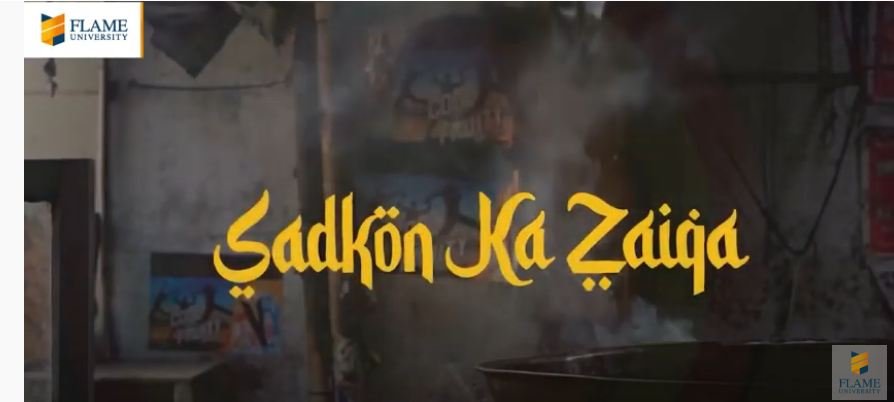
A group of 15 undergraduate students—Maanya Monnanda, Aman Jude Alexander, Chirag Bopaiah, Divyata Muralidharan, Gaurav Achaiah, Ivanka Irani, Kavan Modi, Mehak Neel, Mohak Kukreja, Nikhil Raghuveer, Tarana Ponappa, Tejas Nair, Utkarsh Maharishi, Varnika Hathi and Vibha Mohan—whose skills lie in various areas, finalised on studying the street food of Lucknow as their research project.
The team thought of a common interest, a binding factor that connected the 15 of them, and the answer was simple, ‘food’. When it comes to studying food in India, cross-cultural factors play a huge role. The team’s aim, however, was to explore a city where the food culture has remained relatively untouched, throughout centuries. One of the oldest cities in India, Lucknow, known for having retained its traditional and authentic street food cuisine for over five centuries became the centre of their project.
In the process of going into the depths of Lucknowi food and through interactions with the joint owners and food scholars, the team gained a metahistorical perspective. Apart from being exposed to a variety of ideologies and beliefs, credits to the research project, they also learnt to respect the difference of opinions within the group. Ironically, the attempt to explore ‘food’ through a daedal lens was also an attempt at creating an amalgamated identity for it. Not only did the team discover the authentic food gem of India, the city of Nawabs, Kebabs and Aadab, but also discovered themselves in the context of a different culture. The project is available for viewing here:
https://www.youtube.com/watch?v=vWdUiqM67kM&t=2s
With a purposive sampling and ethical guidelines in mind, the team set out to obtain authentic and credible information which could further be critically analysed. While studying the history and origin of dishes, it was clear that the popular joints as well as the food items spanned across a large timeline. Dishes such as the Biryani, Galawati Kebabs, Sheermal, etc. are original to this city of Nawabs. While dishes such as Chaat, Kulfi and Makkhan Malai travelled to Lucknow and integrated into its identity. Several other newer joints only opened in the last decade or so. With regards to the deep-rooted beliefs that guided the street food vendors of such a culturally and religiously rich city, a variety of ideologies were discovered. From vegetarianism and environmentalism, religious value systems, innovative cooking styles, secret recipes and specific business approaches, Lucknow’s street food culture was an amalgamation of all this and more. The same can be said about the various cooking techniques that followed.
While some recipes remained intact over the years, other vendors kept theirs a secret. Adaptation and continuation of traditional cooking techniques that use copper vessels, tandoors, and homemade equipment were observed on-field and credibility was analysed by referring to scholarly archives. While acknowledging such aspects of cooking methods and historical tracing were rather tangible and visible to the naked eye, the philosophical dimension of their research was relatively implicit. The direct interactions only gave the team a limited view of the beliefs followed, but drawing inferences from the ambience, body language and other additional factors played a huge role in the findings and facilitated this small-scale ethnographic research. Throughout the course of the research project, the team’s findings went beyond the content and research aspect of the experience. An interesting thing to note here is that none of the team members had ever been to the city of Lucknow and more than half of the group belonged to the southern parts of India, making the Lucknowi culture an unfamiliar one to all.
The team’s on-field experience in this city began in the month of February, 2020. They decided to adapt a historical, socio-cultural as well as a philosophical perspective while conducting the research, both, off-field and on-field. The study focused on asking questions pertaining to the origin of popular Lucknowi dishes. It also emphasized on the belief systems that guided and influenced these street food joints as well as the traditional cooking techniques that continue to be practised. The findings of the research project were guided by a research methodology that the team laid out beforehand. Majorly qualitative, and involving both primary as well as secondary sources, the tools of data collection aimed to contribute towards a structured research design. The primary sources included tools like online pre-field surveys, interviews and oral histories. The secondary sources on the other hand, focused on the books, journals, archives and articles that the team referred to, throughout the course of their research journey.
FLAME University the Discover India Program provided a wonderful opportunity to its undergraduate students to study a topic of great potential interest.