












sonbahis girişsonbahissonbahis güncelgameofbetvdcasinomatbetgrandpashabetgrandpashabetエクスネスMeritbetmeritbet girişMeritbetVaycasinoBetasusBetkolikMeritbetmeritbetMeritbet girişMeritbetbetciobetcioromabetromabetromabetteosbetteosbetbetnisalobetbetrasonbahisrinabetcasinomilyoncasibomcasibom girişcasibomcasibom girişjojobetjojobet girişjojobetjojobet girişbetciojojobetjojobet girişjojobetjojobetjojobetjojobet girişbetciobetcio girişbetciobetgarbetgar girişbetgarbetplaybetplay girişbetplaybetzulabetzula girişbetzulaeditörbeteditörbet girişeditörbetenjoybetenjoybet girişenjoybetnorabahisnorabahis girişbetciobetcio girişnorabahisbetciobetcio girişavrupabetavrupabet girişavrupabetroketbetroketbet girişroketbetalobetalobet girişalobetbahiscasinobahiscasino girişbahiscasinobahiscasinobahiscasino girişhiltonbethiltonbet girişhiltonbethiltonbet girişmillibahismillibahis girişmillibahismillibahis girişwbahiswbahis girişwbahiswbahis girişkulisbetkulisbet girişkulisbetkulisbet girişjokerbetjokerbet girişjokerbetjokerbet girişgalabetgalabet girişgalabetgalabet girişbetzulabetzula girişparobetparobet girişparobetparobet girişwipbetwipbet girişwipbetwipbet girişbetmarinobetmarinosetrabetsetrabetromabetromabetalobetalobetsuperbetinsuperbetinroketbetroketbetbetnanobetnanoprensbetprensbetbetnisbetnisbetpipobetpipo
  • About
  • Advertise
  • Privacy & Policy
  • Contact
Monday, March 30, 2026
  • Login
Curriculum Magazine
  • Home
    • Home – Layout 1
    • Home – Layout 2
    • Home – Layout 3
    • Home – Layout 4
    • Home – Layout 5
  • News
    • All
    • Business
    • Politics
    • Science
    • World

    Meet the woman who’s making consumer boycotts great again

    New campaign wants you to raise funds for abuse victims by ditching the razor

    Twitter tweaks video again, adding view counts for some users

    A beginner’s guide to the legendary Tim Tam biscuit, now available in America

    India is bringing free Wi-Fi to more than 1,000 villages this year

    Betterment moves beyond robo-advising with human financial planners

    Magical fish basically has the power to conjure its own Patronus

    This Filipino guy channels his inner Miss Universe by strutting in six-inch heels and speedos

    Oil spill off India’s southern coast leaves fisherman stranded, marine life impacted

    You can now play Bill Gates’ first PC game and run over donkeys on your iPhone, Apple Watch

    Trending Tags

    • Donald Trump
    • Future of News
    • Climate Change
    • Market Stories
    • Election Results
    • Flat Earth
  • Tech
    • All
    • Apps
    • Gear
    • Mobile
    • Startup

    Rap group call out publication for using their image in place of ‘gang’

    Meet the woman who’s making consumer boycotts great again

    New campaign wants you to raise funds for abuse victims by ditching the razor

    Twitter tweaks video again, adding view counts for some users

    A beginner’s guide to the legendary Tim Tam biscuit, now available in America

    India is bringing free Wi-Fi to more than 1,000 villages this year

    Betterment moves beyond robo-advising with human financial planners

    People are handing out badges at Tube stations to tackle loneliness

    Trump’s H-1B Visa Bill spooks India’s IT companies

    Oil spill off India’s southern coast leaves fisherman stranded, marine life impacted

    Trending Tags

    • Flat Earth
    • Sillicon Valley
    • Mr. Robot
    • MotoGP 2017
    • Golden Globes
    • Future of News
  • Entertainment
    • All
    • Movie
    • Music
    • Sports

    Meet the woman who’s making consumer boycotts great again

    New campaign wants you to raise funds for abuse victims by ditching the razor

    Twitter tweaks video again, adding view counts for some users

    A beginner’s guide to the legendary Tim Tam biscuit, now available in America

    People are handing out badges at Tube stations to tackle loneliness

    Trump’s H-1B Visa Bill spooks India’s IT companies

    Magical fish basically has the power to conjure its own Patronus

    This Filipino guy channels his inner Miss Universe by strutting in six-inch heels and speedos

    Oil spill off India’s southern coast leaves fisherman stranded, marine life impacted

    You can now play Bill Gates’ first PC game and run over donkeys on your iPhone, Apple Watch

  • Lifestyle
    • All
    • Fashion

    Rap group call out publication for using their image in place of ‘gang’

    Twitter tweaks video again, adding view counts for some users

    People are handing out badges at Tube stations to tackle loneliness

    This Filipino guy channels his inner Miss Universe by strutting in six-inch heels and speedos

    ‘Idol’ contestant besieged by pro-Trump Twitter users because of his name

    Using a mind reading device, ‘locked-in’ patients told researchers they’re happy

    How Nike plans to break one of the most daunting barriers in human performance

    Trump Attends the Return of the Remains of the Navy SEAL Who Died in Yemen

    J.K. Rowling Is Shutting Down Readers Who Burned All Their Harry Potter Books

    Trending Tags

    • Golden Globes
    • Mr. Robot
    • MotoGP 2017
    • Climate Change
    • Flat Earth
No Result
View All Result
Curriculum Magazine
No Result
View All Result
Home Education Editorial

The Lesson from Panjab University: Let Universities Govern Themselves

by Editorial team
November 9, 2025
in Editorial
0
The Lesson from Panjab University: Let Universities Govern Themselves
491
SHARES
1.4k
VIEWS
Share on FacebookShare on Twitter

Across India, the past decade has seen a quiet but unmistakable centralisation of higher education policy — through the National Education Policy (NEP) 2020, the creation of umbrella regulatory bodies, and expanding ministerial oversight over institutions once defined by their autonomy. The recent controversy at Panjab University (PU) — over the Union Ministry of Education’s now-withdrawn notification restructuring the university’s Senate and Syndicate — has only made that trend more visible.

“The debate in Chandigarh mirrors what’s happening nationwide — the shrinking space for academic self-rule,” noted Dr. Meenakshi Gopinath, a respected academic leader.

Founded in 1882, Panjab University stands among India’s oldest centres of higher learning, tracing its lineage to the pre-Partition University of the Punjab in Lahore. Re-established in Chandigarh after 1947, it occupies a unique legal and moral space. Under the Punjab Reorganisation Act, 1966, PU was conceived as an inter-state body corporate, giving both the Centre and the state a stake in its governance — a federal arrangement meant to preserve the university’s shared intellectual and cultural heritage.

Over decades, PU’s Senate and Syndicate came to symbolise that delicate balance. The Senate — a body of elected teachers, alumni, and college representatives — embodied the university’s public character. The Syndicate, its executive arm, carried out academic and administrative decisions. Together, they reflected an essential belief: that a university’s strength lies in its community of scholars and citizens, not in bureaucratic hierarchy.

That balance was shaken on October 28, 2025, when the Union Ministry of Education issued a notification restructuring PU’s Senate and Syndicate. The new rules reduced the number of elected representatives — traditionally drawn from teachers, alumni, and even non-teaching staff — while expanding the number of nominated members, many appointed through central mechanisms.

For an institution that has long prided itself on participatory governance, the proposal was seismic. Critics saw in it not reform, but a quiet transfer of control.

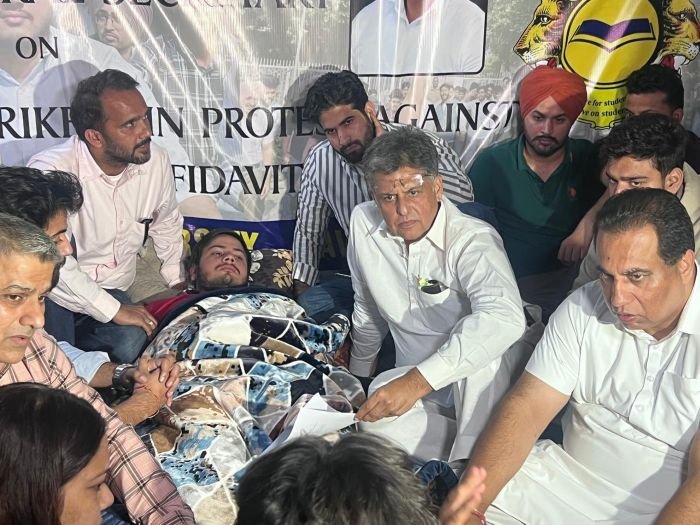
The roots of the unrest lay earlier, in the admissions season of June 2025, when incoming students were asked to sign an affidavit pledging not to participate in protests or demonstrations without prior permission. To many, this was more than a bureaucratic formality — it was a symbolic gag order.

Student groups across the spectrum mobilised in protest. In a gesture that became emblematic, they printed the affidavit on toilet paper rolls, distributing them across hostels — a biting metaphor for administrative overreach. By August, the movement had spread across departments.

University officials defended the clause as a “measure to maintain order.” But for students and faculty, it reflected a larger anxiety: the shrinking space for dissent and debate within Indian universities.

As the controversy deepened, the Aam Aadmi Party–led Punjab government and opposition parties threw their weight behind the protesters. Chief Minister Bhagwant Mann called the Centre’s move an “attempt to rob Punjab of its educational heritage.” Legal experts noted that any unilateral change in PU’s structure could violate the Punjab Reorganisation Act, which enshrines the university’s federal character.

The university’s unique status — “a national university with a regional character,” jointly funded by both Centre and state — became the core of the debate. For many in Punjab, the notification was not simply administrative; it was political, touching questions of identity, representation, and the constitutional boundaries of federalism.

By early November, following protests, petitions, and mounting public pressure, the Ministry withdrew the notification. But the questions it raised have not disappeared.

Observers see in the Panjab University row a national pattern. Across India, from Visva-Bharati to JNU, universities face creeping centralisation — whether through appointments, funding control, or curriculum approval. The impulse for “streamlining” often masks a deeper drive toward administrative conformity.

The so-called “affidavit culture” — conditioning academic participation on political silence — sets a dangerous precedent. It redefines citizenship within campuses as compliance rather than critique, turning universities from laboratories of free inquiry into gated institutions of obedience. For India’s scholars, the fear is not merely bureaucratic interference, but the slow erosion of the collegial culture that sustains higher education. “Universities are not factories,” a retired professor of political science remarked. “They are spaces of debate, dissent, and discovery. Governance must reflect that spirit.”

Panjab University’s 143-year-old story offers a warning for the nation. Autonomy is not a privilege bestowed by governments; it is a constitutional trust that enables the pursuit of knowledge free from fear. The boundaries of India’s federalism, democracy, and the freedom to think — all find their reflection in how universities govern themselves.

In restoring the Senate’s elected character, the Ministry may have stepped back. But the larger question remains:
Will India’s universities continue to be governed by their scholars — or by those who fear what free minds can do?

Donation

Buy author a coffee

Donate
Share196Tweet123
Editorial team

Editorial team

  • Trending
  • Comments
  • Latest
Samsung Innovation Campus Certifies 1,000 Students in Future-Tech Skills in UP

Samsung Innovation Campus Certifies 1,000 Students in Future-Tech Skills in UP

March 24, 2026
ARISE Members’ Meeting at Varanasi marked two years of ARISE as an independent platform; announces new Company Board

ARISE Members’ Meeting at Varanasi marked two years of ARISE as an independent platform; announces new Company Board

March 25, 2026
Former CJI Uday Umesh Lalit Chief Justice appointed as Professor of Emeritus at SRM School of Law

Former CJI Uday Umesh Lalit Chief Justice appointed as Professor of Emeritus at SRM School of Law

March 24, 2026

test first article

0

this test from admin panel

0
The property water based murals and installations

The property water based murals and installations

0
IIMA inaugurates Krishnamurthy Tandon School of Artificial Intelligence

IIMA inaugurates Krishnamurthy Tandon School of Artificial Intelligence

March 27, 2026
Delhi Allocates ₹19,148 Crore for Education in 2026–27 Budget

Delhi Allocates ₹19,148 Crore for Education in 2026–27 Budget

March 25, 2026
Samsung Innovation Campus Certifies 1,000 Students in Future-Tech Skills in UP

Samsung Innovation Campus Certifies 1,000 Students in Future-Tech Skills in UP

March 24, 2026
Curriculum Magazine

Copyright © 2017 JNews.

Navigate Site

  • About
  • Advertise
  • Privacy & Policy
  • Contact

Follow Us

Welcome Back!

Login to your account below

Forgotten Password?

Retrieve your password

Please enter your username or email address to reset your password.

Log In
No Result
View All Result
  • Home
  • News
    • Politics
    • Business
    • World
    • Science
  • Entertainment
    • Music
    • Movie
    • Sports
  • Tech
    • Apps
    • Gear
    • Mobile
    • Startup
  • Lifestyle
    • Fashion

Copyright © 2017 JNews.

WordPress Market Image Showcase for Cornerstone Image Slider Plugin For WordPress Image Toggle – Addon for WPBakery Page Builder Image Video Audio Background for WordPress Image Zoom Pan WordPress Plugin ImageLinks – Interactive Image Builder for WordPress Immigo – immigration and Visa Consulting WordPress Theme Immigway – Immigration and Visa Consulting WordPress Theme Imogen – Designer and Creative Business WordPress Theme Impacto Patronus | Nature Protection, Petitions & Social Activism WordPress Theme + RTL