
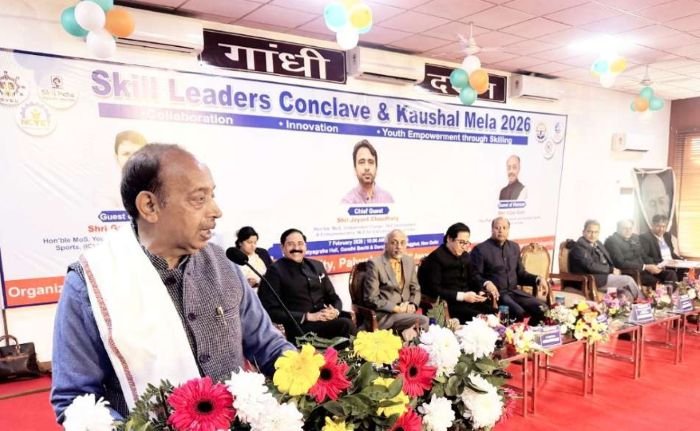
Shri Vishwakarma Skill University (SVSU), Palwal in partnership with Delhi Skill and Entrepreneurship University (DSEU) and Assam Skill University on February 7 organized, a first of its kind joint conference cum exhibition at the Gandhi Satyagraha Auditorium, Rajghat, New Delhi—providing a model for wider collaboration amongst the new category of skill universities that have come up in last 15 years in the country. As a follow up, a conference of Vice Chancellors of skill universities would be organized soon as per the outcome shared by the organizers.
Former Union Minister in PMO and BJP leader, Vijay Goel, who inaugurated the event emphasized the critical role of skills and innovations that can be catalyzed by the emerging ecosystem of skill universities. He added that Prime Minister Narendra Modi has promoted skill development in the country and strengthened this concept. He also urged students to learn from the life of Mahatma Gandhi, who faced immense struggles and was never afraid of failure. Goel also appreciated the skill-based projects presented by the students.
At the plenary, Professor Dinesh Kumar, Vice chancellor of the Shri Vishwakarma Skill University (India’s first state run skill university) explained that skills, innovation, and entrepreneurship will play a vital role in making India a developed nation. He stated that by 2027, 44 percent of skills will undergo change. “It is with this objective, that the idea of this conclave came up. Skill universities together will help strengthen the country’s skill ecosystem,” he added while presenting his university as a model of skill education, which is now being followed by many universities across India.
In his keynote address, Prof. (Dr) A. K. Nagawat, Vice Chancellor of Delhi Skill and Entrepreneurship University, explained the key features of the DSEU model, MoUs with over 200 industries and suggested its implementation in other institutions, stressing the need for deeper industry collaboration. He also emphasized on the importance of character, behavior and values saying, “often these are not seen as skills, but these cultural skills can go a long way in making an individual successful in his vocation.” India’s traditional skills they can play a significant role in boosting the country’s GDP and there is a need to integrate them with the ecosystem. He mentioned that short-term skill courses efforts by DSEU in marginal communities within Delhi have empowered a large number of women through self-help groups. Emphasizing that the shelf life of skills is limited, he stressed the need for continuous upgradation and the importance of using skilled professionals to train and upskill others.
Prof Kailash Chandra Sharma, Chairman of the Haryana State Higher Education Council, called for promoting skills under the Recognition of Prior Learning (RPL) framework by giving recognition to traditional knowledge systems. Akhilesh Mishra, Director of the National Institute of Open Schooling, talking about the vocational stream of NIOS, offered its vast network across the country for collaboration on research and skill development with universities.
Dr. Raj Nehru, OSD to the Chief Minister of Haryana and former VC of SVSU, talked about immense contribution and expectations from skills to grow country’s economy to five-fold in coming decades. He highlighted the low ranking of country in innovation index and wondered if teachers and institutions remain complacent even if thousands of P hD holders are churned every year. He talked about need of teachers to work in industries to follow the trends citing SVSU, where teachers were given paid leaves upto 6 months so that that can get industry exposure and come back empowered to innovate back in the classrooms and labs. He said productivity, creativity and intellectual growth are still with the humans even as AI is transforming workspace everywhere.
Prof S. P. Singh, Director General of Kaushalya Skill University, Ahmedabad, proposed reserving seats for students from Industrial Training Institute (ITIs) in HEIs like IITs to make skills more aspirational and also disrupt the coaching culture, which has taken teen skilling space and made engineers largely not inherent skills from schooling years. He also advocated mobility of students within skill universities’ whereby students can complete one year at another university in a different geography according to skilled force gaps in the regions.
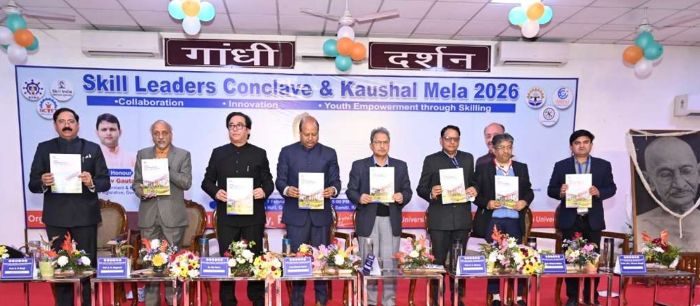
Among others who spoke included Suhas Deshmukh, Director of NCVET, along with Milan Sahu, Sarika Dixit. Manish Kumar delivered presentations during a technical session on the skill education model. Also present at the event were Professor R. S. Rathore, State Project Director; Professor Sanjay Goyal, Indian Skill Development University; Mr. Kuldeep Sharma, Pro-Vice Chancellor of Medhavi Skill University; Ms. Chanchal Bhardwaj, Director of IRA; and several other heads of universities and institutions associated with the skill ecosystem. Students showcased their skill-based projects during the fair.