
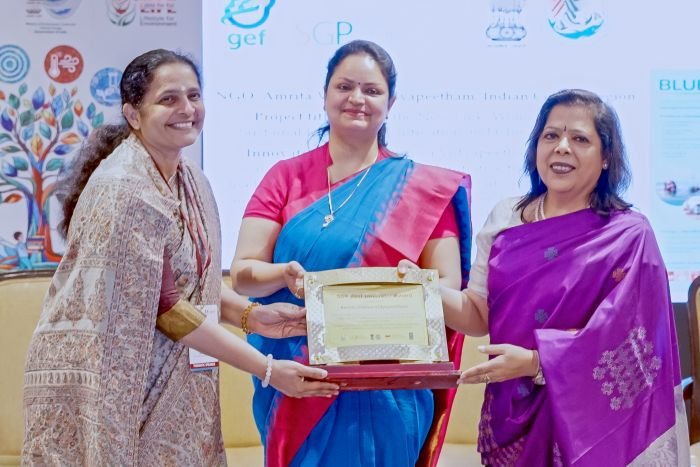
At the World Sustainable Development Summit 2026, Amrita Vishwa Vidyapeetham was conferred the SGP Best Innovator Award under the Global Environment Facility Small Grants Programme (GEF-SGP) on Feb 26. The honour recognises the university’s pioneering skilling model that positions women at the frontline of climate action – a transformational journey that strengthens coastal livelihoods while advancing marine ecosystem restoration, sustainable aquaculture, and climate resilience.
The GEF Small Grants Programme (SGP) is a partner initiative that includes the Ministry of Environment, Forest and Climate Change (MoEF&CC), TERI and UNDP. The event was attended by policymakers and development leaders, including Ms Tanvi Garg, Joint Secretary and GEF Operational Focal Point (OFP), MoEF&CC. The initiative was implemented with financial support from ESRI and Transworld.
In many ways, the award marks a quiet return to an older idea — that education is not merely the transfer of knowledge but the shaping of responsibility and values. The award honours a philosophy. Amrita’s approach is centred on transforming community realities through research rooted in compassion. And in a world searching for sustainable answers, the most powerful innovation may simply be a university willing to step outside its campus and learn before it teaches.
At Amrita, students and faculty do not merely study sustainability — they live it through the Live-in-Labs programme. They travel to villages, spend weeks with families, observe daily struggles, and co-design solutions alongside communities. The premise is simple yet radical: development cannot be delivered; it must be built together.
Representing the institution, Dr Bhavani Rao R, Dean, School of Social and Behavioural Sciences, described the model as research that listens before it speaks.
“Knowledge becomes meaningful only when it touches life. When we work with communities, we realise poverty is not only about resources but also about exclusion. If compassion enters research, sustainability follows naturally,” she said.
She emphasised that universities occupy a rare space — capable of translating grassroots wisdom into structured knowledge and carrying it upward into policy conversations.
The gathering, attended by heads of state and government, senior policymakers, representatives of multilateral institutions, development agencies, scholars, corporate leaders, youth representatives, and civil society organisations from across the world, reflected the growing global consensus that climate resilience must be built in partnership with those most affected by change — farmers, women’s collectives, and local communities.
Isabelle Tschan, Deputy Resident Representative, UNDP India, highlighted why partnerships with academic institutions matter.
“Long-term change happens when communities lead decisions, not just participate in projects. Institutions that combine evidence with local understanding help small initiatives grow into lasting systems,” she said.
What distinguished Amrita’s work, speakers noted, was its hybrid nature — part university, part implementing partner. The institution conducts research, tests solutions in the field, and refines them through real-world feedback. The result is not a project that ends with funding, but a model that sustains itself.
For decades, programmes measured success by numbers — beneficiaries reached, funds allocated, infrastructure built. Increasingly, impact is being measured by ownership — whether communities continue the work long after the experts leave. Amrita’s initiatives, many led by women’s groups and local networks, have demonstrated precisely that continuity. The recognition also reflects a broader shift in development thinking: from scale to depth, from intervention to inclusion.