
Schools may hold the key to tackling India’s growing nutrition crisis — from persistent malnutrition to rising lifestyle diseases — with experts now pushing to make nutrition education a core part of everyday learning.
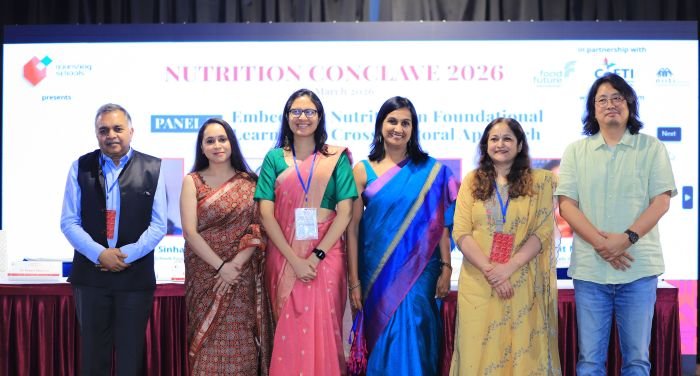
At the third edition of the Nutrition Conclave hosted by the Nourishing Schools Foundation in New Delhi on March 20, policymakers, educators, and industry leaders called for integrating nutrition literacy into school systems, arguing that early awareness can significantly influence lifelong health outcomes.
The conversation comes at a time when India faces a dual burden: undernutrition in many regions and increasing cases of obesity, diabetes and other metabolic disorders, often beginning at younger ages.
Speakers noted that while national programmes such as POSHAN Abhiyaan, PM POSHAN and the School Health and Wellness Programme under Ayushman Bharat have expanded access to food and health services, there is now a clear need to go beyond access and focus on behaviour change.
“India needs to re-establish its elemental connection with food,” said Arti Ahuja, former Secretary to the Government of India, stressing that nutrition policy must move towards a more holistic, multi-sectoral approach. “Efforts across the food system must converge into something concrete and actionable.”
At the heart of the discussion was a simple idea: children who understand nutrition early are more likely to make healthier choices — not just for themselves, but within their families and communities.
Archana Sinha, Co-founder and CEO of the Nourishing Schools Foundation, highlighted this long-term impact. “The food choices children make tomorrow will be shaped by what they learn today. Schools are where this change can begin,” she said.
Experts at the conclave emphasised that classrooms can serve as powerful platforms for shaping habits — from understanding balanced diets to questioning ultra-processed foods — especially when learning is experiential rather than textbook-driven.
A key theme that emerged was the need for stronger collaboration between government, corporates and civil society. Participants argued that corporate social responsibility (CSR) efforts should move beyond compliance to support scalable, long-term interventions in schools.
Another panel focused on embedding nutrition into foundational learning, with speakers calling for better alignment between education, health and child development systems. Practical tools — such as activity-based modules, school-level interventions and community engagement — were cited as critical to making nutrition education effective.
The broader message was clear: improving India’s nutrition outcomes may not depend solely on what is served on plates, but also on what is taught in classrooms.