
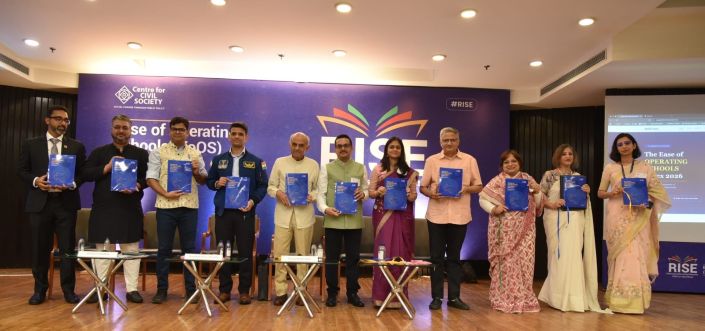
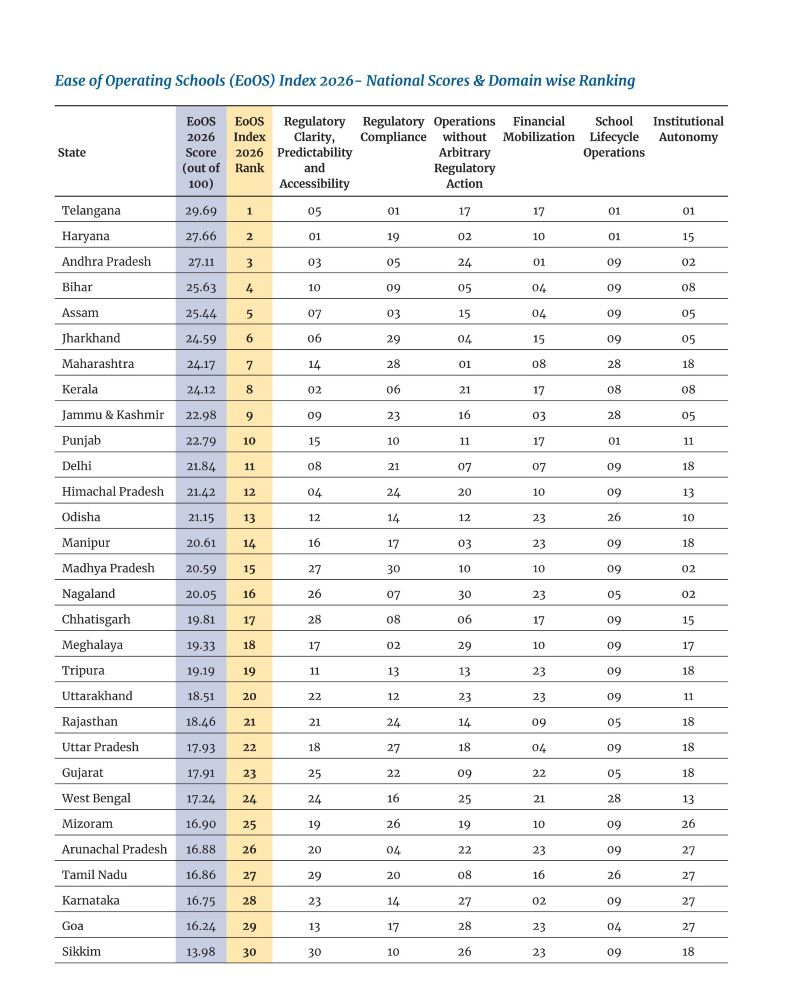
The Centre for Civil Society (CCS), a Delhi-based public policy think tank focused on education, livelihoods and governance, has released the Ease of Operating Schools (EoOS) Index 2026, India’s first comprehensive comparative assessment of the regulatory environment governing private unaided schools across states. Released in New Delhi on June 19, the Index evaluates and ranks states based on how conducive their regulatory frameworks are for the establishment, operation and growth of private schools.
Telangana emerged as the best-performing state with an EoOS score of 29.69, while Sikkim ranked last with 13.97. The national average stands at 20.86, highlighting a significant gap between states and underscoring the uneven nature of school regulation across India.
The report finds that regulatory systems are generally stronger in defining obligations, monitoring compliance and exercising oversight, but considerably weaker in supporting financial sustainability, institutional adaptability and operational autonomy. Nationally, private unaided schools account for 23.1 per cent of all schools and educate nearly 38.8 per cent of students, making the quality of their regulatory environment a matter of considerable public importance.
According to the authors, India’s school governance framework is marked by three interconnected shortcomings — a Sustainability Deficit, an Adaptability Deficit, and a Trust Deficit. Together, these explain many of the operational challenges faced by schools. The report argues that the future of school regulation lies not merely in tightening compliance but in creating a regulatory architecture that balances accountability with enablement, oversight with flexibility, and public interest with institutional sustainability.
“The future challenge for school regulation in India is not simply improving compliance or strengthening oversight. It is building a regulatory architecture that combines accountability with enablement, oversight with flexibility, and public interest with institutional sustainability. Ultimately, schools can only deliver educational outcomes if they are not merely regulated, but also empowered to succeed,” the authors state.
The Index is designed not to assess whether regulations exist, but how effectively they operate. By benchmarking states and identifying areas of regulatory friction, it seeks to foster evidence-based discussions on school governance and support reforms that make regulation more transparent, predictable, proportionate and conducive to educational provision.
Authored by CCS scholars Dr Animesh Kumar, Shaivy Maheshwari and Nitesh Anand, the EoOS Index evaluates 28 states and two Union Territories across six domains of school governance:
- Regulatory Clarity
- Regulatory Compliance
- Protection Against Arbitrary Regulatory Action
- Financial Sustainability and Resource Mobilisation
- School Lifecycle Operations
- Institutional Autonomy
The assessment is based on 164 indicators, derived from a systematic review of state education laws, rules, regulations, government orders, notifications and other legally operative instruments. All indicators were assigned equal weight after normalisation to arrive at a composite score out of 100.
One of the report’s key findings is that schools in India do not function within a uniform regulatory environment. Instead, they operate within distinct state-level ecosystems that differ significantly in design, quality and degree of enablement. While some states have developed relatively transparent and predictable frameworks that support institutional functioning while maintaining accountability, others continue to rely on systems characterised by administrative complexity, excessive discretion and limited flexibility.
The report argues that sustainability should be recognised as a legitimate public policy objective, noting that educational quality depends not only on standards and oversight but also on the long-term viability of educational institutions. These principles, it says, align closely with the vision of the National Education Policy (NEP) 2020, particularly its emphasis on institutional autonomy, transparency, separation of functions and “light but tight” regulation.
However, the Index finds that the separation-of-functions agenda underpinning the proposed State School Standards Authorities (SSSAs) remains only partially realised across most states. While 22 states have reportedly notified SSSAs, it remains unclear how many are operational on the ground.
The report further stresses that a well-designed regulatory system should not eliminate state authority but structure it through transparent procedures, reasoned decision-making and effective appeal mechanisms. Many states, it notes, still need to strengthen this procedural architecture.
The EoOS Index highlights that while many states have introduced robust fee regulation mechanisms—including fee control laws, approval committees, fee determination authorities, restrictions on fee hikes, and grievance redressal systems—to protect affordability and prevent exploitation, far less attention has been paid to ensuring the financial sustainability of schools.
The report argues that the key issue is not whether fee regulation should exist, but whether it is accompanied by policies that allow schools to remain financially viable. Schools today are required to meet expanding obligations related to infrastructure, safety, staffing, compliance, reporting, and educational quality, yet they are given limited flexibility to generate the resources needed to meet these demands.
According to the Index, Financial Sustainability and Resource Mobilisation is the weakest-performing domain of school regulation in India. The findings suggest that regulatory systems are far more developed in controlling school finances than in enabling schools to sustain themselves. This creates a governance imbalance where schools are expected to do more without corresponding financial capacity.
The report stresses that institutional sustainability is not merely a private concern but a public interest issue, as it directly affects educational continuity, teacher retention, infrastructure quality, organisational resilience, and long-term learning outcomes. Sustainable schools are essential for sustainable education systems.
The Index concludes that unless financial sustainability becomes a central consideration in educational governance, regulatory frameworks risk undermining the very institutions they seek to improve. Schools can deliver quality education only if they have the resources necessary to remain viable and grow.
Another area of concern is School Lifecycle Operations, which records the second-lowest national average score among the six domains assessed. Schools are dynamic institutions that must continually adapt by expanding enrolment, adding grades, introducing new programmes, upgrading facilities and responding to changing demographic and technological realities. Yet regulatory systems appear far more developed in governing school establishment than in facilitating school evolution.
“The challenge is not merely that schools face procedural barriers. The deeper challenge is that regulatory systems appear considerably more developed in governing school establishment than in governing school evolution,” the report observes.
Concluding on a reform-oriented note, the report reiterates that India’s next frontier in school governance lies in completing the transition from compliance-centric regulation to an enabling framework that preserves accountability while expanding institutional capacity.
In an accompanying foreword article with the report, Parth J. Shah, Founder-Chairman of CCS, draws a parallel with India’s economic liberalisation. “India did not become an economic success story by having the government produce more. It succeeded by redirecting state energy toward what the state can actually do well: set standards, enforce them fairly, fund those left behind by the market, and get out of the way of enterprise. Education needs the same clarity of thinking,” he writes.
“From controller to regulator. From producer to financier. From inspector to informer. India’s economy had its 1991 moment. Its education system needs it badly and soon.”