
Even as the Cockroach Janata Party (CJP)-led agitation over the NEET controversy continues to keep the spotlight on the Union Minister of Education in Delhi, another education-related controversy is rapidly entering the national discourse. The proposed demolition of 38 out of the 40 buildings of Mohammad Ali Jauhar University in Rampur, Uttar Pradesh, has opened a wider debate on the governance of higher education, regulatory accountability and the balance between enforcing the rule of law and protecting educational institutions.
The Rampur Development Authority (RDA) has issued demolition notices under the provisions of Uttar Pradesh Urban Planning and Development Act of 1973 to the university, alleging widespread violations of development and building regulations, and has given the institution until August 5 to respond. The action has triggered political reactions across party lines and raised concerns over the future of nearly 2,400 students studying on the campus.
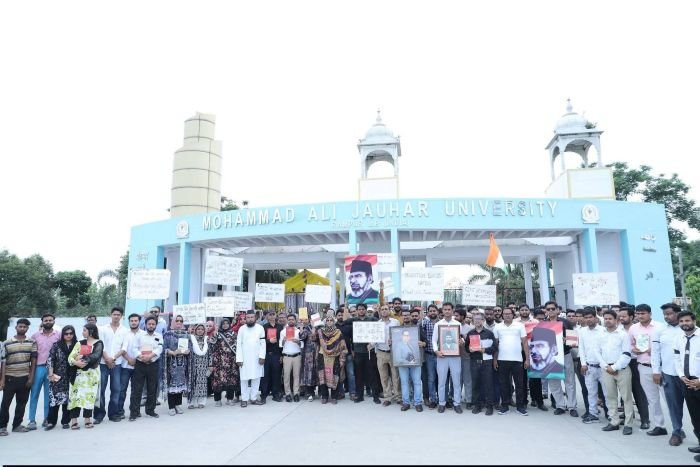
A delegation of Opposition MLAs from Uttar Pradesh, led by Leader of the Opposition Mata Prasad Pandey, visited the university and urged the district administration to withdraw the demolition notices in the larger interest of students and higher education. The delegation argued that any action affecting a functioning university should be preceded by a comprehensive review of its academic and social consequences.
Established in 2012 under the Uttar Pradesh Private Universities Act, Mohammad Ali Jauhar University was conceived as a flagship institution to expand access to higher education in Rampur, one of western Uttar Pradesh’s educationally underserved districts. Named after freedom fighter Maulana Mohammad Ali Jauhar, the university currently offers around 40 degree, diploma and professional programmes through 14 faculties, including science, law, humanities, commerce, Islamic studies, education, agriculture and pharmacy.
Over the past decade, however, the university has become a symbol of the complex intersection of education, politics, land governance and regulatory oversight.
Founded by senior Samajwadi Party leader Azam Khan, who continues to serve as its lifetime Chancellor, the university increasingly came under official scrutiny after the BJP government assumed office in Uttar Pradesh in 2017. Multiple investigations were launched into alleged irregularities involving land acquisition, encroachment on government land, violations of development norms and unauthorised occupation of public property. Several criminal cases have also been registered against Azam Khan and members of the university trust over the years.
A major legal milestone came in October 2024, when the Supreme Court declined to interfere with an Allahabad High Court judgment upholding the cancellation of the university trust’s lease over certain parcels of government land. While the verdict did not determine the legal status of every structure on the campus, it significantly strengthened the state’s position in pursuing subsequent regulatory action.
The present demolition notices, however, are based not on criminal proceedings but on alleged violations of urban planning laws. According to the Rampur Development Authority, almost the entire campus was constructed without approved building plans and therefore violates statutory development regulations. The university administration is expected to challenge these findings before the appropriate appellate authority and, if necessary, the courts, making prolonged litigation almost certain.
The controversy has also highlighted the educational implications of any large-scale demolition. Rampur district has no other university of its own. The nearest institutions are in Moradabad, nearly 50 kilometres away. The district administration has reportedly identified around 30 affiliated colleges where students could be accommodated if required. Most of these institutions are affiliated with Guru Jambeshwar University, a recently established university that is itself yet to develop a full-fledged campus, raising questions about the practicality of such rehabilitation.
The demolition notices have attracted criticism from several political leaders and education observers. Senior Congress leader Shashi Tharoor described the proposed demolition as “perverse”, particularly in a state facing a shortage of quality higher education institutions. “If construction was illegal, impose penalties, levy fines, or even consider government takeover. But do not destroy a functioning university that Uttar Pradesh needs,” he said.
Academic and public intellectual Badri Raina, writing in The Wire, argued that those campaigning against corruption in education should also speak out on the Jauhar University issue. He suggested that the Cockroach Janata Party and education activist Sonam Wangchuk, currently mobilising public opinion over examination reforms and transparency, should broaden their campaign to include the fate of the university and the thousands of students studying there.
Other opposition voices have echoed similar concerns. Bhim Army chief and Member of Parliament Chandra Shekhar Azad questioned whether demolition should proceed before all judicial remedies are exhausted. Jamiat Ulama-e-Hind president Maulana Mahmood Madani described the action as politically motivated and stressed the symbolic importance of preserving an institution named after one of India’s foremost freedom fighters.
The Uttar Pradesh government has firmly rejected allegations of political vendetta. It maintains that the issue concerns the enforcement of planning laws and accountability for unauthorised construction, irrespective of the identity of those managing the institution. Officials argue that compliance with building regulations cannot be selectively relaxed simply because an educational institution is involved.
| Year | Development |
| 2006 | University established by Mohammad Ali Jauhar Trust |
| 2012 | Granted private university status |
| 2013 | Minority institution status granted |
| 2019–24 | Multiple investigations and legal disputes involving land and construction |
| Oct 2024 | Supreme Court upholds cancellation of land lease |
| Jul 2026 | Demolition ordered for 38 buildings; campus road declared public; protests intensify |
Beyond the immediate political contest, the Jauhar University case raises broader questions about the regulation of private higher education in India. Over the past two decades, private universities have expanded rapidly, particularly in regions where public investment in higher education has remained inadequate. While these institutions have significantly improved access, their growth has at times outpaced regulatory oversight, leading to disputes over land acquisition, environmental clearances, planning approvals and institutional governance.
The controversy also underlines an enduring challenge in higher education policy. Universities are expected not only to deliver quality teaching and research but also to comply fully with land laws, environmental norms, financial regulations and urban planning requirements. Administrative failures in these areas can undermine institutional credibility and place the academic future of thousands of students at risk, even though they bear no responsibility for such lapses.
The larger questions it has brought to the fore—how India should regulate private universities, protect students, uphold institutional accountability and prevent politics from overshadowing educational priorities—are likely to remain part of the national conversation well beyond this dispute.