
For decades, India’s private schools were largely local institutions. Founded by educationists, philanthropists, religious organizations or entrepreneurial families, they were built around reputation, community trust and long-term stewardship rather than financial engineering. Expansion, when it happened, was gradual and largely funded through internal surpluses or promoter capital.
That landscape is changing.
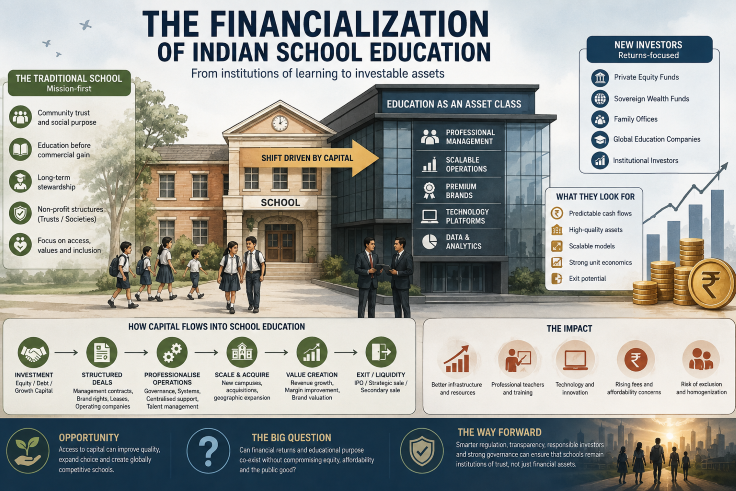
Over the past three years, India’s K-12 education sector has witnessed a quiet but unmistakable shift. Global private equity firms, sovereign wealth funds and institutional investors are entering school education with unprecedented interest. The recent headline-grabbing acquisition of Gurugram’s Pathways School by KKR-backed Lighthouse Learning for an estimated ₹1,500 crore is perhaps the clearest symbol yet of this transformation. It is not merely a high-value transaction; it signals that premium schools are increasingly being viewed as investable assets alongside hospitals, hotels and office parks.
This is the financialization of school education.
From Community Institutions to Investment Platforms
Financialization refers to the growing influence of financial markets, investors and investment logic in sectors traditionally driven by social or public objectives. In education, it means that schools are increasingly evaluated not only by learning outcomes or academic reputation but also by metrics such as revenue growth, operating margins, return on invested capital, scalability and enterprise value.
The change has been gradual.
The first wave of private education in India, beginning in the 1980s and accelerating through the 1990s, was driven by unmet demand. Families sought alternatives to overcrowded government schools, while state governments encouraged private participation. Most schools were established by trusts or societies, often with a strong local identity.
The second phase saw the emergence of organized school chains. Groups such as EuroKids, Billabong High, Vibgyor, Orchids, Narayana and others demonstrated that education could be standardized, branded and expanded across multiple cities.
Today, the sector has entered a third phase. Investors are no longer simply funding growth—they are consolidating ownership, acquiring established brands and creating large education platforms with national footprints.
Why Investors Are Interested
The renewed enthusiasm for school education is rooted in economics rather than sentiment.
Unlike many consumer-facing businesses, schools generate relatively predictable cash flows. Admissions are annual, fee collections are regular and demand for quality education remains resilient even during economic downturns. India’s favourable demographics, rising middle-class aspirations and increasing preference for premium schooling further strengthen the investment case.
International curriculum schools following the IB or Cambridge framework have become especially attractive because they command premium fees and cater to families seeking global educational pathways.
Another factor is fragmentation. Thousands of respected schools across India continue to be independently managed, presenting opportunities for consolidation under professionally run education groups.
Ironically, the correction in India’s edtech sector has also redirected investor attention. As the rapid expansion of online learning businesses slowed after the pandemic, many funds began looking once again at physical schools—businesses with tangible assets, established brands and stable revenue streams.
The Regulatory Puzzle
School acquisitions in India are rarely straightforward.
Most schools are legally owned by charitable trusts, societies or Section 8 companies, entities that are generally prohibited from distributing profits. As a result, investors do not usually purchase the school itself.
Instead, transactions are structured around operating companies, management contracts, intellectual property, branding rights, lease agreements or promoter-owned corporate entities associated with the institution. The legal architecture can be complex, requiring careful separation between the educational trust and the commercial operations supporting it.
This explains why every major acquisition attracts close scrutiny. The real transaction often lies not in the transfer of the school, but in the transfer of the operating ecosystem around it.
What Financial Capital Brings
The entry of institutional capital is not inherently detrimental to education.
Professional investors often introduce stronger governance, improved financial discipline, transparent reporting and structured expansion strategies. They can finance modern campuses, invest in teacher development, upgrade technology infrastructure and strengthen student services.
Large education groups also benefit from economies of scale. Procurement, digital platforms, curriculum support, teacher training and administrative functions can be centralized, reducing costs while potentially improving consistency across campuses.
Families increasingly expect schools to offer international curricula, artificial intelligence education, robotics laboratories, career counselling, mental health support and world-class sports infrastructure. Delivering these facilities requires substantial capital, which institutional investors are often willing to provide.
The Risks of Financialization
Yet financialization also raises difficult questions.
Education is fundamentally a public good, even when delivered through private institutions. When financial returns become a dominant objective, schools may face pressure to maximize enrolment, increase fees, expand rapidly or prioritise premium markets over educational inclusion.
Investor expectations for growth may not always align with the slower rhythms of educational development. Improving learning outcomes, nurturing teachers or building institutional culture often requires patience—qualities that can sit uneasily with investment cycles focused on exits and valuation multiples.
There is also the risk of homogenization. As large chains acquire independent schools, distinctive educational philosophies and local identities may gradually give way to standardized operational models designed for scale.
The Next Decade
The coming decade is likely to see accelerated consolidation.
Family-owned schools seeking expansion capital may increasingly opt for minority stake sales rather than remaining entirely independent. Premium school chains are expected to continue attracting domestic and international investors, while global education companies may expand their presence through partnerships and management contracts.
At the same time, regulators will face the challenge of ensuring that commercial innovation does not compromise educational equity, transparency or affordability. Greater disclosure around ownership structures, governance practices and fee-setting mechanisms may become increasingly important.
The central question is not whether finance belongs in education. Capital has always played a role in building schools. The more pertinent question is whether financial capital can remain aligned with education’s broader social purpose.
India’s classrooms are becoming an asset class. Whether they also remain institutions of trust, intellectual growth and public responsibility will depend not on who owns them, but on how they are governed.
The financialization of Indian school education is therefore neither a story of triumph nor one of decline. It is a story of transition—one that will shape how schools are funded, managed and valued for years to come.
Significant PE investments preceding acquisitions
These investments have often been precursors to acquisitions or consolidation.
| Year | Investor | School Group | Investment |
| 2026 | Vitruvian Partners | Orchids The International School | ₹1,159 crore |
| 2026 | Private equity discussions | Vibgyor Group | Minority stake sale (20–30%) |
| 2026 | Multiple PE firms | Various chains | Active discussions |