
Artificial intelligence must remain a tool to augment human creativity, research and decision-making rather than replace human judgement, experts from the global publishing and research ecosystem said at PubliCon 2026, organised by the Federation of Indian Chambers of Commerce and Industry (FICCI) in New Delhi on Aug 10. Speakers at Conference called for stronger disclosure, verification and human oversight, and urged publishers, creators, researchers, technology companies and policymakers to jointly shape responsible AI frameworks.
The conference, themed “Copyright, Research Integrity and Publishing in the AI Era,” brought together publishers, authors, researchers, academics, technology experts and policymakers to examine how the industry can harness AI while protecting intellectual property, research integrity and public trust.
Dr. Geetha Vani Rayasam, Director, CSIR–National Institute of Science Communication and Policy Research (CSIR-NIScPR), said the rapid adoption of AI makes research integrity and awareness more important than ever. “Using an AI tool does not transfer responsibility to the tool. The responsibility remains with the human user. If AI produces an inaccurate statement, a fabricated reference, incorrect data or a hallucination, the responsibility for using that information still rests with the author or researcher,” Rayasam said.
Highlighting the need for greater awareness among the research community, Dr. Rayasam said, “Many students and particularly early-career researchers may not always be fully aware of what constitutes plagiarism, research misconduct or unethical research practice. Research ethics and integrity therefore need to be incorporated into academic and research training programmes.” Dr Rayasam also emphasised that AI use should be transparently disclosed and that authors must verify AI-generated information, including references, data and citations.
Caroline Sutton, CEO, STM Association joining virtually, said the publishing industry is confronting a critical intersection of trust, AI and research integrity. “STM’s mission is to advance trusted research. In a world where people increasingly struggle to determine whether information is credible, it is critically important to protect and strengthen sources of validated knowledge and actively build trust in those sources,” she said.
Ms Sutton stressed that research communication is part of a self-correcting knowledge system that must remain traceable and accountable. “We need transparency about sources when AI systems present scientific or academic information. We need to be able to see the genealogy of knowledge behind an answer, recognise the researchers whose contributions make that answer possible and understand where research may have got something wrong so that it can be corrected,” she said. She added that what is at stake is not simply the future of academic publishing, but the preservation of the self-correcting knowledge system that underpins research communication.
Sarah Nassar, Associate Program Officer, World Intellectual Property Organization (WIPO), brought a global intellectual-property perspective to the discussion, stressing that publishers must navigate an increasingly complex and fragmented legal environment around AI training and copyrighted content. “AI has exposed how differently jurisdictions answer the same fundamental question: can a copyrighted work be used without permission to train a machine?” she said.
Ms Nassar pointed out that the legal position differs across jurisdictions, with the European Union providing text-and-data-mining exceptions alongside opt-out mechanisms, while the United States generally considers such questions under fair-use principles and Japan has historically adopted a broader approach to AI training. “For a publisher, the same book in the same repository may be lawfully usable for AI training in one market and not in another. It is therefore not simply a question of ‘What is the rule?’ but ‘Whose rule, and where?’” she said.
Calling for publishers to take a more proactive approach to AI-related intellectual property, Nassar recommended that businesses audit their publishing contracts, introduce AI disclosure provisions in submission processes and carefully examine the terms and conditions of AI platforms before uploading unpublished or proprietary material. She also advised publishers negotiating AI licensing agreements to pay close attention to scope, duration, compensation, attribution and integrity, output restrictions, and audit and transparency rights.
Monica Malhotra Kandhari, Chair, FICCI Publishing Committee & Managing Director, MBD Group, said AI has already arrived in publishing and the industry must address the opportunities alongside its responsibilities. “AI has already arrived. We are already seeing publishers use AI extensively for content creation, editing, production and dissemination. But alongside these opportunities come questions around authorship, ownership of content, copyright and, most importantly, research integrity,” she said.
Ajay Mago, Co-Chair, FICCI Publishing Committee & Publisher, OM Books International, said AI represents one of the biggest technological shifts the publishing industry has experienced since Gutenberg. “AI is not the future of publishing. AI is already present. The debate is no longer about whether publishers should use AI, but how we should use it responsibly, what should be disclosed, what should be independently verified and what we must refuse to compromise,” he said.
Shashi Ranjan, Co-Chair, FICCI Publishing Committee & CEO, Manipal Global Print Solutions, said the central values of publishing must remain unchanged even as technology transforms the industry. “Artificial intelligence may change the way we create and distribute knowledge, but it must never change the values on which publishing is built, trust, integrity, creativity and respect for intellectual property,” he said.
Arend Kuester, Country Manager, Springer Nature, India said, “Publishing has withstood centuries of technological disruption because fundamentally it is founded on human curiosity, creativity and judgment. Artificial intelligence can accelerate, streamline and democratize publishing, but it can’t replace researchers’ intellectual curiosity,’ editorial judgment or authors’ creative vision. “The future of publishing will therefore be a matter of humans and AI working together responsibly to amplify human potential, while safeguarding the trust and integrity that is at the core of scholarly communication,” added Mr Kuester.
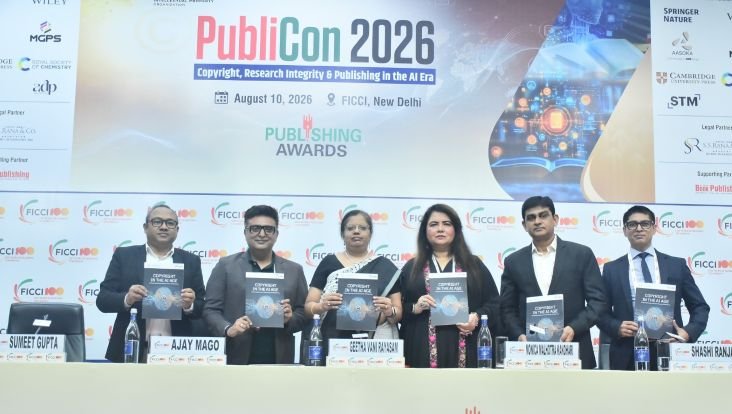
The conference also witnessed the launch of the FICCI–SS Rana & Co. report, “Copyright in the AI Age,” examining emerging copyright challenges around AI and highlighting the need to balance technological innovation with the rights of creators and publishers. (Attached / shared)
The conference also featured the FICCI Publishing Awards 2026 (List shared / attached), recognising excellence and contribution across India’s publishing ecosystem. The awards provided a platform to celebrate publishers, authors and other stakeholders whose work has contributed to strengthening the country’s publishing landscape. The awards, held alongside PubliCon 2026, reinforced the industry’s commitment to creativity, quality, innovation and the continued evolution of publishing in a rapidly changing technological environment.