
India’s higher education sector is undergoing epochal change, driven not only by the brutal technological disruption of the past decade but also by the rapid internationalisation of Indian higher education and the growing integration of India into the global education ecosystem.
The scale of the transformation is significant. India’s higher education enrolment has risen to nearly 4.50 crore in 2024-25. The Gross Enrolment Ratio in higher education has also climbed from 23.7 in 2014-15 to 30 in past decade. Education loans, perhaps unique to India has also enabled student force both within the country and its mobility abroad.
But the transformation is no longer about expansion alone. It is increasingly about internationalisation — both inward and outward — at a pace unprecedented in India’s higher education history.
The Study in India initiative, which began essentially as a soft-power and diplomatic project aimed at building student linkages, particularly with countries in the Global South and India’s neighbourhood, has evolved into a much more ambitious programme. Its stated objective is now to position India as an attractive global study destination, increase the flow of international students and integrate Indian institutions more deeply into the global higher education ecosystem. The government has also sought to use international education to improve the quality and global standing of Indian higher education.
The shift is visible in the way Indian universities are approaching international partnerships. The era when internationalisation largely meant signing ceremonial MoUs and organising symbolic student or faculty exchanges is giving way to more substantive academic arrangements — including twinning, joint-degree and dual-degree programmes. The UGC introduced regulations for such collaborations in 2022, creating a formal framework for Indian and foreign institutions to offer these programmes.
The next step has been even more consequential: bringing the foreign university to India.
The UGC’s 2023 regulations created a regulatory framework for foreign higher educational institutions to establish and operate campuses in India. Eligible foreign institutions — including those ranked among the top 500 globally or possessing outstanding expertise in a particular area — can apply to establish Indian campuses. The framework also allows such campuses to admit both Indian and international students and to offer their own programmes, subject to regulatory approval.
This has already begun changing the landscape. The University of Southampton became the first foreign university to establish a campus in India, with its Delhi-NCR campus positioned by the government as a significant milestone in the internationalisation of Indian higher education. By 2026, the government has been actively promoting international branch campuses as part of its broader Study in India and internationalisation strategy, with applications from leading institutions in countries including Australia, Italy, the UK and the US being processed under the new framework.
At the same time, India is witnessing a major recalibration of its relationship with overseas education.
For years, the outward mobility of Indian students grew at an extraordinary pace. The Ministry of External Affairs estimates that nearly 1.25 million Indian students were pursuing higher education abroad as of January 2025. Official data also show that Indian students disclosed education as their purpose of travel across a remarkably wide range of countries, reflecting the diversification of India’s overseas education map well beyond the traditional destinations.
The rush has, however, begun encountering a more complicated global environment. Policy changes and economic pressures in traditional destinations such as the US, Canada, the UK and Australia, coupled with geopolitical uncertainty, changing immigration rules, rising costs and concerns over employment prospects, have somewhat moderated the outward surge. But the aspiration to acquire an international qualification has certainly not disappeared.
What appears to be changing is the basis on which students and families make study-abroad decisions. The question is increasingly less about which country is most prestigious and more about what value the investment will deliver. Tuition fees, living costs, visa conditions, post-study work opportunities, employment prospects, migration pathways and expected salaries are becoming integral to the decision-making process.
In other words, return on investment is increasingly competing with destination prestige as the defining metric of international education.
This recalibration could have important consequences for Indian institutions. As the cost and uncertainty associated with studying abroad rise, domestic universities have an opportunity to retain a larger share of students who might previously have left the country. International partnerships, foreign university campuses, dual degrees and globally benchmarked programmes can further strengthen that proposition by offering students international exposure without necessarily requiring them to bear the full cost of studying overseas.
India is therefore witnessing an interesting convergence: the country is simultaneously trying to send its universities and students into the world and bring the world into its universities.
The transformation is also taking place against the backdrop of a higher education system that has become one of the world’s largest. The UGC currently lists 57 central universities, 522 state universities, 161 deemed-to-be universities and 560 private universities, underscoring the enormous institutional base from which India is attempting to build a globally connected higher education system.
The challenge now is to ensure that internationalisation goes beyond numbers, campuses and partnerships. The real test will be whether these developments improve academic quality, research collaboration, faculty mobility, employability and learning outcomes — and whether India can evolve from being primarily a large exporter of students into a credible global hub for higher education.
That would represent the real transformation of Study in India: from a diplomatic initiative designed to attract students from friendly countries into an international education strategy capable of making India a meaningful participant — and eventually a major destination — in the global higher education economy.
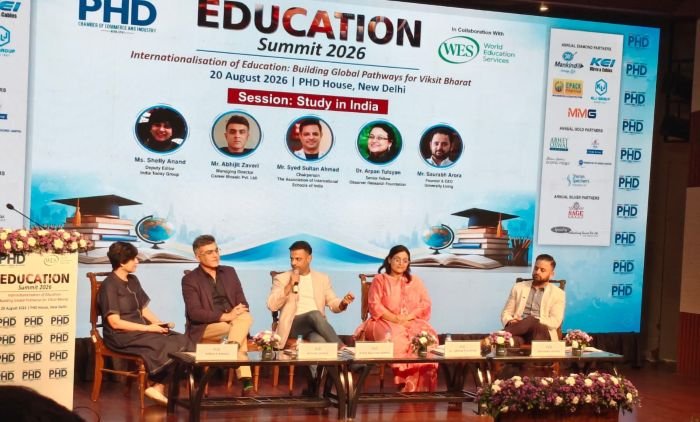
Against this backdrop, the PHD Chamber of Commerce and Industry, at its Education Summit 2026: “Internationalization of Education: Building Global Pathways for Viksit Bharat” held on August 20, organised two panel discussions focusing on Study in India and the internationalisation of Indian education. Domain experts and education leaders shared valuable insights into the developments underway and discussed how these seminal changes could foster stronger collaborations at the institutional and local levels.
The Study in India initiative has reached a significant milestone, with the intake of international students reportedly doubling to around 58,000 nearly doubling in the past decade. However, panellists stressed that this is only the beginning and that the road ahead would depend largely on creating an enabling ecosystem for international students.
Experts said India would need to address the basics — including infrastructure, accommodation, safety and student services — while also improving the overall student experience. Greater access to internships, industry exposure and opportunities for meaningful engagement beyond the classroom would be essential if India is to emerge as a competitive global education destination.
One of the panellists observed that India could have emerged as a much larger education destination had it earlier recognised the enormous potential of the international student market extending from the Global South to Central Asian republics, South America and ASEAN countries. “These regions face challenges similar to those we have in India, so the knowledge gained here is relevant back home. India would also need to develop new courses to cater to these emerging markets,” he said. “Our education killed our farming and there is a need to reimagine higher education and a lot of focus has to be agriculture and local economy.”
The experts, however, felt that it was “better late than never” and that India still had a significant opportunity to build its position as a global education hub.
The discussion also highlighted practical barriers that could discourage international students from choosing India. Difficult travel connectivity, inadequate accommodation and the absence of a strong tourism and hospitality culture were cited as areas requiring attention, particularly when India is compared with smaller countries such as Sri Lanka that have developed more student- and tourist-friendly ecosystems.
Panellists said India would need to build the necessary infrastructure, including affordable and quality student housing, while ensuring that academic programmes are internationally competitive and responsive to student expectations. Regulations and administrative frameworks would also need to be simplified to make it easier for foreign students and institutions to navigate the Indian higher education system.
In this context, the five education hubs announced in the Union Budget were described as a step in the right direction. Panellists suggested that these hubs should be developed comprehensively, with strong academic infrastructure, international linkages, industry connections, research facilities and student-support systems.
The discussions also turned to the quality of teaching and research, with experts stressing the need for more systematic performance review of teachers, stronger links between academic performance and research grants, continuous teacher-quality improvement and greater investment in faculty development.
The concept of a “campus within a campus” was also discussed as a potential model for creating specialised academic and research environments within existing institutions by aligning with incoming branch campuses of foreign universiites. Such initiatives, along with a culture of excellence, stronger research ecosystems and greater investment in teachers, could help Indian institutions become more competitive globally.
Another important area identified was the Indian diaspora. Experts suggested that India should develop structured mechanisms to leverage the skills, expertise and networks of its global academic and professional diaspora. Creating platforms for diaspora engagement, facilitating academic collaborations and enabling the circulation of teaching and research talent could significantly enrich India’s internationalisation journey.
The discussions underscored that internationalisation cannot be achieved simply by increasing foreign student intake or signing international MoUs. It requires a broader ecosystem that combines quality academics, world-class infrastructure, safety, student experience, research, industry linkages, international faculty and meaningful global engagement.
For India, the opportunity is substantial. But converting the growing interest in Study in India into a sustainable global education proposition will depend on how effectively the country addresses these foundational challenges and builds an environment in which international students and institutions see India not merely as an affordable alternative, but as a destination of academic and professional value. It will also hold back a lot of outbound students as quality and experience becomes available at home at affordable prices.