
Nearly fifty years after environmental education was first formally defined in the Tbilisi Declaration of 1977, Environment Education as a dedicated and compulsory subject for Class 10 is set to become a reality in India. NCERT, the country’s apex school curriculum-setting body, is in the final stages of preparing a textbook for the subject.
The draft textbook has been submitted to NCERT for review and, according to the current plan, will be introduced from the 2027–28 academic session in line with the National Curriculum Framework (NCF) 2023.
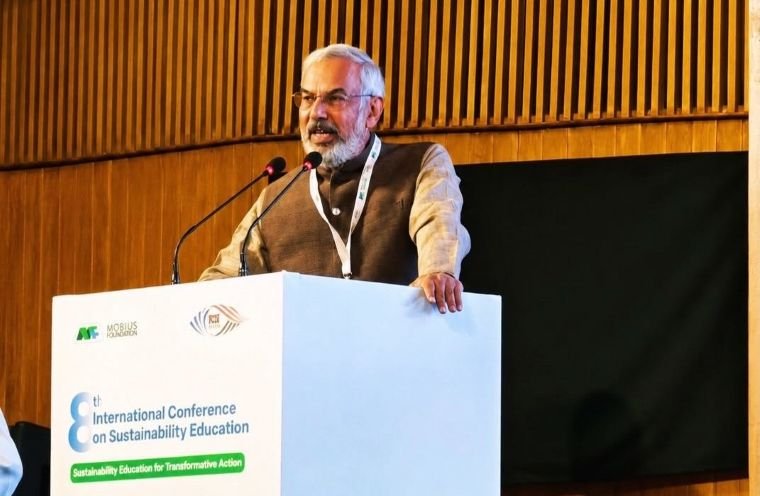
Speaking at the 8th International Conference on Sustainability Education (ICSE) 2026 by Mobius Foundation in New Delhi on September 2, Kartikeya Sarabhai, founder-director of the Centre for Environment Education (CEE) and chairman of NCERT’s Curricular Area Group (CAG) on Environment Education, said the draft of the textbook had been completed and would now undergo the mandatory review and other approval processes.
“The draft of the book is ready. It will now go through the mandatory review and other processes, but it should be ready for introduction next year,” Sarabhai said.
Environmental education has already been integrated into the curriculum from Classes 3 to 8. The proposed Class 10 subject, Sarabhai said, would serve as a refresher while deepening students’ understanding of environmental issues and empowering them to develop a stronger sense of environmental responsibility and a “handprint” approach to creating positive change.
He also pointed to the Ministry of Education’s Eco Clubs for Mission LiFE (Lifestyle for Environment) initiative, under which every school in the country is expected to have an eco-club by 2030.
“Eco-clubs are already a significant co-curricular component. With the introduction of a formal curriculum, the environmental offerings in schools will effectively be doubled,” he said.
Sarabhai also highlighted the importance of action-oriented learning. One proposal, he said, is for every school to adopt and take shared responsibility for a one-square-kilometre area around it. Students could work towards reducing waste, increasing green cover and contributing to issues such as road safety and other local environmental concerns.
Such initiatives, he said, would help develop critical thinking among children and encourage them to engage actively with issues affecting their communities—whether by raising concerns, writing letters or participating in discussions and local action.
Sarabhai expressed hope that the initiative would help scale up nature-positive action and establish environmental education not merely as a subject of study, but as an area that shapes students’ attitudes and mindsets.