
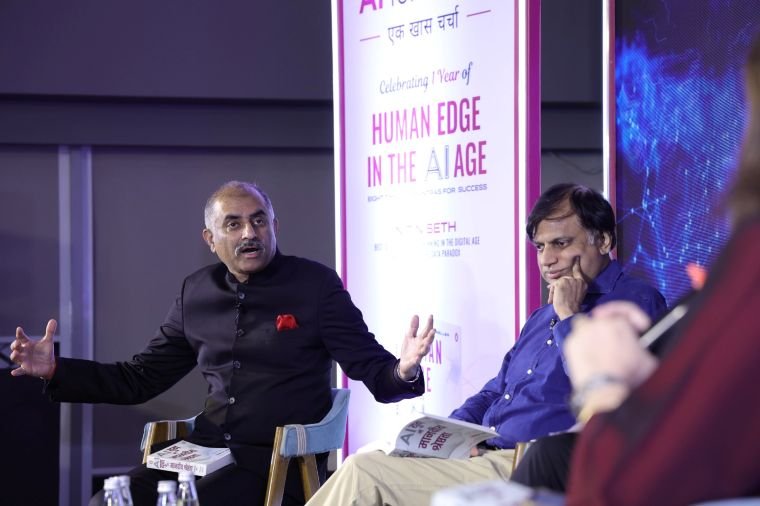
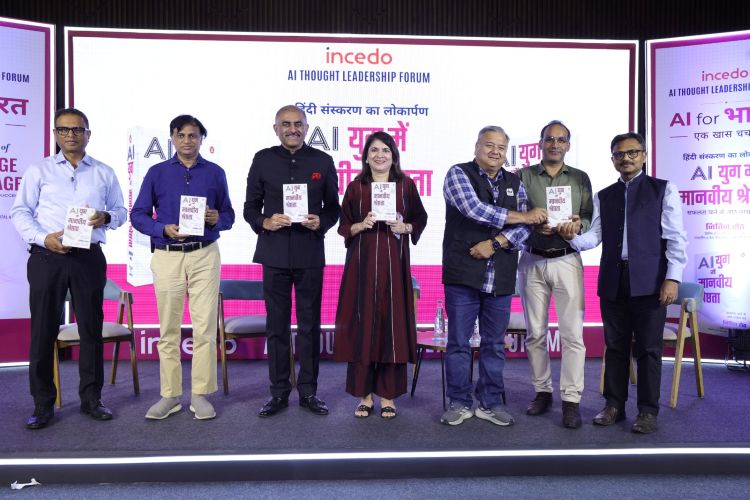
Nitin Seth, Co-founder and CEO of Incedo, on Sep 17 marked one year since the release of his bestselling book “Human Edge in the AI Age” with the launch of its Hindi edition, titled “AI Yug Mein Manaviya Shreshtha,” alongside a new AI assistant called NitinSeth.AI, at an event in New Delhi. The book is Seth’s third after Winning in the Digital Age, and Mastering the Data Paradox.
The evening also featured a panel discussion on “AI for Bharat,” moderated by veteran journalist Sonia Singh. The panel brought together Akhil Kumar, MD and CEO of Digital India Corporation; Sankrant Sanu, Founder and CEO of Garuda Prakashan; Peepal Baba, environmentalist and founder of Swami Prem Parivartan; and Seth himself, widening the conversation from the book’s themes to a broader debate on what an AI-ready Bharat should look like across technology, publishing and sustainability.
Earlier in his presentation, Seth cited research suggesting that 35 percent of jobs could be displaced by AI over the next 15 years, with white-collar roles potentially among the hardest hit. He named software development as the profession most exposed today, a sharp reversal from just a couple of years ago when computer science was seen as the safest bet for graduates. “Most of the code in the world today is being generated through English language prompts,” he said. Operations and customer support roles come next, he added, followed by research-heavy knowledge work in law, investment banking and consulting, areas he has watched closely since building the McKinsey Knowledge Center earlier in his career.
However, Seth was quick to frame the disruption as an opportunity rather than only a threat. He argued that when change is incremental, incumbents usually win, but when disruption is severe, outsiders tend to take over, and that dynamic is what makes this moment ripe for entrepreneurship. In his words, the AI age marks the end of the era of jobs but, more importantly, the beginning of the era of entrepreneurship. This is the premise behind the book’s central framework, POSSIBLE, an eight-part model built around problem solving, openness to change, spirituality, sports, impact, balance, leadership and entrepreneurship. Seth described the underlying idea as blending the risk-taking instinct of early humans with an expanding sense of consciousness, drawing on Indian philosophical ideas about human potential not being fixed.
On India specifically, Seth said the country’s heavy investment in sovereign AI, while necessary, addresses only a small part of the real challenge. “Sovereign AI is not going to create jobs. Not at all,” he said, pointing to what he described as Anthropic’s roughly 70 billion dollars in revenue generated with about 4000 or so employees, a headcount he noted is close to that of his own company, Incedo, as evidence of how few people core AI companies now need to generate outsized value.
Seth said capital is no longer the constraint it once was for Indian startups, with investors, in his assessment, now sitting on more funding than they can deploy. What is missing, in his view, is depth, with many young founders showing entrepreneurial energy but shallow ideas, lacking the industry expertise or deep technical grounding needed to build lasting companies, a gap he linked to the relatively shallow state of computer science education in India compared with ecosystems like Stanford and UC Berkeley, where academia and startups are closely intertwined.
He was especially optimistic about smaller cities and towns. Comparing the shift to Indian cricket, he noted that the sport used to be dominated by players from Mumbai, Bangalore, Chennai and Delhi, but now draws talent from across the country, citing Dhoni, Ishaan Kishan, Yashasvi Jaiswal and Vaibhav Suryavanshi as examples. He said AI could do something similar for entrepreneurship, recalling a visit to a small engineering college near Phagwara where most students had never given a presentation in English but were already active users of ChatGPT and asked sharp, informed questions once given the chance. “AI is a great equalizer,” he said. “AI is a great democratizing force.”
On education, Seth said the shift toward AI means technical skills alone are losing value, while soft skills such as problem solving, creativity, communication and leadership are becoming more important, along with a broader rethink of what colleges and teachers are meant to prepare students for once entry-level jobs shrink. He also pointed to rising interest in spirituality as a coping mechanism for the pace of change, citing the scale of public response to the Mahakumbh as one indicator of that shift.
Seth flagged two longer-term concerns he called close to existential. One is the possibility that AI-driven wealth becomes concentrated among a small group while large populations, supported by some form of universal basic income, remain comfortable but economically disengaged. The other is the accelerating debate around artificial general intelligence, following recent public comments from OpenAI’s Sam Altman and Anthropic’s Dario Amodei about the risks of AI systems gaining independent agency. “If AI begins to have agency, that means AI creates AI without human control,” Seth said. “That could be quite something.”
He also pointed to a widening gap between AI adoption and the market’s patience for results, noting that after a sharp downturn in software and technology stocks earlier this year, in which the S&P 500 Software and Services index lost close to 2 trillion dollars in market value, businesses are under growing pressure to show that AI investment translates into real returns, not just usage.
The Hindi edition and NitinSeth.AI are both aimed at extending the book’s reach beyond English-speaking, metropolitan audiences. NitinSeth.AI is designed to help students and young professionals navigate questions on digital transformation, data, AI and leadership, and Seth said it will roll out in multiple Indian languages in the coming months.
Closing the briefing, Seth returned to the book’s core message a year on. “The future is not to be feared. The future is to be created,” he said. “Replace fear with hope, and hope with action.”