


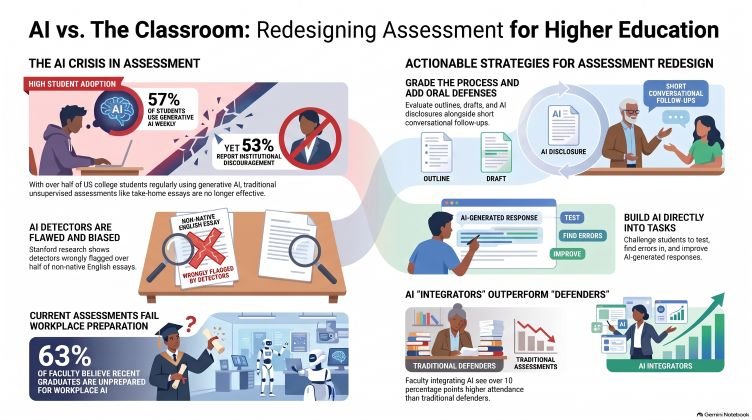
 American college students have already made up their minds about AI. As per the research in The Lumina Foundation-Gallup 2026 State of Higher Education, 57% of US college students use generative tools in their coursework at least once a week, and about one in five do so every day. With roughly four in five universities overall relying on this tool, Stanford’s 2026 AI Index puts that figure even higher.
A number represented in the Gallup study surfaced something even more concerning for the university leaders: more than half of students (53%) say their school discourages or prohibits this kind of use. Moreover, students are basically relying on something they must avoid. That is a gap, and our assessments sit right in the middle of it.
Faculty feel this every day. In a survey of 1,057 faculty by the American Association of Colleges and Universities (AAC&U) and Elon University, 90% said these tools will weaken students’ critical thinking, 78% said cheating has increased since they arrived, and nearly three in four had personally dealt with an integrity case tied to their use. I share many of these worries. But we cannot keep pretending that the take-home essay still measures what it measured five years ago. As the academic integrity director at UC San Diego has argued, unsupervised written work is no longer reliable proof of learning.
Detection is not the answer
Many campuses first turned to AI detection software. This is declining but at a brighter note. Institutions such as Yale, Vanderbilt, Johns Hopkins and Indiana University are among the ones that have banned or discouraged these tools, leading to unreliability and bias against non-native English writers. A 2023 Stanford study found that popular detectors wrongly flagged more than half of essays written by non-native English speakers as machine-written. For any university that welcomes international students, a tool that unfairly accuses them isn’t protecting anyone, it’s putting them at risk. It is a liability.
Two roads for faculty
The Time for Class 2026 report found that 47% of faculty are now changing how they assess students because of AI. They tend to fall into two camps. “Defenders” are going back to controlled formats such as in-class exams and handwritten blue books. “Integrators” are redesigning assessment around AI through project work, repeated drafts, AI disclosure and asking students to critique what AI produces. The report found that Integrators see an attendance advantage of more than 10 percentage points over Defenders.
Supervised exams have their place, but they cannot be the whole strategy. Our graduates will not work in an exam hall. They will work alongside AI, and we should test whether they can do that well.
What redesign should look like
First, grade the process, not just the final product. Ask for outlines, drafts, revision notes and a short statement on how AI was used. The thinking a student does along the way is much harder to fake than a polished final page.
Second, bring back conversation. A 10-minute oral follow-up, where a student explains and defends their work, tells an instructor more than any detector ever could.
Third, build AI into the task instead of banning it. Ask students to test an AI answer, find its errors and improve it. The Digital Education Council’s 2026 global survey found that only 28% of students feel most of their assessments reflect the skills they will need in an AI-enabled workplace. In the US and Canada, 38% say they are not allowed to use AI in any assessment at all.
Fourth, is connecting assessment to real problems. As per the reports by Time for Class, a percentage of 61% of reports that they assign real-world projects, yet only 26% of students say they have completed one. That work needs to be more visible and more common.
Faculty cannot do this alone
None of this happens without support. Only 32% of institutions have an active AI policy, according to Time for Class, and just 17% of students in the US and Canada believe their instructors are well equipped to guide them on AI, the Digital Education Council found. Redesigning a course takes time, training and sometimes smaller classes. University leaders have to fund that, not just announce it.
For university leaders, the starting point should be simple. The question is no longer whether students use AI. It is whether a degree still shows that a graduate can think, judge and explain their reasoning. In the AAC&U and Elon survey, 63% of faculty said 2025 graduates were not ready for AI in the workplace. That is a warning the whole sector should take seriously.
This generation who is dependent on ChatGPT is not trying to skip learning. A major part of students reported to Gallup that their top reason for using AI is to understand difficult material. Our job is to design assessments that reward that curiosity, protect honest work and prepare students for the world they are actually entering.