
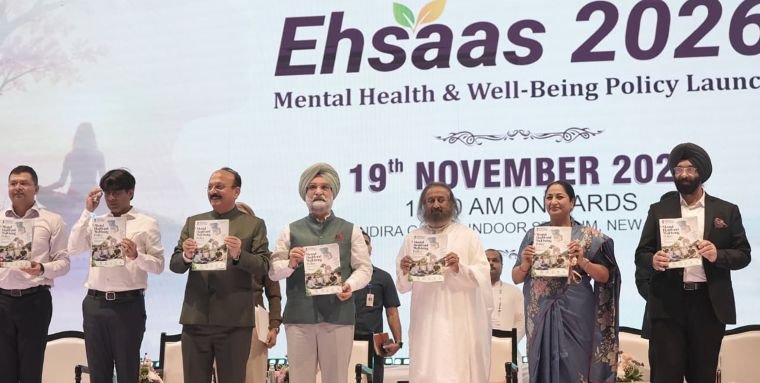
Recognising that the emotional and psychological well-being of students is as important as their academic performance, the Delhi government on November 19 launched Ehsaas 2026, a comprehensive Mental Health and Well-Being Policy covering schools and higher educational institutions across the national capital.
Launched by Lieutenant Governor Taranjit Singh Sandhu, Chief Minister Rekha Gupta and spiritual leader Sri Sri Ravi Shankar at the Indira Gandhi Indoor Stadium, the policy seeks to move mental health support beyond occasional counselling sessions to an institutional framework involving teachers, parents, school administrators, professional counsellors and even non-teaching personnel.
The initiative addresses growing concerns over examination stress, anxiety, depression, bullying, cyberbullying and other forms of psychological distress among students. Its underlying premise is that mental health intervention should not begin only when a child reaches a crisis point; educational institutions must be equipped to recognise early warning signs and provide timely support.
Education Minister Ashish Sood, who was instrumental in formulating the policy, said the education system needed to look beyond classrooms, textbooks and examination results. Parents, he observed, routinely ask children about their studies and career aspirations but often fail to ask whether they are happy.
The policy is expected to bring approximately 23 lakh school students under uniform mental health support standards. Its coverage extends to government, government-aided, CM SHRI and recognised private schools, besides higher educational institutions under the Delhi government’s jurisdiction. It also envisages support for Children with Special Needs and young people up to 29 years of age, including those outside the formal education system.
Counsellors to become integral to schools
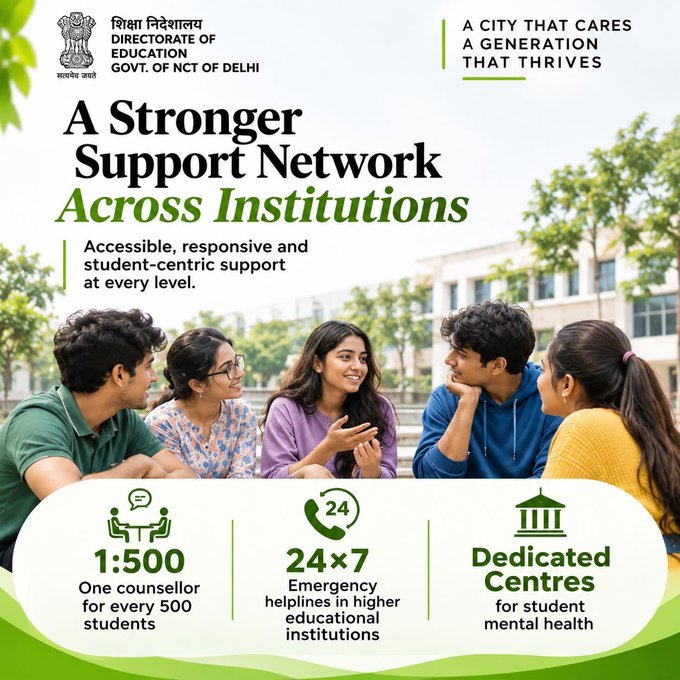
A major provision is the appointment of at least one qualified counsellor for every 500 students in schools. Counsellors will have dedicated, accessible and confidential rooms for interacting with students, with secure arrangements for maintaining counselling records.
Importantly, they will not be diverted to administrative or disciplinary duties, which could compromise their professional role or discourage students from approaching them.
Higher educational institutions will have a separate staffing norm: one qualified mental health professional for every 100 students in institutions with up to 3,000 students, and one for every 500 students in larger institutions. Colleges will also be required to establish dedicated Mental Health and Well-being Centres.
These centres will provide counselling, psychological support, academic and career guidance, peer-support programmes and referrals to specialised services. A 24-hour helpline, connected to qualified crisis responders, will be made available, with its number displayed on student identity cards, hostel notice boards and institutional websites.
A whole-school approach to mental well-being
The policy’s distinguishing feature is that responsibility for student well-being will not rest exclusively with counsellors or teachers. It seeks to sensitise the entire educational ecosystem to children’s emotional needs.
Teachers, principals, Educational and Vocational Guidance Counsellors (EVGCs), parents, administrative and non-teaching staff, transport personnel, drivers and ayahs will receive training to identify behavioural changes that may indicate psychological distress.
These could include sudden withdrawal, persistent sadness, declining academic performance, unusual behavioural changes and social isolation. Dedicated handbooks containing structured questions, practical exercises and activities will help personnel understand how to respond appropriately.
The intention is not to turn teachers or other employees into mental health professionals, but to equip them to recognise warning signs, listen sensitively and refer students to qualified counsellors.
The policy also envisages psychometric assessments of personnel working closely with children, including teaching, non-teaching and transport staff.
Six-tier crisis-response mechanism
For students experiencing severe psychological distress or displaying signs of self-harm or suicidal tendencies, the policy provides a six-level support and referral mechanism.
The process begins with the class teacher, followed by the school counsellor or designated first responder, the school head or School Wellness Team, the District Well-being Centre, hospital or emergency mental health services, and, where necessary, statutory authorities.
District Well-being Centres will provide psychological assessments, therapeutic interventions and psychiatric consultations, helping bridge the gap between school-level counselling and specialised medical care.
An important safeguard is that a student facing immediate danger must not be left alone. A responsible adult must remain within sight until professional or emergency assistance takes over. Schools can also approach emergency services directly without waiting for every stage of the referral process.
The framework includes specific protocols for bullying, cyberbullying, abuse, violence and substance-related emergencies. It also provides for follow-up counselling and reintegration plans for students returning to school after hospitalisation or a serious mental health episode.
Monitoring and accountability
To ensure that the policy does not remain a paper exercise, it envisages institutional monitoring and periodic assessments.
Every school will establish a School Wellness Committee and a School Wellness Team to coordinate and oversee interventions. Schools will undertake quarterly self-assessments through a School Wellness Services Index, covering counsellor availability, staff training, safety arrangements, referral mechanisms and confidentiality.
A digital monitoring portal will track implementation. Personal counselling records, however, will remain confidential, with information shared only when necessary for student care, safety or legal compliance.
The policy also introduces an accountability dimension. Neglect of serious bullying complaints, delays in urgent intervention and failure to provide prescribed safeguards may invite administrative action. Teachers’ contributions to student well-being are also envisaged as a component of their annual performance appraisals.
From classroom activities to institutional support
The Delhi initiative is distinct from the Happiness Curriculum introduced by the previous AAP government in 2018 for students from nursery to Class VIII. While the earlier programme focused largely on classroom-based activities intended to promote mindfulness, emotional awareness and happiness, Ehsaas 2026 seeks to establish a wider institutional support system encompassing professional counselling, early identification, crisis intervention and specialised treatment.
The policy was finalised following consultations and technical inputs from organisations and experts, including NITI Aayog, UNESCO and the Institute of Nuclear Medicine and Allied Sciences (INMAS), besides specialists from government departments, private institutions and universities.
Implementation will be the real test
The policy marks an important recognition that student mental health cannot be treated as a peripheral concern or addressed only after a tragedy. However, translating its ambitious provisions into functioning services will require sustained investment, qualified professionals and effective coordination between schools, health institutions and families.
The prescribed counsellor-to-student ratio raises immediate questions about the availability of trained personnel, particularly in institutions that have never maintained a dedicated counselling system. Delhi will also need to clarify the timelines for recruitment, establishment of district centres, training of staff and operationalisation of the digital monitoring mechanism.
Private schools, which form a substantial part of the city’s education ecosystem, will need to be brought under effective compliance monitoring. Equally important will be protecting students’ confidentiality and ensuring that counselling does not become another mechanism for labelling or disciplining children.
Ultimately, the success of Ehsaas 2026 will depend not on the number of committees constituted or assessments completed, but on whether a distressed student can actually find a trained professional, receive timely help and return to the classroom with dignity and confidence.
The policy’s most significant message is perhaps that a child’s emotional well-being is not separate from education. It is fundamental to learning, development and the ability to navigate life.