
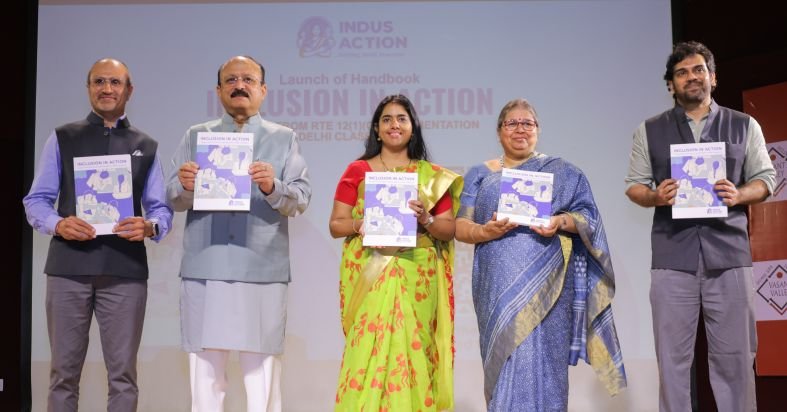
Indus Action, a Delhi-based non-profit that has been working to strengthen the implementation of Section 12(1)(c) of the Right to Education (RTE) Act, launched a new handbook, Inclusion in Action: Lessons from RTE 12(1)(c) Implementation in Delhi Classrooms, in New Delhi on November 18. The provision mandates 25% reservation in private unaided schools for children from Economically Weaker Sections (EWS) and Disadvantaged Groups (DG). The initiative has received support from the Delhi government’s Directorate of Education.
The publication, based on a study conducted in collaboration with Vasant Valley School and Alstonia, presents evidence from nine private unaided schools in Delhi on what it takes to transform a guaranteed school admission into genuine belonging, participation and academic achievement for children admitted under the RTE Act.
To understand what enables inclusive learning, Indus Action conducted an intensive study involving 81 observation sessions across 26 classrooms. It also gathered insights from students, parents, teachers and school leaders. The study identified five broad categories of challenges and 14 evidence-based practices to promote meaningful inclusion.
“A seat in a classroom is where inclusion begins, not where it ends. This handbook shows what schools are doing to help every child belong. It tells us whether the promise of the RTE Act is truly realised,” said Raj Singh Bhandal, Trustee, Vasant Valley Centre for Excellence in Education.
Key challenges
The study identifies five major barriers to meaningful inclusion:
- Limited academic and extracurricular participation: Students often struggle to meet grade-level expectations, with learning gaps widening as curriculum demands increase.
- Gaps in teacher pedagogy, beliefs and preparedness: Limited collaborative learning, low expectations of RTE students and heavy teacher workloads restrict the individual attention children need.
- Difficult family circumstances: Limited parental involvement, challenging home environments and visible economic disparities can affect children’s experiences in the classroom.
- Peer segregation and exclusion: RTE and fee-paying students may form separate friendship groups, reinforcing social divisions within the same classroom.
- Financial barriers beyond the classroom: Cost constraints prevent many RTE students from participating in school trips, sports, competitions and summer camps, adding to their sense of exclusion.
What works: Practices for meaningful inclusion
The handbook identifies four broad areas of intervention that schools can adopt:
- Teachers as facilitators: High expectations, collaborative learning, differentiated instruction and remedial academic support can help every student participate and learn with confidence.
- Fostering an inclusive school culture: Avoiding labels, ensuring mixed seating arrangements and equipping teachers with the necessary training and empathy can help all children feel safe and valued.
- Equitable access and career readiness: Equal opportunities in extracurricular activities, along with clear pathways to higher education, can build students’ confidence, leadership abilities and long-term prospects.
- Engaging parents and communities: Sustained and dignified engagement with families can strengthen the support children receive both inside and outside school.
The handbook seeks to provide school administrators and policymakers with a practical framework for shifting the focus from mere classroom integration to deeper, systemic inclusion.
Speaking at the launch, Delhi Education Minister Ashish Sood emphasised the government’s commitment to bridging the gap between access to schooling and the quality of education.
“Enrolment does not, by itself, ensure that students experience meaningful inclusion. What happens after a child enters the classroom matters just as much. How a school responds to differences in students’ backgrounds, learning needs and experiences shapes whether they feel supported, can participate in school life and progress in their learning. This handbook looks at how the vision of Section 12(1)(c) of the RTE Act and the NEP takes shape in practice,” he said.
Tarun Cherukuri, Founder and CEO of Indus Action, highlighted the systemic changes needed to move beyond mere legal compliance.
“For over a decade, we have focused heavily on opening the school gates for vulnerable families, but a seat without structural belonging is a promise half-kept,” he said.
“The study moves the conversation from classroom integration to deep, empathetic inclusion. By addressing hidden costs, transforming teacher pedagogy and eliminating peer segregation, we can co-create learning spaces where every RTE student thrives with dignity and strives for their highest potential,” Cherukuri added.