

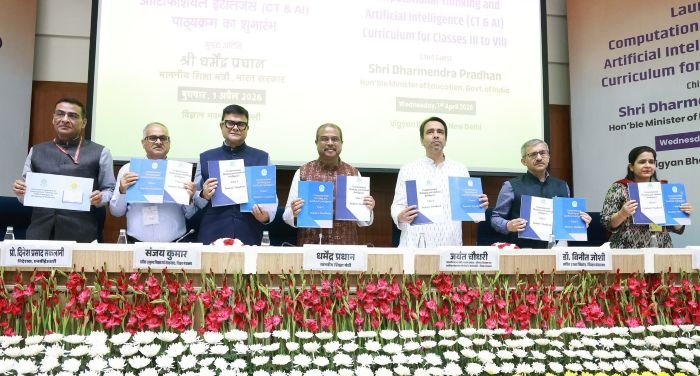
Formally introducing structured AI education into the school ecosystem at scale, the Central Board of School Education (CBSE) this academic session (2026-27) launches a new CBSE Curriculum on Computational Thinking (CT) and Artificial Intelligence (AI) for students of Classes III to VIII to inculcate AI-readiness in school students. The curriculum is backed by structured modules, comprehensive teacher handbooks, and robust student assessment frameworks, ensuring early and systematic exposure to emerging technologies.
Union Minister for Education, Dharmendra Pradhan, on April 1 launched this new curriculum in New Delhi in presence of MoS Jayant Chaudhary along with Sanjay Kumar, Secretary, Department of School Education & Literacy; Dr Vineet Joshi, Secretary, Department of Higher Education; Chairman CBSE, Rahul Singh; Director, NCERT, i Dinesh Prakash Saklani and senior officials of Ministry of Education, CBSE, Kendriya Vidyalaya, Navodaya Vidyalaya and NCERT.
While addressing the gathering, Shri Pradhan said that the launch of the new curriculum marks a transformative step towards future-ready learning at the start of the academic year. The initiative formally introduced structured AI education into the school ecosystem at scale, he added.
The Minister added that, aligned with the vision of “AI for Education, AI in Education,” the initiative marked a decisive shift towards augmented learning by nurturing critical thinking, design orientation, and a culture of innovation among young minds. Shri Pradhan also highlighted that as India’s leadership in technology-driven computing gains global recognition, the curriculum would empower students to meaningfully engage with and shape the digital future.
Speaking on the occasion, Shri Jayant Chaudhary said that by introducing computational thinking from an early stage, we are laying the foundation for a generation that can learn, unlearn, and re-learn continuously, navigate uncertainty with confidence and transform disruption into opportunity. This is not merely an academic reform, but a national investment in human capability—aligned with the vision of NEP 2020, to ensure that India’s learners are equipped not only for the jobs of tomorrow, but to shape the ideas, systems, and solutions that will define the future of the world, he added.
The Curriculum aims to build strong foundations in computational thinking, digital literacy, and responsible use of technology, along with nurturing innovation, critical thinking, and ethical decision-making capacities.
Relevance: Importance of Introducing CT and AI
Introducing CT and AI is vital for positioning students as future-ready digital citizens.
- Foundation for AI: Computational thinking is the intellectual backbone and cognitive framework required to understand and eventually create AI-driven solutions
- Cognitive Development: It fosters essential human capacities such as logical thinking, systematic problem-solving, and pattern recognition
- Preparation for the Future: Early exposure equips individuals with the ability to use data effectively and apply technology ethically, which is necessary for the modern world of work
- Holistic Growth: It promotes interdisciplinary learning, helping students see that knowledge is not compartmentalized by connecting Math, Science, and Humanities
Mapped with NEP and NCF 2023
The curriculum is directly aligned with national educational reforms:
- NEP 2020 Vision: It fulfils the goal of making India a global leader in emerging domains like AI and Machine Learning by integrating them into school education
- NCF-SE 2023 Alignment: The learning standards (Goals, Competencies, Outcomes) are derived from the framework suggested in the National Curriculum Framework for School Education 2023
- Phased Implementation: Following NCF recommendations, the curriculum introduces CT first as a basis for learning AI later in higher classes
Approach / Pedagogy
The pedagogical approach is designed to be playful and experiential:
- Activity-Based: Learning is driven by fun math games, puzzles, and hands-on exercises using specialized worksheets
- Problem-Solving Focus: Teachers guide students to break larger problems into smaller parts and interpret visual representations like charts and diagrams
- Collaborative Learning: The curriculum emphasizes peer discussions and group tasks to solve problems collectively
Assessment
Assessment shifts from rote memorization to continuous and competency-based methods:
- Interactive Tools: Methods include written tests with CT puzzles, interactive group activities and the use of a Teacher Observation Journal to track progress
- Qualitative Focus: The goal is to assess a student’s ability to apply knowledge and think creatively


