
The private university sector in India is still relatively young, having emerged after the liberalisation of the 1990s. While controversies over the past three decades may be seen as part of an evolutionary phase, persistent suspicions of irregularities, corruption, and malpractice undermine the very purpose for which these institutions were established — and further damage their already fragile reputation as “degree shops.”
In November, the Supreme Court of India passed a pathbreaking order directing an examination of the background, circumstances, and legal provisions under which all private, non-government, and deemed-to-be universities were established. This apex court–mandated exercise, to be undertaken in the coming months, is expected to yield significant insights into the functioning of private universities and may well expose several “skeletons in the cupboard.” More importantly, it is expected to plug systemic gaps and help the sector rebuild public trust in the long run.
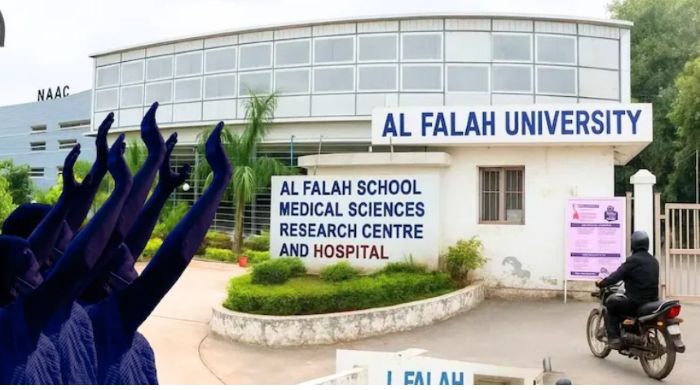
Independent of the court order, Al-Falah University in Faridabad — now under intense scrutiny for its alleged link to the recent Red Fort terror incident — is emerging as a case study of how the private university system can be compromised, and why a robust regulatory framework is urgently required.
Multilayered Probe Into Al-Falah University
After four doctors associated with Al-Falah University were booked under UAPA in connection with the November 10 Red Fort blast — which killed 15 people and injured over 20 — the Delhi Police registered two additional FIRs. These alleged that the university falsely claimed accreditation from the National Assessment and Accreditation Council (NAAC) and misrepresented itself as recognised under Section 12(B) of the UGC Act.
Under scrutiny for both its alleged role in facilitating a “white-collar terror module” and for using fake institutional legitimacy, it has emerged that Al-Falah University had no valid NAAC accreditation, yet continued to display and promote NAAC credentials long after their expiry. This deceptive branding is believed to have misled numerous unsuspecting students.
Established by the Delhi-based Al-Falah Charitable Trust (est. 1995), the university came into being through the Haryana Private Universities (Amendment) Act, 2014, and was notified on May 2, 2014. Spread across 70 acres, the institution began as an engineering college in 1997, later adding a medical college in 2016 and admitting its first MBBS batch in 2019. It currently offers 200 MBBS and 50 MD seats, with admissions conducted through the DMER. The university also runs schools of humanities, teacher training, and social sciences, serving roughly 2,000 students.
Although ostensibly established to support educationally disadvantaged Muslim youth from the Mewat region, investigators now allege that the institution was misused to fabricate legitimacy and help Jawad Ahmad Siddiqui — Al-Falah’s Chancellor and Managing Director of the Al-Falah Group — expand his business empire illegally. Siddiqui, an engineer from Devi Ahilya Vishwavidyalaya, Indore, is a convicted fraudster (₹7.5 crore) and has been arrested by the Enforcement Directorate (ED) under PMLA charges for money laundering and forging documents.
According to ED findings, the university collected over ₹415 crore between 2018 and 2025, much of which was diverted through affiliated entities for non-educational purposes.
Regulators Seek Answers on “Systematic Deception”
Following the blast, multiple regulatory bodies — UGC, NMC, NAAC, AIU, NCMEI, and the Haryana Education Department — demanded explanations for what they describe as systematic deception in student recruitment and compliance.
Al-Falah was never eligible for 12(B) recognition, making its claims of UGC recognition and grant eligibility patently false. The university also allegedly misrepresented its expired NAAC accreditation. Accreditation for the School of Education and Training expired in 2016, and for the School of Engineering and Technology in 2018. NAAC has ordered the institution to remove misleading content from its website and submit a detailed explanation.
Reports also suggest that the university received funds from certain Arab countries despite being ineligible to do so.
Future of Students and Regulatory Shake-up
The National Medical Commission has assured that “innocent medical students” — including the current 2025–26 MBBS batch of 150 students — will be protected, and their academic futures will not be jeopardised because of administrative or criminal misconduct. The NMC also announced upcoming guidelines instructing medical institutions to avoid “anti-national activities within workplaces” and to uphold greater social accountability aligned with national health priorities. These may significantly reshape the oversight of private medical colleges.
Meanwhile, the NCMEI has issued a show-cause notice to Al-Falah regarding its minority status, demanding detailed records on its trust structure, funding sources, appointment procedures, and compliance with the Minority Educational Institutions Act, 2004. The Haryana Education Department has likewise initiated an inquiry through a two-member committee to review university operations, financial records, and questionable land acquisitions. The consequences could be severe: revocation of licence, loss of minority status, freezing of admissions, or even closure.
If minority status is revoked, many students depending on scholarships and grants may face hardship.
Community Concerns and Calls for Accountability
Several Muslim academicians have criticised certain religious leaders for framing the controversy solely as discrimination under the BJP government, while neglecting the urgent need to counter radicalisation.
Firoz Bakht Ahmed, former Chancellor of MANUU and noted columnist, remarked:
“Leaders like Maulana Arshad Madani should be ashamed of his sweeping statements. What is needed is a condemnation of terrorism, efforts to minimise the damage to the community, and initiatives to educate Muslim children in human and patriotic values. We must defeat the perception that Muslims are terrorists.”
The Larger Picture: A Sector at Crossroads
Ultimately, the Al-Falah case is a stark example of good intentions gone disastrously wrong. Many of India’s 436+ private universities, created under various state laws to expand higher education capacity, may indeed be driven by social and developmental motivations. But the time has come for systemic transparency and regulatory robustness to be established beyond question.
Perhaps the Supreme Court has finally taken that decisive step in 2025.