
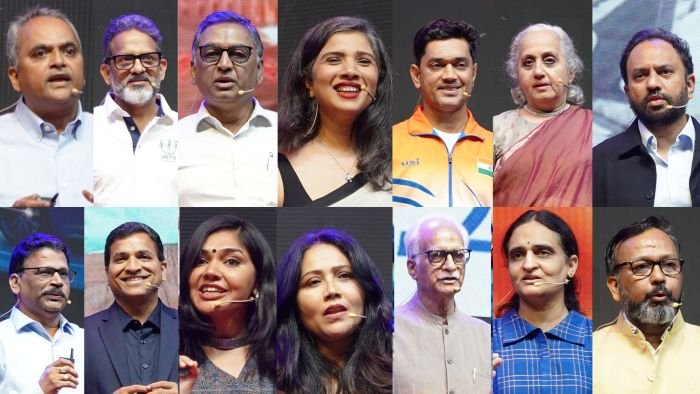
The 11th edition of TEDxHyderabad, held on April 19, 2026, brought together a powerful lineup of 14 thinkers, creators, and changemakers under the theme “FIRE-UP.” Hosted at Akshaya Convention, Vattinagulapally, Hyderabad, the day-long event drew over 1,200 attendees, including prominent personalities such as Allu Arvind. Four curated performances added vibrancy and artistic depth to the experience.
The performances featured a diverse blend of musical expression—from a soulful sitar recital by Ramprapanna Bhattacharya to immersive handpan sets by Vikrant Dhadwal and Trilok Chander, culminating in a dynamic fusion act by A Sonic Voyage.
The engagement zone showcased impactful grassroots innovation and creativity. Artists Swathi and Vijay captured attention with their “End Begging Mafia” campaign, using evocative art on construction debris. Navid Ahmed presented “Planterior Design,” integrating plants into interior spaces, with over 240 completed projects. Goonj exhibited innovative products made from repurposed materials, including a ₹650 bag crafted from discarded ties.
Viiveck Verma, Curator and Licensee, said, “TEDxHyderabad has always been about ideas that inspire action. FIRE-UP reflects the urgency of turning ideas into impact.”
Ramesh Loganathan added, “It’s the diversity of ideas and people that creates lasting conversations beyond the stage.”
Since its inception in 2015, TEDxHyderabad has curated over 29 events, engaged more than 20,000 attendees, featured 113 speakers, and garnered over 15 million views globally.
Ideas That Inspired
The speaker lineup reflected a wide spectrum of human experience, innovation, and purpose:
Dr. M. Subrahmanyam, founder of Sparsh Hospice, spoke on compassionate end-of-life care. “When cure is not possible, care must step in. Every soul has the right to die with dignity,” he said. Highlighting a critical gap, he noted that while 1.5 million cancer cases emerge annually in India, less than 5% receive palliative care. “Death is not the failure of medicine.”
Dr. Sivaranjani Santosh, a pediatrician, shared her eight-year legal battle against misleading ORS products. She warned, “Misinformation in something as basic as oral rehydration can cost lives,” calling for stronger awareness and regulation.
Ritesh Tiwari, a karate coach from Madhya Pradesh, highlighted the power of “skill as service.” Over 25 years, he has trained more than 67,000 individuals—especially young girls—in self-defense. “I may not have wealth, but I have a skill—and I chose to give it away.”
Uttam Kumar brought attention to the realities of deafblindness, affecting over 500,000 Indians. He emphasised that the real barrier lies in societal design, not disability, calling for inclusion with dignity.
Dr. Soma Raju shared insights into medical innovation, including the Kalam–Raju stent developed with A. P. J. Abdul Kalam, priced at approximately ₹15,000—dramatically improving access to cardiac care. He highlighted the rise of minimally invasive procedures and the role of artificial intelligence in healthcare: “AI is the great second opinion today.” He also outlined five pillars of modern healthcare—hospitals, universities, technology institutes, public health foundations, and software companies.
Dr. Suravi Kumar reframed menopause as not an ending, but a pivotal phase for brain and long-term health.
Uday Krishna, an environmental storyteller, captivated the audience with narratives of India’s heritage trees. Having travelled over 40,000 km and helped save over 5,000 trees, he urged a shift in perspective:
“The true wealth of a city stands quietly in its trees.”
He shared remarkable stories—from trees that saved lives during floods to those that silently witnessed history—and concluded, “Throughout history, trees have saved us; we have rarely saved them.”
Shezzi M spoke about her unconventional journey from finance to radio, highlighting courage and authenticity: “Fortune favours the brave.”
Pavan Goyal, an education innovator, challenged rote learning systems. “What matters today is not what you learned, but what you built,” he said, noting that 80% of students struggle with memorisation.
Krishna Sastry Pendyala, a cybersecurity expert, warned about emerging digital risks: “The real danger isn’t technology—it’s treating cybersecurity as an afterthought.”
Srikanth Badiga spoke about dignity in death, inspired by the Mahaprasthanam crematorium. “Cremation grounds are a mirror of society,” he said, advocating for humane infrastructure.
Hemakshi Meghani, co-founder of the Indian School of Democracy, called for principled political leadership.
“We don’t just need better politicians—we need deeper politicians.”
She urged citizens to engage actively, adding, “If the water itself is poisoned, what’s the point of fixing the pipes?”
Rajiv Chilaka, creator of Chhota Bheem, shared his journey of building a global animation brand. Referencing Netflix CEO Reed Hastings, he noted that over 27 million households outside India watched Mighty Little Bheem. “If you are afraid, don’t do it. If you do it, don’t be afraid.”
The event concluded with Rajni Bakshi, who reflected on nonviolence and humane economics:
“If violence is a choice, so is compassion—we must consciously choose the world we want to build.”