
As the June 21 re-examination of NEET-UG 2026 approaches, the National Testing Agency (NTA), seeking to restore public confidence and prevent any repeat of the paper leak controversy, has adopted unprecedented security measures reminiscent of China’s Gaokao examination protocols.
In a first for India, the NTA has placed paper setters, moderators, and translators under a strict lockdown until the day of the examination. Mobile phones, laptops, smartwatches, and other communication devices have been prohibited. Internet access has been restricted, external communication tightly controlled, and movement into and out of the undisclosed facility where they are housed is being closely monitored and documented.
Another unprecedented measure is the use of Indian Air Force aircraft to transport NEET question papers for the June 21 examination.
Whether these extraordinary arrangements become the norm in future examinations may become clearer in the coming months as the Supreme Court continues hearings on petitions concerning both NEET and the NTA. Taking a stern view of the matter, the Court has kept the case pending and indicated that it will closely monitor the conduct of the re-examination before commencing substantive hearings in July.
It is pertinent to note that barely two years after the NEET-UG 2024 scandal shattered public confidence in the National Eligibility-cum-Entrance Test (NEET-UG)—the NTA-administered gateway to nearly 824 medical colleges and approximately 1.3 lakh MBBS seats across India—the controversy has returned with even greater force this year.
This year’s NEET-UG examination, conducted on May 3 across more than 5,400 centres in over 550 cities for nearly 22.7 lakh candidates, was cancelled by the NTA on May 12 after verified complaints of a question paper leak surfaced. The decision triggered nationwide outrage among students and their families, once again exposing the immense psychological, academic, and institutional costs of repeated failures to safeguard the credibility of India’s high-stakes examination system.
Reports of at least three student suicides linked to the cancellation have further amplified concerns about the human consequences of administrative lapses. Once again, fundamental questions have been raised about the integrity of the country’s largest undergraduate entrance examination.
The episode has reinforced long-standing concerns about the fragility of India’s single-shot, high-stakes testing model and the persistent governance failures surrounding its administration. As the Central Bureau of Investigation (CBI) continues its probe and has already arrested 13 individuals in connection with the alleged leak, the full extent of the network and the identities of its beneficiaries may become clearer once charge sheets are filed.
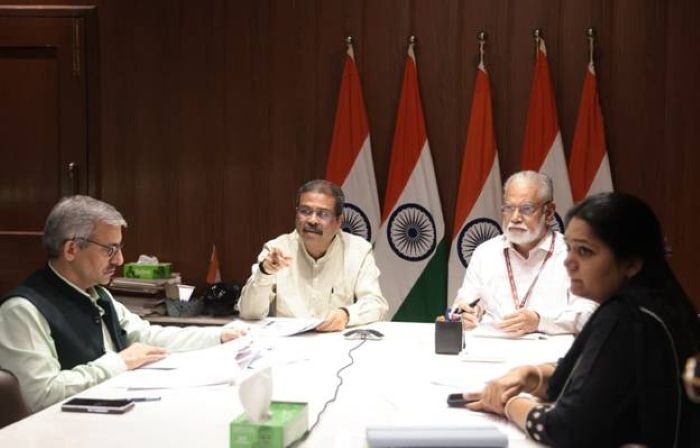
The NTA may have secured temporary breathing space until the re-examination, but it faces a far more difficult task in explaining the systemic failures that enabled the breach and addressing accountability concerns repeatedly highlighted by the Supreme Court. Union Education Minister Dharmendra Pradhan, already under intense political and public scrutiny, faces growing calls for his resignation amid criticism over recurring NEET controversies and other examination-related issues.
The pressure is particularly acute because, following the 2024 crisis, he had publicly assured students that corrective measures would ensure a secure and credible examination process. The recurrence of a similar controversy has inevitably revived questions about those assurances.
The developments are especially significant because they come despite extensive reforms initiated after the 2024 scandal. Following widespread protests and legal challenges, the Ministry of Education constituted a High-Level Committee of Experts (HLCE) on June 22, 2024, under the chairmanship of Dr. K. Radhakrishnan, former ISRO Chairman and Chairman of the Board of Governors of IIT Kanpur. The committee was tasked with recommending reforms to examination processes, data security protocols, and the institutional structure of the NTA.
After extensive consultations, the committee submitted its report to the Ministry of Education on October 21, 2024. The report contained 35 long-term and 60 short-term recommendations. The government subsequently stated that approximately 94 per cent of these recommendations had been implemented, with the notable exception of transitioning examinations to a computer-based testing (CBT) format. In the wake of the latest controversy, the Ministry has now announced its intention to introduce CBT for NEET from next year.
Going forward, two distinct but interconnected issues emerge from the crisis. The first concerns institutional reform—specifically, the future of the NTA and the broader architecture required to secure India’s competitive examination ecosystem. The second relates to the political consequences of repeated examination failures and the resulting erosion of public trust.
On the first issue, a broad consensus is emerging that securing NEET must become a national priority. Experts increasingly point to China’s Gaokao examination as a model of large-scale examination security. Taken annually by more than 12 million students, the Gaokao operates under extraordinarily stringent protocols involving extensive surveillance, highly restricted access to examination materials, and coordinated administrative oversight.
Discussions in India are now focusing on stronger technological safeguards, enhanced surveillance systems, secure logistics, and stricter legal penalties for those involved in compromising examination integrity. Some experts have even argued for invoking stringent public-security laws against organised examination fraud networks as a deterrent.
Dr. K. Radhakrishnan, whose committee’s recommendations are now under renewed scrutiny, is expected to remain closely involved as the Supreme Court evaluates both implementation gaps and future reforms. The Court has also sought greater clarity on the extent to which the committee’s recommendations were actually operationalised.
As Dr. Ishwar Gilada, one of India’s longest-serving HIV specialists, public health expert, and Secretary General of the People’s Health Organisation-India, argued in an article published by Times Now on May 25: “The vast majority of students are honest aspirants. They deserve a system that respects their effort, protects merit, minimises uncertainty, and inspires confidence. NEET was created to standardise medical admissions, and that goal remains valid. But standardisation should not mean rigidity. Centralisation should not mean fragility. India’s future doctors and the healthcare system they will one day serve deserve an entrance process built on transparency, quality, predictability, and equity.”
The political consequences of the controversy are likely to endure well beyond the re-examination. The opposition’s criticism has resonated widely because the issue cuts across class, region, and political affiliation. Millions of families invest years of effort and substantial financial resources in preparing for NEET, making any perceived compromise of fairness particularly damaging. The controversy has therefore become not merely an administrative failure but a broader question of governance and public trust.
Ultimately, however, the debate extends beyond the NTA and examination reform. It also raises larger questions about India’s medical education ecosystem. Despite the government’s claim in December 2025 that India’s doctor-population ratio had improved to 1:811—better than the World Health Organization benchmark of 1:1000—the intense competition for medical seats continues to generate enormous pressure on students and families.
Policymakers must therefore address not only examination security but also capacity expansion, informed career counselling, alternative pathways into healthcare professions, and the broader challenge of aligning educational aspirations with workforce needs.
Equally important is the issue of student well-being. Between 2020 and 2024, at least 91 suicides were reportedly linked to NEET preparation and examination-related stress. The recurring controversies underscore that the challenge is not merely administrative—it is also human. Any comprehensive reform agenda must therefore focus not only on protecting the sanctity of the examination but also on safeguarding the mental health and welfare of the millions of young people whose futures are tied to it.
-Autar Nehru