
By Ritu Jawa, Principal, Dharav High School
 Today, we stand at another such moment. Artificial Intelligence is reshaping the education landscape, and for educational institutions across India, it opens a genuinely exciting set of possibilities worth approaching with the same openness that carried us through every shift before this one.
Where AI Supports the Art of Teaching
AI complements traditional classroom teaching rather than replacing it. AI can act as an assistant to support other tasks that may be more time-consuming. A system flagging a gap in a student’s grasp of a specific concept saves a teacher hours of manual checking each week. That time returns to the classroom, to the actual work of sitting beside a child until a concept settles.
Schools bringing AI in with this understanding are not outsourcing teaching. They are freeing up more of a teacher’s time for what matters most: teaching with intention and care. Teachers can use various AI-generated assessment tools for quick results, allowing teachers the time to invest in teaching and resolving queries.
Personalised Learning Through Thoughtful Technology
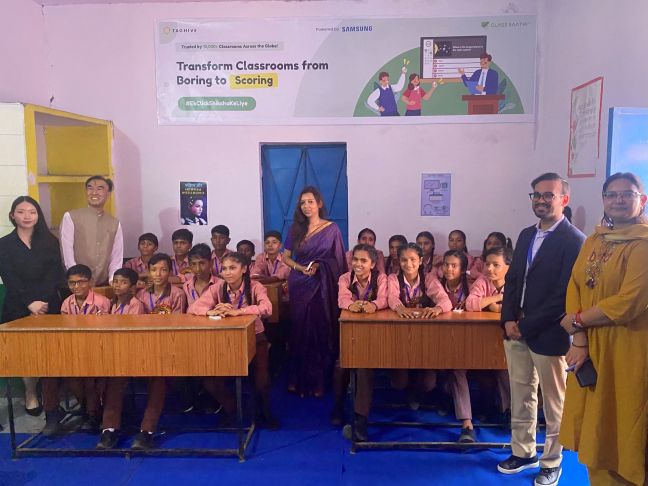
AI-powered tools are opening up a new scale of personalised learning for classrooms across India. A classroom holds children moving at their own pace, each in their own way. A teacher grading homework sheets manually may take an entire week to observe that a particular child is facing difficulty with a specific concept. Many AI-enabled assessment platforms can identify recurring learning gaps within a lesson and recommend targeted practice. Digital classrooms, interactive boards, and AI-assisted assessments can make learning more interactive and accessible in educational institutions across the country.
Technology has evolved over the years, and it is a known fact that it will only grow at a faster pace in the near future. As humans, we have always found ways and mediums to utilise resources and adapt to the changes fluently. As educators, our responsibility is much larger than others, and hence it is critical for us to build a fine balance between Artificial Intelligence and Human Intelligence in classroom teaching. Dependence on AI is not the way to manoeuvre our teaching, but using AI as an assistant to support our work is the way to handle it.
The human touch that teachers provide cannot be replaced. If anything, this progress makes it more valuable, not less. AI works best as a medium, a tool that makes learning more useful and interactive. At the same time, the relationship between a teacher and a student continues to carry the real weight of a child’s education. As facilitators, we need to be better prepared to use the tools that support students’ learning, so that technology remains one part of teaching and never becomes the only medium through which a child learns.
Ethical Foundations for a Digital Classroom
Educational institutions have to ensure that AI is being used in an ethical manner as it becomes a part of everyday teaching. Data privacy and transparency should be taken into account right from the beginning. Equal access to digital infrastructure and quality education carries the same weight. As connectivity continues to expand across the country, the advantages of these tools reach beyond a small circle of well-resourced schools into many more classrooms across the country.
Innovation and creativity are unique to each and hence cannot be replicated. Educators who model the behaviour of honesty and integrity set an example for their students to understand the principles of using AI in an ethical manner.
A Shared Vision Between Home and Educational Institutions
This is, at its heart, a shared endeavour. Parents, teachers, and school leaders must work collaboratively to create a balanced learning environment, one where technology strengthens the relationships at the centre of a child’s education.
Access to AI is not limited to students. While schools and educational organisations create a fine balance between technology and experiential learning, it is imperative for home and school to work collaboratively with the same vision. Home tasks should have a blend of both, and learning by doing cannot be replaced. Uniformity and exchange of information on the tools used, alongside other pedagogies, should be regularly communicated with parents.
Leading India’s Classrooms into a Promising Future
Schools integrating AI with thoughtful planning today are equipping their students not only with skills to use technology but also with the skills to be leaders in an increasingly dynamic world. That is the real measure of this moment, not the technology itself but what it allows teachers to focus on: judgement, character, curiosity.
Embracing AI is only about accepting and adapting to the changing trends in technology. It must be celebrated globally as another industrial and technological revolution. India is a hub of creators and innovators. While we remain rooted in our values, we are committed to nurturing learners who are ready to embark on the journey of growth and excellence.
Education has always evolved in step with society. From chalkboards to smart classrooms, from printed textbooks to digital content, every generation has witnessed a shift in how students learn and how educators teach. Each of these transitions asked something of schools willing to change with the times, and each left classrooms a little richer than before.