
By Dr N. V. H. Krishnan, Advisor at JAIN Online and Member, Chancellor’s Advisory Board, JAIN (Deemed-to-be University)
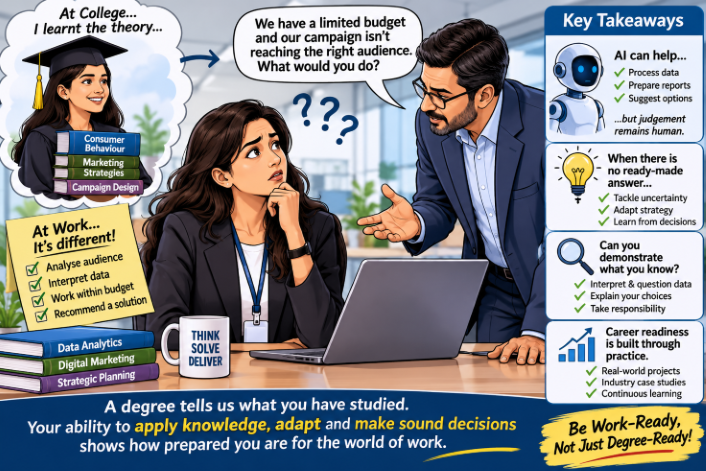
Imagine a fresh marketing graduate joining an organisation. While at college, the student would have studied consumer behaviour, understood marketing strategies and perhaps even worked on a few campaign assignments. On the first day at work, however, the manager asks a simple question: “We have a limited budget and our campaign isn’t reaching the right audience. What would you do?”
Knowing the theory is one thing. Analysing the audience, interpreting available data, working within a budget and recommending a solution is quite another. This is where the difference between having a degree and being ready for the workplace becomes evident.
The transition from classrooms to workplaces has always required adjustment. Artificial Intelligence (AI) has made this transition more significant. Tasks such as collecting information, analysing spreadsheets, preparing reports and creating presentations can now be completed much faster. But speed does not necessarily translate into better decisions. Someone still needs to understand what the information means, whether it is accurate and what action should follow.
When there is no ready-made answer
In college, students are often given a defined problem, a set of instructions and an expected outcome. At work, situations are rarely so straightforward. A client may change a requirement midway, a deadline may move forward, or different teams may disagree on how a problem should be addressed.
Students need opportunities to experience this uncertainty before entering the workforce. Consider an assignment where a group is given a business problem, a limited budget and a deadline, but no prescribed method of solving it. They must decide where to begin, divide responsibilities, evaluate possible solutions and justify their choices.
The learning lies not just in the final presentation, but in the decisions made along the way. It also teaches students that changing their approach when circumstances change is not a failure; it is part of solving problems.
AI can provide answers, but judgement remains human
AI can analyse information and generate recommendations, but its responses still need to be examined. A business recommendation, for instance, may overlook a regulatory requirement, a customer’s specific circumstances or a limitation within the organisation.
The ability to question an AI-generated response is therefore just as important as knowing how to use the tool. Students must learn to verify information, recognise gaps and take responsibility for the decisions they make. AI can assist with the process, but accountability cannot be handed over to software.
Can a graduate demonstrate what they know?
A useful way to assess career readiness is to look beyond examination scores and ask what a student can actually demonstrate. Can they interpret a dataset rather than simply generate one using AI? Can they explain why they chose one solution over another? Can they identify when an AI-generated recommendation does not fit the situation?
For instance, a student working on a business case could use AI to analyse customer feedback, but should also be able to identify patterns, question unusual findings and recommend an action based on the business objective. The value lies not in the tool used, but in the thinking that goes into the final recommendation.
This distinction is important because employers increasingly need people who can take a task from understanding the problem to delivering a considered outcome.
Career readiness is built through practice
These capabilities cannot be developed through a single internship or a final-semester placement programme. They require consistent opportunities to apply knowledge, make decisions, receive feedback and improve.
Universities can create this environment through practical assignments, industry-based case studies, simulations and projects that reflect actual workplace challenges. Students, in turn, need to approach these experiences as opportunities to test their understanding rather than simply complete an academic requirement.
As AI continues to change how work gets done, the advantage will not necessarily belong to those who know the most tools. It will belong to those who understand the problem, know how to use the available tools and can take responsibility for the outcome.
A degree tells us what a person has studied. Their ability to apply that knowledge, adapt when circumstances change and make sound decisions tells us how prepared they are for the world of work.