
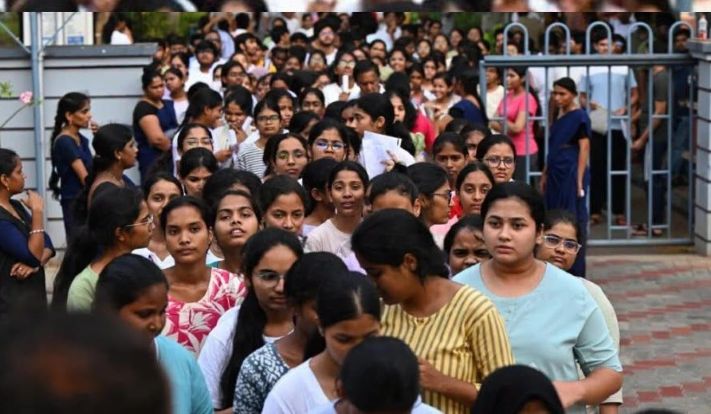
For nearly 2.3 million students, NEET is not merely an examination. It is the gateway to a profession, a dream nurtured over years, and often the culmination of enormous personal and family sacrifice. In 2026, however, the examination became much more than an academic contest. It evolved into a national debate about fairness, institutional credibility, and the future of high-stakes testing in India.
The year began conventionally enough. Candidates prepared for the May 3 NEET-UG examination under the familiar framework of an offline, OMR-based test. But allegations of paper leaks and irregularities soon engulfed the process, triggering investigations, legal scrutiny, and eventually the cancellation of the examination. The decision forced millions of students back into preparation mode, prolonging uncertainty and emotional strain. The National Testing Agency (NTA) subsequently conducted a re-examination on June 21 under significantly enhanced security arrangements. According to NTA officials, the re-test concluded without any reported paper-leak complaints, suggesting that the immediate crisis had been contained.
Yet the story of NEET 2026 is not merely about an exam that had to be conducted twice. It is about the fragile relationship between merit and trust. Competitive examinations derive legitimacy from a simple promise: every candidate competes on equal terms. Once that promise is questioned, even the most rigorous evaluation loses credibility. The controversy exposed vulnerabilities in examination management and intensified demands for stronger safeguards, technological oversight, and greater institutional accountability.
For students, the consequences have been profound. Many aspirants found themselves trapped in an unexpected cycle of revision after months of intensive preparation. Mental fatigue became a recurring theme in student discussions. The challenge was no longer limited to mastering Physics, Chemistry, and Biology; it was about sustaining motivation amid uncertainty. Ironically, the re-examination itself became a test of resilience.
Initial analyses of the June 21 paper suggest that it was of moderate difficulty, with Physics emerging as the differentiating section while Biology remained comparatively scoring. Coaching institutes and academic analysts noted that the examination continued the broader trend toward conceptual understanding rather than rote memorization.
As the dust settles, attention is shifting to the next phase. The provisional answer key is expected shortly, followed by the objection window, final answer key, and results. Candidates will have an opportunity to challenge disputed questions before scores are finalized.
Beyond the immediate administrative milestones lies the more consequential question: what comes next for aspirants?
For high scorers, the focus will soon move toward counselling strategy. Government medical colleges remain intensely competitive, and even small variations in rank can significantly influence outcomes. For candidates whose scores fall short of expectations, the landscape is broader than it may initially appear. BDS, BAMS, allied health sciences, private medical institutions, and international medical programs continue to offer viable pathways into healthcare professions. Missing a desired MBBS cutoff is disappointing, but it is not equivalent to the end of a medical career.
The larger implications of NEET 2026 may extend far beyond this year’s admissions cycle. Policymakers and education experts are increasingly debating whether India’s largest entrance examination should continue in its traditional paper-based format. The events of this year have strengthened arguments for more secure testing systems, potentially including computer-based examinations, biometric verification, enhanced surveillance mechanisms, and independent audit structures. Such reforms would not eliminate every risk, but they could reduce the vulnerabilities exposed in 2026.
For aspirants preparing for future editions of NEET, the lesson is clear. Academic preparation alone is no longer sufficient. Adaptability, emotional endurance, and the ability to navigate uncertainty have become equally important. The students who ultimately succeed are often those who can maintain focus despite circumstances beyond their control.
NEET 2026 will likely be remembered not for a particular question paper or cutoff score, but as a turning point in the evolution of medical entrance examinations in India. It exposed weaknesses in the system, tested the patience of millions, and forced institutions to confront uncomfortable questions about trust and transparency. For candidates, however, the central truth remains unchanged: while examinations may be disrupted, delayed, or redesigned, the pursuit of a medical career continues to reward persistence. In that sense, the defining quality of NEET 2026 may not be controversy. It may be resilience and systemic upgrade. However, its accountability question lingers and must not go without punishing those broke the trust.