
By Syed Sultan Ahmed, Chairperson, The Association of International Schools of India (TAISI)
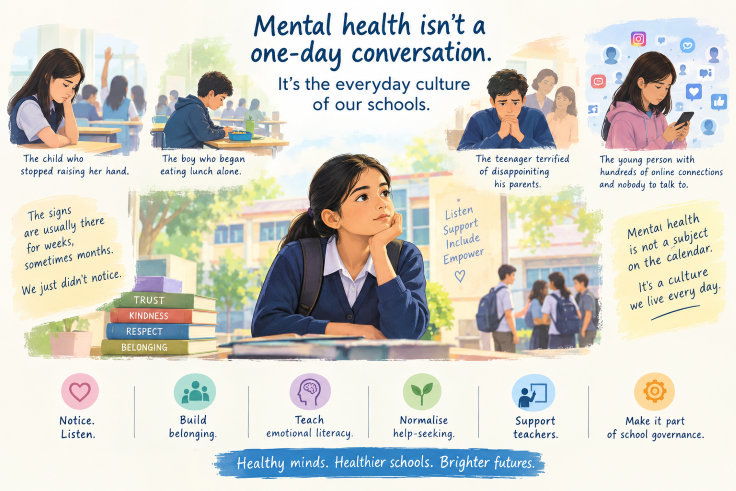
 A child does not suddenly develop a mental health concern on the day they first walk into the counsellor’s room. The signs are usually there for weeks, sometimes months. The student who stopped raising her hand. The boy who began eating lunch alone. The teenager terrified of disappointing his parents. The young person with hundreds of online connections and nobody to talk to. Perhaps we did not notice because we were busy measuring everything else. Attendance. Marks. Rankings. Results. So on World Mental Health Day, I want to ask an uncomfortable question of all of us who run schools. We have become mental-health-conscious schools. Have we become mentally healthy ones?
The Monday workshop and the Tuesday humiliation
Most of our schools now have counsellors, wellness weeks and awareness campaigns. That is real progress. But a school cannot run a stress-management workshop on Monday and humiliate a child for poor marks on Tuesday. It cannot celebrate resilience in the morning assembly and then run classrooms where children are terrified of being wrong. Counselling is essential for the children who need it. But we cannot counsel children out of a culture that keeps producing the very anxiety we are counselling them for. Mental health cannot be an event on the school calendar. It has to live in the culture of the school.
The vocabulary we never taught
Think about what a child learns in twelve years of school: equations, chemical reactions, historical causes, grammar rules. Now think about how much time we spend helping them understand disappointment, loneliness, jealousy, rejection or fear. How many children can recognise what they are feeling, say why, and ask for help when it becomes too much? These are not soft extras. They are basic human capabilities, and NEP 2020’s emphasis on holistic development recognises exactly that. The answer is not necessarily another subject. A story about rejection can open a conversation about belonging. A disagreement in a group project can become a lesson in empathy. A failed experiment can teach perseverance. Literature, cinema, sport and even academic setbacks can all teach emotional literacy, if we choose to use them that way.
Almost every subject can teach a child something about being human.
Have we made failure too frightening? Somewhere along the way, we began to confuse performance with worth. We celebrate toppers and winners. But what happens to the child who tries hard and comes twentieth? When every examination feels like a verdict on who you are, children learn to fear mistakes rather than learn from them. A disappointing mark should tell a child what they have not yet mastered. It should never make them question whether they are enough. We also need to be careful about what we mean by well-being. Mental health is not the absence of distress. Nervousness, sadness, setbacks and failure are part of growing up. Resilience is not built through motivational speeches or by removing every difficulty. It grows when children face manageable challenges and recover from disappointment. It also grows when they learn that asking for help is a sign of strength, not an admission of crisis. An emotionally healthy school does not protect children from every struggle. It gives them the safety, relationships and support to come through it.
The most important mental health resource is already in the classroom
CISCE has just launched a nationwide dialogue for nearly 16 lakh students and 32,000 teachers. It brings them into structured classroom conversations on academic stress, digital life, relationships and help-seeking. It is an encouraging recognition that children’s voices belong in this conversation. But listening must lead somewhere. A counsellor usually meets a child once a concern has been identified. A class teacher sees that child almost every day. The teacher is often the first to notice the withdrawal, the dip in participation, the unusual irritability.
Teachers should not become therapists. Children with significant difficulties need qualified professionals. But every teacher can learn three things
- to listen without judgement
- to frame a sensitive conversation
- to recognise when a child needs more support
Sometimes “You don’t seem yourself today, is everything okay?” opens a door that no awareness programme ever could. And we must ask honestly: can emotionally exhausted teachers create emotionally healthy classrooms? Caring for teachers is not separate from caring for children. It is the same responsibility.
Connected to everyone. Belonging nowhere.
The Supreme Court-appointed National Task Force has run a preliminary survey of over 2.43 lakh higher education students. About 34% had felt like outsiders on campus to some degree. Around 15% recalled a recent period of being overwhelmed or persistently low. These are college students. But a sense of not belonging is rarely acquired at eighteen. The questions it raises must be asked much earlier, in our schools. The digital world makes this harder. Children grow up surrounded by curated lives, filtered faces, instant comparison and an endless chase for approval. Our response cannot stop at restricting screen time, because restriction builds compliance, not understanding. Children need to understand:
- how images shape perception
- how algorithms decide what they see next
- why a count of likes is not a measure of worth
Visual literacy and emotional literacy are becoming inseparable.
From programmes to governance
Perhaps we should stop asking how many mental health programmes a school runs, and start asking how mentally healthy the school itself is.
Does every child have at least one adult they trust?
Can a student disagree with a teacher without fear?
Can a child fail without being humiliated?
When students speak about pressure, bullying or exclusion, does anything actually change?
That last question matters most. Listening means little unless it reaches into:
- assessment practices
- disciplinary methods
- teacher workloads
- the language we use to define success
That is why mental health cannot sit with the counselling department alone. It is a leadership responsibility. Perhaps the true measure of a good school is not how well its children perform when everything is going right, but how supported they feel when something goes wrong.
Every year on this day, we ask children to speak up. The harder task is to build schools where they feel safe enough to do so, and where the adults are willing to change when they do.