
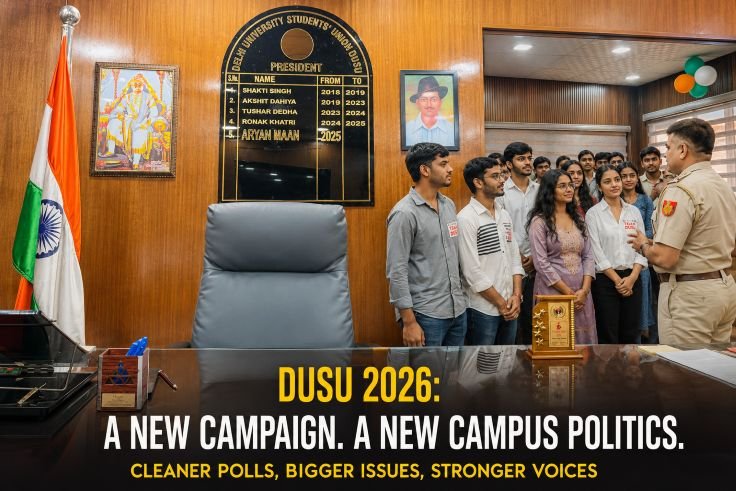
The momentum for this year’s Delhi University Students’ Union (DUSU) elections, scheduled for September 18, 2026, with counting and declaration of results on September 19, may still be building. The last date for filing nominations is September 10, and the major contenders are yet to announce their final panels. Yet, one thing is already clear: DUSU 2026 could set a new benchmark for student elections in the country.
For the first time in years, the election is expected to be largely free of the familiar sights and sounds associated with DUSU polls—piles of campaign literature, paper litter across campuses, walls plastered with posters, noisy convoys and celebrity-led roadshows. Wall defacement and paper pollution had become major controversies in previous elections, at times prompting judicial intervention and strict directions to student organisations.
This year, the University of Delhi has imposed a significantly tighter campaign regime, restricting the use of vehicles and campaign teams, banning celebrity roadshows and pushing candidates towards digital and paperless campaigning. If these restrictions hold through polling day, DUSU 2026 could demonstrate that a fiercely contested student election need not necessarily translate into an environmental and public-order nightmare.
The social media election
That, in turn, is likely to make social media the principal battlefield.
With traditional mass campaigning curtailed, organisations will have to rely far more heavily on Instagram, YouTube, X and other digital platforms to reach students, build narratives, counter opponents and mobilise support. The election could therefore become a real-time demonstration of the political power of social media among India’s Gen Z voters.
The larger question is whether the generation that has grown up with smartphones, short-form video, influencers and digital communities will bring a different political vocabulary to campus politics. Will students respond to traditional organisational mobilisation, or will issues, personalities and digital campaigns increasingly determine voting behaviour?
That makes the 2026 election particularly interesting—not merely as a contest for four DUSU posts, but as a possible indicator of changing youth political preferences.
A test for ABVP
For the BJP-backed Akhil Bharatiya Vidyarthi Parishad (ABVP), the election is essentially a test of whether it can consolidate its dominance. The organisation won three of the four central posts in the 2025 DUSU elections, including the presidency, and will be seeking to retain that advantage.
A defeat, particularly if it involves a significant swing against ABVP, will inevitably be watched beyond the university campus. DUSU has traditionally been regarded as an important indicator of youth political sentiment, and a decisive verdict against the dominant student organisation could be interpreted as a signal of changing political preferences among urban youth.
At the same time, it would be premature to treat a DUSU result as a direct referendum on the BJP. Campus elections have their own dynamics, personalities, local networks and student-specific issues. Nevertheless, the political symbolism of the contest makes the outcome important.
SFI-AISA: Can the Left convert issues into votes?
In the same breath, considerable attention will be on the performance of the SFI-AISA alliance.
The Left-backed groups have spent the past several years trying to build a sustained presence on the university campus, proactively raising issues ranging from student welfare and fee structures to academic concerns, democratic rights and broader social questions. Unlike the two larger organisations, their strength has traditionally rested less on sheer organisational resources and more on issue-based mobilisation and activism.
The 2026 election will therefore test whether that sustained campus engagement can translate into electoral gains.
Even a significant increase in the alliance’s vote share—or a breakthrough in the central panel—could alter the conventional ABVP-NSUI binary that has dominated DUSU politics.
NSUI’s comeback bid
For the Congress-affiliated National Students’ Union of India (NSUI), meanwhile, the election represents another major test of its ability to challenge ABVP’s dominance.
NSUI regained the DUSU presidency in 2024 after a seven-year gap, only to lose it to ABVP in 2025. It will now be looking for a comeback. The Congress party has also sought to build momentum through its “Chhatron Ki Goonj” campaign, taking student concerns beyond the traditional campus election framework. Will this help on DU campuses to secure votes, is a question on most minds.
With the Congress attempting to reassert itself politically after years of electoral setbacks, a strong NSUI performance would carry significance for the party as well. The organisation is therefore likely to put considerable organisational and political capital into the contest.
The real question, however, is whether NSUI can convert its renewed outreach and anti-incumbency sentiment into votes and prevent the election from once again becoming a straightforward ABVP-versus-NSUI contest.
From manifestoes to consultation
Perhaps another significant change this year is how the major organisations are attempting to construct their manifestoes.
Both ABVP and NSUI have taken a consultative route, inviting students to suggest issues and priorities rather than simply presenting manifestoes from the top down. This is more than a campaign gimmick. It reflects an attempt by the organisations to claim greater legitimacy through wider student participation.
It also reflects a changing electorate. Today’s university student is likely to be more demanding about tangible outcomes—transport concessions, affordable education, accommodation, internships, placements and campus infrastructure—than broad ideological promises alone.
What will students vote on?
The Delhi Metro concession remains one of the most visible student demands and is likely to feature prominently in the campaign. But the agenda is considerably wider.
Hostel availability, affordability, scholarships and student welfare remain immediate concerns, particularly as the cost of living and education rises.
Campus infrastructure—from classrooms and libraries to sanitation, Wi-Fi and digital facilities—will also remain important.
On the academic front, students are likely to raise concerns over attendance requirements, the Four-Year Undergraduate Programme (FYUP), examinations, internships and the transition between academic programmes and employment.
Issues of women’s safety, drug abuse and campus security are likely to find space in most manifestoes, while larger concerns such as unemployment, employability and the aspirations of India’s young population could give the campaign a broader political dimension.
The interesting shift is that many of these issues are simultaneously local and national. A student may vote on something as immediate as a Metro concession while also thinking about employment, competitive examinations, education policy and the future of the country’s youth.
Could DUSU become a model?
Against this backdrop, DUSU 2026 has the potential to surprise—and to become a model.
If the University succeeds in conducting a genuinely competitive election without the traditional spectacle of wall defacement, paper waste, unruly convoys, excessive noise and celebrity mobilisation, it could demonstrate that student politics can be both vigorous and responsible.
More importantly, a successful election could send a message to universities across the country where student politics has either been restricted, suspended or gradually weakened: competitive campus democracy does not necessarily have to come at the cost of order and academic life.
The outcome, therefore, will be judged on more than who wins the four central posts.
It will be a test of ABVP’s dominance, NSUI’s recovery, the Left’s expanding campus politics, the political influence of Gen Z, the power of social media and the ability of India’s largest university to conduct a high-voltage democratic contest within clearly defined limits.
And perhaps that is what makes DUSU 2026 different: the real election may not just be about who wins the union—it may be about what the future of student politics in India looks like.