
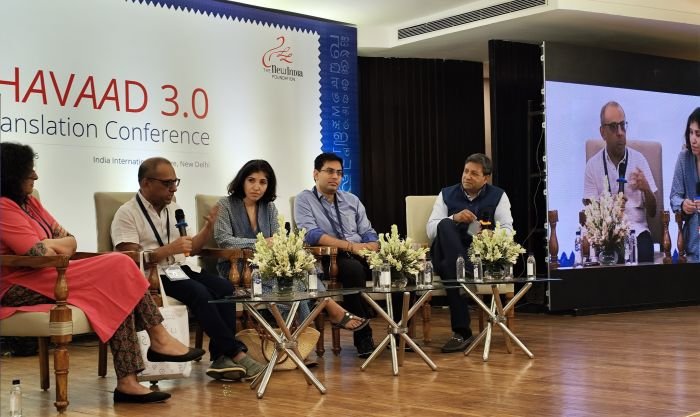
The growing influence of artificial intelligence on translation, writing and publishing emerged as a central concern at the third edition of Bhashavaad: National Translation Conference, held over two days on August 29-30 in New Delhi. Speakers at the conference organised by the Ashoka Centre for Translation (ACT), in partnership with The New India Foundation, discussed how AI is changing literary practices while underlining the continuing importance of human judgement, cultural context and linguistic diversity.
A key finding presented at the conference from the ACT-IDAF Fellowship for Research into AI Translation from Malayalam was that AI can produce useful translations when given targeted, context-specific human guidance, but its outputs still require substantial human intervention and editorial oversight. This is particularly important in literary translation, where preserving the cultural, psychological and literary texture of an original work is more complex than reproducing its words.
The debate over whether AI could eventually make translators redundant reflected similar concerns. Panellists acknowledged that AI can improve efficiency and assist translators, but argued that literary translation involves interpretation and cultural understanding that cannot easily be automated. Questions of authorship, copyright, ethics and the changing responsibilities of translators, editors and publishers are also becoming increasingly important as AI becomes embedded in the literary ecosystem.
Chiki Sarkar, Founder, Juggernaut Books, challenged the idea that AI and creativity are inherently opposed. She noted that publishers are already using AI for tasks ranging from editing and manuscript review to idea generation and illustration. “The tension between AI and creativity is a false one,” she said, stressing that AI remains a tool whose value depends on human imagination and judgement.
The broader discussion suggested that the rise of AI does not diminish the importance of translation but could alter how it is practised. Simona Sawhney, Professor of Literature, IIT Delhi, argued that translation has never been simply about finding an equivalent word or sentence in another language. “Translation is not about finding a perfect substitute for one language in another,” she said, describing it instead as an encounter between languages in which meanings are carried across, transformed and sometimes lost.
For Rita Kothari, Co-Director, Ashoka Centre for Translation, translation is particularly significant in the Indian context because it reflects rather than merely resolves the country’s multilingualism. “Translation is not simply a solution to the problem of multilingualism. In India, it is its manifestation, its expression and its site,” she said, emphasising its role in enabling ideas, cultures and texts to move between linguistic communities.
Arunava Sinha, Co-Director, Ashoka Centre for Translation, similarly pointed to the scale and diversity of Indian literature that translation is beginning to reveal. He said the Centre’s work had shown that India’s literatures are “far richer, far deeper and far more diverse than we could have imagined”, and argued that translation could help literary centres take their stories and ideas beyond their own linguistic boundaries.
The conference also highlighted another continuing trend: the effort to widen the literary mainstream by bringing marginalised languages, oral traditions and communities into greater visibility. Discussions on Adivasi writing, for instance, questioned the tendency to view such literature only through the prism of marginalisation and stressed the diversity of its languages and literary traditions.
Urvashi Butalia, feminist, publisher and writer, connected questions of literary representation with the broader politics of who gets to define modernity and whose voices are heard. “We should not be in a hurry to allow gatekeepers to decide what concepts such as modernity mean, or whose languages and voices are allowed to matter,” she said.
The first day featured a keynote address, ‘Translation, Mimesis, Aphasia’, by Simona Sawhney, Professor of Literature, IIT Delhi, who reflected on translation as an act that moves beyond simple reproduction or equivalence, exploring how meaning is reshaped as it travels between languages. She said, “Translation is not about finding a perfect substitute for one language in another. It is about the encounter between languages, about what can be carried across, what is transformed in the process, and what cannot be reproduced at all.”
The conference also explored the relationship between writers and translators through ‘The Writer and Her Translator’, featuring Volga, Purnima Tammireddy, Salma and GJV Prasad in conversation with Nandini Nair. The session examined the role of trust, interpretation and collaboration in carrying literary works across languages.
Another key discussion, ‘Are Translators Redundant?’, featured Poonam Saxena, Murali Ranganathan, Moutushi Mukherjee and Nishat Zaidi, in conversation with Arunava Sinha. The panellists examined the growing role of AI in translation, acknowledging its potential to support translators and improve efficiency while emphasising the distinctly human dimensions of literary translation, particularly the interpretation of cultural context. The conversation also raised questions around ethics, copyright and the evolving responsibilities of translators, editors and publishers as AI becomes increasingly embedded in the literary ecosystem.
The session ‘What Is India Reading?’, featuring B Srinivasan, Semanti Ghosh and Jayant Mammen Mathew in conversation with Manish Sabharwal, Co-founder, Teamlease Services and Ashoka University, turned attention to India’s reading landscape and the ways in which literary consumption is evolving.
Taken together, the discussions at Bhashavaad 3.0 pointed to a literary ecosystem in transition: AI is becoming an increasingly practical tool, but human interpretation remains central; translation is expanding access to India’s diverse literatures; and publishers and writers are confronting new questions about creativity, ownership and representation. The emerging challenge is therefore not simply whether technology can translate, but how it can be used without flattening the linguistic, cultural and human complexity that makes literature worth translating.