
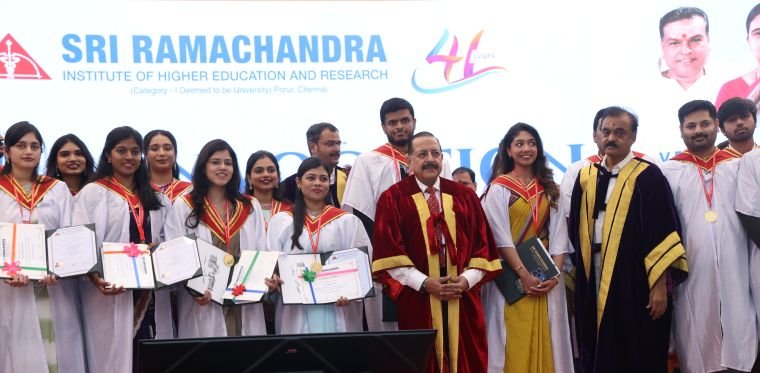
Chennai-based Sri Ramachandra Institute of Higher Education and Research (SRIHER) held its 42nd Convocation on October 22, conferring degrees on 2,116 graduates, including Doctor of Science, PhD, postgraduate and undergraduate students across medical, engineering and management disciplines.
Dr Jitendra Singh, Union Minister of State (Independent Charge) for Science and Technology and Earth Sciences, graced the occasion as Chief Guest and presented 106 gold medals to meritorious students across various specialities.
In his convocation address, Dr Singh highlighted how artificial intelligence (AI), genomics and quantum technologies are transforming healthcare. He noted that while communicable diseases such as tuberculosis and malaria were once major public health concerns, non-communicable diseases, including diabetes and coronary artery disease, have increasingly emerged as significant challenges.
Highlighting developments in nuclear medicine research and growing private-sector participation, he emphasised its potential in diagnosing and managing conditions such as acute lymphoblastic leukaemia, liver cirrhosis and fatty liver disease.
“Our primary objective must be to prevent long-term disorders, particularly those affecting young people. We must harness the energy, talent and potential of our young population. The contribution of our youth will be vital to building a developed India. We cannot afford the potential of our youth to be lost to preventable diseases,” he said, calling for collective efforts to protect young people’s health and contribute to the realisation of Viksit Bharat 2047.
The minister also highlighted the importance of genomic research in advancing precision medicine. Referring to the Sequencing Atlas for National Genomics and Medicine (SANGAM) initiative under the National Genomics Data Grid (NGDG), he outlined the objective of sequencing the genomes of approximately one million genetically diverse Indians and integrating the information with clinical outcomes.
Such an approach, he said, would help advance precision medicine, enabling healthcare decisions to be increasingly tailored to individual patients based on their genetic profiles, lifestyles and environmental exposures.
The degrees were conferred by Chancellor V. R. Venkataachalam, who, along with Pro-Chancellor R. V. Sengutuvan, distributed the degree certificates.
Presenting the annual report, Dr K. Balaji Singh, Dean, Medical College, highlighted the institution’s academic and research achievements during 2025–26. He said that 12 new postgraduate and 14 new undergraduate programmes had been introduced during the academic year.
With funding support from the Biotechnology Industry Research Assistance Council (BIRAC), Department of Biotechnology (DBT), Government of India, the university is incubating more than 40 start-ups in areas including digital health, diagnostics, medical technologies, clean energy and waste management.
The institution has recorded more than 14,034 publications and an H-index of 111. In innovation, it filed 65 patents, of which 29 were published and three granted. It also secured 71 copyrights. The Institution’s Innovation Council (IIC) at SRIHER received a four-star rating from the Ministry of Education’s Innovation Cell, he added.
The convocation was attended by Samyuktha Venkataachalam, Trustee, Sri Ramachandra Educational and Health Trust; Dr S. Senthil Kumar, Registrar; Dr R. Padmavathi, Controller of Examinations; Dr P. Venkatachalam, Dean, Research; J. Ravisankar, Director, Finance and Accounts; and other heads of departments.