
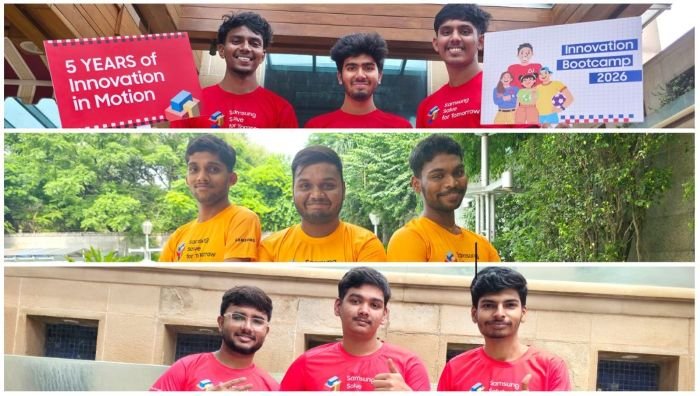
Here are a few of the innovations that have made it to the Top 20.
From discarded denim to a circular-economy venture
Yogeeta Kishore, a 21-year-old innovator from Maharashtra, has spent the past year and a half exploring how denim waste can be turned into opportunity. Through her initiative, Indiejeanous, she transforms discarded denim and textile scraps into lifestyle products while creating livelihood opportunities for women artisans.
Before joining the programme’s Bootcamp, Yogeeta’s approach was largely focused on giving discarded textiles a second life. Interactions with mentors, experts and fellow innovators encouraged her to examine the entire journey of textile waste—and think more closely about the people who would ultimately use or benefit from her solution.
What began with discarded denim in one community is steadily evolving into a broader circular-economy proposition: reducing textile waste, supporting women artisans and demonstrating how young innovators can turn overlooked problems into new possibilities.
“There is a huge difference in my idea. Earlier, we were only focused on upcycling, but now we are looking more deeply at how that waste can be utilised. We have also started prototyping,” Yogeeta said.
The experience has also helped her recognise that a meaningful idea must work not only environmentally, but also for its customers and the community it seeks to support.
“You have to understand the customer and make sure the solution genuinely addresses the community’s needs,” she added.
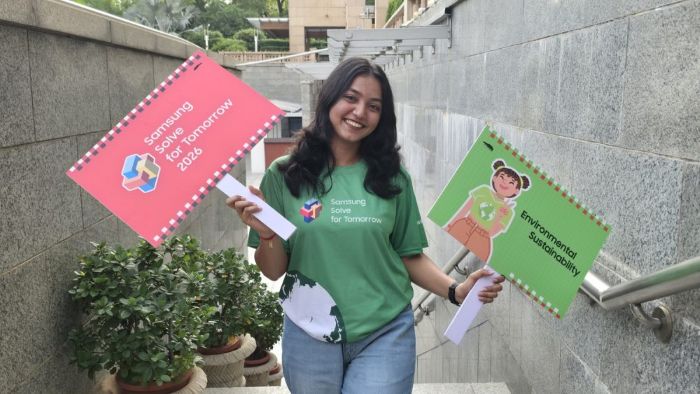
Presenting Indiejeanous before a jury and discussing it with young innovators from across India further expanded Yogeeta’s sense of what the initiative could become.
“When I presented my idea and shared it with my peers, I realised that I was not just solving a problem within my own community,” she said.
The most important change, however, has been personal. Building an idea largely by herself had often left Yogeeta questioning whether it could create real impact. At Samsung Solve for Tomorrow, she found a community of young people navigating similar challenges.
“When I talk to my peers, I feel that I am doing something real. I feel inspired and confident. Earlier, I was not so confident,” she said.
At 21, Yogeeta may still be at the beginning of her journey. But she no longer feels that she has to build alone.
A shooter turns injury prevention into innovation
For Homanshika Reddy Pullagurla, a Hyderabad-based national-level shooter and national medallist, technology is becoming a way to confront a problem that can abruptly end an athlete’s journey: injury.
The 21-year-old is developing Somatrace, a wearable system that uses sensors to track spinal movement in real time. Initially designed for rifle shooters, the technology aims to give athletes and coaches deeper insights into posture and movement during training and help identify patterns that may be associated with injury risk. The innovation has taken Homanshika to the Top 20 of Samsung Solve for Tomorrow 2026.
Homanshika had not always planned to become an innovator. Growing up, she imagined becoming a doctor or an engineer. Shooting entered her life almost unexpectedly when she took it up as a hobby at the age of 12. The hobby soon became a serious pursuit, bringing competitions, discipline, pressure and national medals.
Inspired by Olympic gold medallist Abhinav Bindra and the young shooters training alongside her, Homanshika discovered what talent and persistence could achieve.
Sport also taught her how much an athlete’s performance depends on the body—and how quickly injury can take that opportunity away. In rifle shooting, where precision is critical, even small variations in posture or repeated movements can influence performance.
Homanshika began wondering whether these movements could be captured and analysed, giving athletes and coaches information that may be difficult to detect with the naked eye. That question became Somatrace.
The wearable system is being developed to capture spinal movement patterns during training. By making this information measurable, Homanshika hopes Somatrace can help athletes better understand their bodies and enable coaches to make more informed training decisions.
Her ambition is straightforward: to help athletes remain in the sport they love for longer.
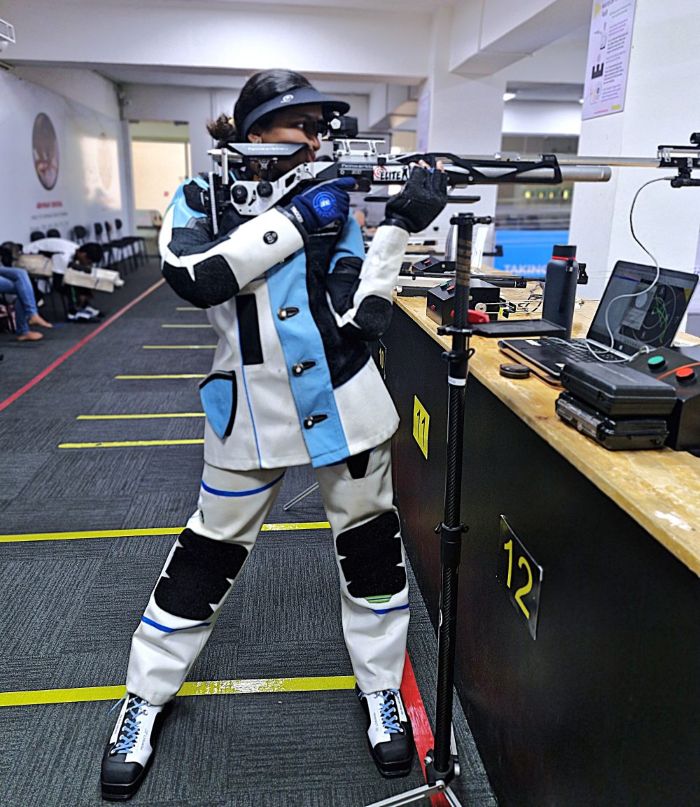
Selection for Samsung Solve for Tomorrow has given Homanshika an opportunity to move Somatrace beyond its early concept.
Through the programme’s Bootcamp, she tested her assumptions, received feedback from mentors and began examining the solution from technical, user and commercial perspectives.
“The Bootcamp was an amazing experience. It helped me validate my idea practically,” she said.
The experience has also changed how she views Somatrace. What began as a solution to a problem she had personally encountered is now taking shape as a potential venture with wider relevance.
Three Tamil Nadu teams put AI to work
Another set of stories comes from Tamil Nadu, where nine young innovators from Chennai and Coimbatore are using artificial intelligence, sensors and wearable technology to address everyday challenges in workplace learning, road safety and healthcare.
Three Tamil Nadu teams—4 Percentage, JARVISS and Rogue—are attempting to turn these possibilities into reality through MicroLearning AI, SafePath AI and NeuroStride. Their ideas have taken them to the Top 20 of Samsung Solve for Tomorrow 2026.
For Sajith J, Mithran B and Kavin Nanadha M K of Coimbatore-based team 4 Percentage, the challenge was clear: conventional training programmes can be difficult to fit into the schedules of factory and frontline workers.
Their solution, MicroLearning AI, converts complex information into short, two-to-three-minute learning videos that can be delivered through WhatsApp in workers’ native languages. The platform is designed to make workplace learning easier to access, understand and complete without requiring employees to step away from their jobs for extended periods.
By combining AI with the familiarity of WhatsApp and regional-language content, the team hopes to make training more practical and accessible for workers across industries.
Similarly, Chennai-based team JARVISS, comprising Sanjay Kumaar, G B Aswindbaghat and Varunprasath K, is developing SafePath AI to help commuters navigate potholes, waterlogged roads and other hazards more safely.
The platform uses smartphone and IoT sensor data to detect road hazards, assess their severity and recommend safer routes. It is also being designed to alert relevant authorities, creating the potential for quicker identification and resolution of unsafe road conditions.
Rather than asking commuters to react after encountering a pothole or flooded stretch, JARVISS aims to give them useful information before they reach it—turning everyday smartphones into tools for safer mobility.
For the third Tamil Nadu team, Rogue, the challenge is deeply human: helping people with Parkinson’s manage involuntary tremors while retaining greater independence in their daily lives.
Team members Manoj Kumar Kasinathan, Jena R and Chriswin William D are developing NeuroStride, an AI-powered wearable designed to distinguish involuntary Parkinson’s tremors from intentional muscle movement. The device then seeks to provide targeted electrical stimulation to support more controlled movement.
The team’s larger ambition is to develop an accessible, non-invasive solution that could help people with Parkinson’s perform everyday activities with greater confidence.
Together, these stories offer a glimpse into the breadth of ideas emerging from Samsung Solve for Tomorrow 2026. For the Top 20 teams, the next stage is no longer simply about having an idea; it is about testing, prototyping and demonstrating whether that idea can work in the real world,