
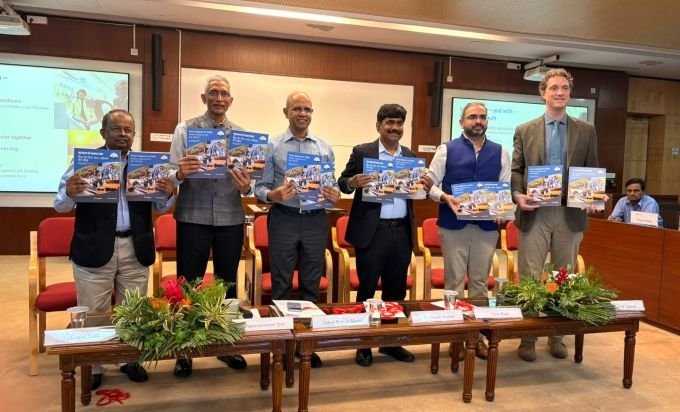
A new case study, From Gujarat to India: Water Lessons for the World, documenting the evolution of water governance in Gujarat and India between 2001 and 2026, was launched at IIM Bangalore on Oct 7. It draws lessons from the experience for policymakers and practitioners across the Global South. Daniel W. Smith, assistant professor at George Mason University; Nitin Bassi, fellow at the Council on Energy, Environment and Water (CEEW); and Parameswaran Iyer, former secretary of the Department of Drinking Water and Sanitation, Government of India, authored the study.
The study traces a 25-year journey that began under Chief Minister Modi in Gujarat in 2001, when recurrent drought and water scarcity led to a combination of large-scale infrastructure, groundwater recharge, conservation, improved water-use efficiency, institutional reform, and community participation. It describes Gujarat’s water governance reforms between 2001 and 2014 as a laboratory for approaches later scaled nationally after 2014.
The scale of the transformation is reflected in both financing and access. Among other lessons learned, one key finding is that Union water-sector allocations increased from 0.8 per cent of the total Union budget in 2001-02 to 2.2 per cent in 2025-26. Across rural India, 464 million more people use safely managed drinking water today than in 2000, while rural household tap coverage has increased from 17 per cent in 2019 to over 80 per cent in 2026.
Gujarat’s response combined the Narmada-based water grid with institutions such as WASMO and village-level Pani Samitis, alongside large-scale water conservation and groundwater recharge. By 2013, the state had constructed more than 76,000 check dams under the Sardar Patel water conservation programme. The study traces how elements of this experience subsequently informed national initiatives including Jal Jeevan Mission, Jal Shakti Abhiyan, Namami Gange, Atal Bhujal Yojana, Per Drop More Crop and AMRUT. In 2019, the creation of the Ministry of Jal Shakti provided a consolidated institutional framework for drinking water, sanitation and water-resource management.
Shri Ashok K. Meena, Secretary, Department of Drinking Water and Sanitation, Ministry of Jal Shakti, said in his keynote: “Ensuring water for every citizen has been a priority for the Department of Drinking Water and Sanitation, Ministry of Jal Shakti. The lesson has always been: when water becomes a people’s mission, backed by strong institutions, steady investment, and Gram Panchayat ownership, change follows at scale. What began in one state has become a national commitment, and work will be relentless until safe, reliable water reaches every household in the country.”
A central conclusion of the study is that water security is as much a governance challenge as an engineering challenge. Infrastructure must be underpinned by the 4Ps: political leadership, public financing, partnerships and people’s participation. The seeds of these lessons were sown in Gujarat starting in 2001 and then scaled up across the country under Prime Minister Modi’s leadership.
Parameswaran Iyer, former Secretary to the Government of India and co-author of the study, said: “Delivering water at this scale comes down to a few things done consistently: political leadership and priority, institutions with one clear line of accountability, and communities that own and maintain their own supply.”
Looking ahead, the study highlights the opportunity to build on India’s achievements through reliable service delivery, water quality, source sustainability, groundwater recharge, greater water-use efficiency and a circular water economy based on treatment and reuse of used water.
Professor Gopal Naik, Chairperson, Senior Fellow and Jal Jeevan Mission Chair Professor at the Centre for Public Policy, IIM Bangalore, said: “IIM Bangalore is glad to host the launch of this case study. Delivering water at scale is one challenge, and sustaining it is another. This study brings together twenty-five years of experience from Gujarat and India to show what works and what comes next. Its lessons on governance, community ownership and ambition are practical ones. Building water systems is one task; sustaining them is another. Twenty-five years of evidence lets us ask what lasted, and why.”
Dr Nitin Bassi, co-author and Fellow, CEEW, said: “The next phase of water security in India will include the prioritisation of the circular water economy, including the optimal usage of treated used water, which is also a significant economic opportunity”
The study distils India’s experience into four lessons that countries across the Global South may find useful: lead with governance, not hardware; manage the water resource and the water service together; root initiatives in community ownership; and go big, matching ambitious goals with political will, financing and administrative capacity.
Daniel W. Smith, co-author and Assistant Professor at George Mason University, said: “India’s water journey offers lessons well beyond its borders. The central message is that water security at scale requires strong water governance. Countries across the world can learn from these governance lessons and adapt them to their own circumstances as they work toward universal and sustainable water security.”
Read the full study here.