
A BITSoM survey report titled the EFMD x BITSoM Global Perspectives Survey Report released at its inaugural All-India Deans Conference in Mumbai on October 8, says 73% of Indian B-school leaders expect AI to cause substantial or fundamental transformation in management education. However, institutional responses vary widely—among those expecting fundamental disruption, nearly 38% remain choose passive watching or early experimentation stages.
Grounded in primary inputs and direct insights gathered from 22 Indian business school deans and academic leaders, the findings provide an evidence-based snapshot of how Indian institutions are navigating macro industry shifts. The other key findings of the report include:
Pivot to Broad Strategic Collaborations: 91% of respondents prioritize broad, multi-dimensional international partnerships—encompassing joint research, faculty exchanges, and industry-linked initiatives—over traditional standalone student mobility programs (9%). Institutional reputation (85%) and faculty quality (80%) dictate partner choice, while mutual value creation (60%) and funding (45%) are cited as the primary determinants of partnership viability.
Shifting Employer & Degree Demand: 59% of Indian deans identify changing employer expectations and evolving graduate roles as their single greatest concern, closely followed by changing market demand for traditional MBA degrees (54%).
AI Governance & Safeguarding Critical Thinking: The hardest challenges in navigating AI centre on governance, privacy, and responsible use (41%), followed by curriculum & assessment redesign (36%) and building faculty capabilities (32%).
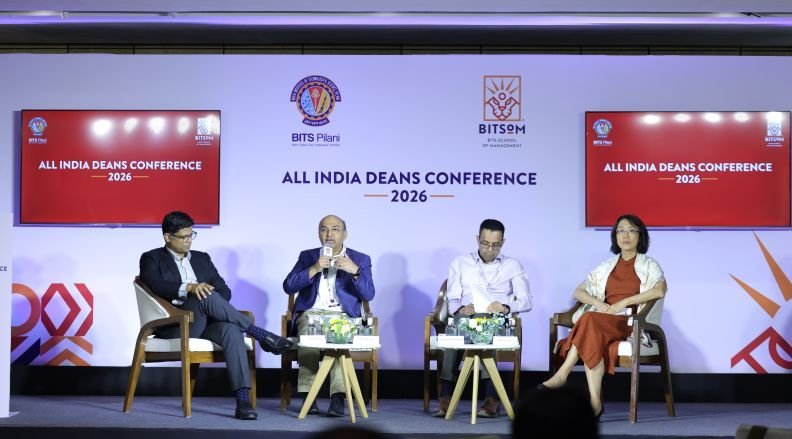
The report was present coinciding with the high-level deliberations in the inaugural All-India Deans Conference in Mumbai of the BITS School of Management (BITSoM), under the aegis of BITS Pilani, that brought together premier academic leaders from India and across the globe to define a shared agenda for the future of management education.
The flagship gathering convened deans and academic heads from leading global and Indian institutions, including Prof. Saravanan Kesavan, Dean of BITSoM; Prof. Geoffrey Garrett, Dean of USC Marshall School of Business; Prof. Vishal Gaur, Dean of Cornell SC Johnson College of Business; Prof. Lasse Mertins, Associate Dean of Johns Hopkins Carey Business School; Prof. Kieran Fernandes, Executive Dean of Durham University Business School; and Prof. Jun Yang, Dean of Nanyang Business School at NTU Singapore, alongside leadership from over 30 business schools across India.
Beyond the survey metrics, deliberations at the Deans Conference highlighted a vibrant roadmap for elevating the value and delivery of management education. Academic leaders emphasized that as AI democratizes information and routine analysis, business schools have an unprecedented opportunity to cultivate higher-order human capabilities—such as strategic judgment, ethical reasoning, empathy, and interdisciplinary problem-solving. Deans advocated for an “AI-first” pedagogical model that integrates artificial intelligence across disciplines while actively nurturing independent critical thinking. The discussions emphasized transitioning from traditional lecture delivery toward immersive, project-based co-creation, live industry problem-solving, and deep peer networking on campus.
The conference also outlined an ambitious global agenda for research and cross-border collaboration, calling for a transition from research about India to generating pioneering management frameworks from India. Leaders highlighted how India’s world-leading digital public infrastructure, unique demographic shifts, and dynamic business models can provide fresh, scalable management insights for the global economy. The deans urged a reimagining of internationalization as a mutually beneficial two-way door – moving beyond standard exchange programs to co-create joint degrees, shared datasets, and high-impact research alliances. Ultimately, the consensus underscored that future-ready business schools will thrive by operating as collaborative, agile ecosystems deeply connected with global academia and industry.
Commenting on the macro shifts facing management education, Prof. Saravanan Kesavan, Dean, BITSoM, said: “Business education is at an inflection point, shaped by rapid advances in technology, changing expectations from industry, and a growing need for leaders who can navigate complexity with both rigour and responsibility. The inaugural All-India Deans Conference brought together diverse perspectives from across India and the world to reflect on how business schools can collectively respond to these shifts. The launch of our survey report further adds to this dialogue by bringing evidence and new perspectives from Indian deans on what the business school of the future should look like. At BITSoM, we see this initiative as the beginning of a sustained conversation—one that will help shape a more relevant, collaborative, and future-focused approach to management education.”
The two-day convening featured keynotes that offered global perspectives paired with high-impact panel discussions tailored to the Indian context, moving the dialogue from isolated institutional goals toward a cohesive vision for the global business education ecosystem.
Prof. Vishal Gaur, Dean, Johnson Graduate School of Management at Cornell University said “AI is going to be the next growth engine for MBA career paths. Integrating AI into business education is an opportunity to elevate how we cultivate human reasoning. Our goal is to ensure that as computational tools become ubiquitous, our students double down on critical analysis, ethical decision-making, and original thought rather than surrendering strategic judgment to automated systems.”
Prof. Kieran Fernandes, Executive Dean, Durham University Business School said “Excellence in research and teaching should reinforce each other. High-impact research must inform pedagogy, bringing cutting-edge insights into the classroom. Global multi-dimensional partnerships between institutions will be vital in co-creating knowledge that elevates both academic rigor and real-world learning.”
Prof. Jun Yang, Dean, Nanyang Business School, Nanyang Technological University, Singapore said “Meeting employer demand is essential, but management education must extend beyond transactional skill delivery. Our responsibility is to develop leaders with the capability to navigate complex business challenges, the intellectual courage to question status-quo practices, and the determination to lead responsible, long-term transformation with cultural dexterity.”