
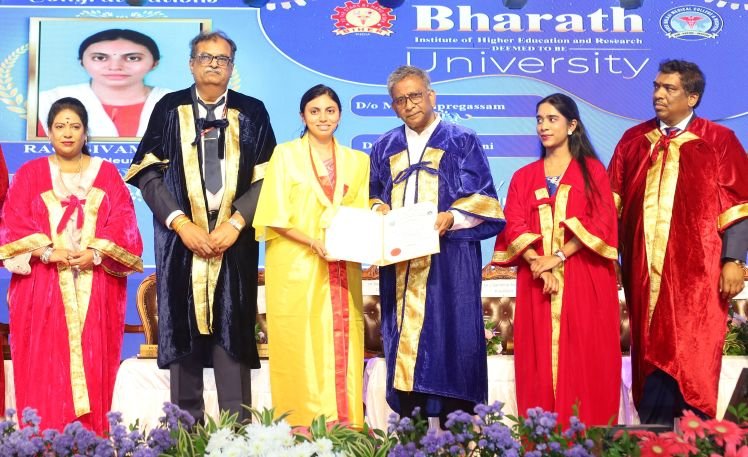
Chennai-based Bharath Institute of Higher Education and Research (BIHER), a Deemed-to-be University also known as Bharath University, held its 44th Convocation for the Academic Year 2025–2026, conferring degrees on a total of 5,278 students on Nov 2. The graduates included 148 Ph.D. scholars, 667 postgraduate students, and 4,463 undergraduate students, representing a wide range of disciplines, including engineering, medicine, dentistry, pharmacy, nursing, physiotherapy, agriculture, science, technology, law, humanities, and management.
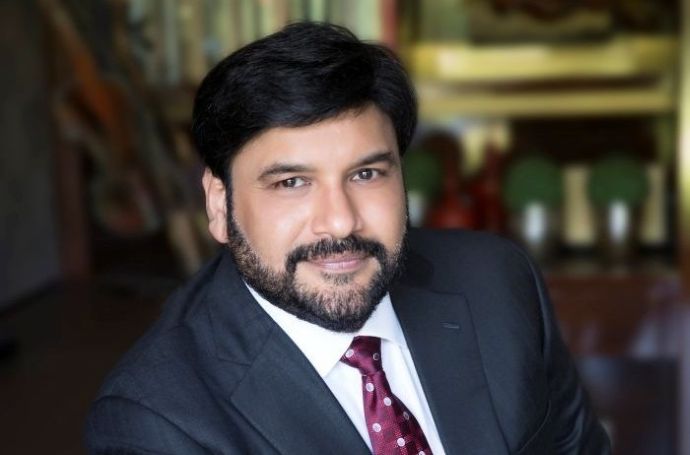
Dr. Abhijat Chandrakant Sheth, Chairman, National Medical Commission, Government of India, delivered the Convocation Address in the presence of Dr. S. Jagathrakshakan, Founder Chairman; Prof. Dr. Mohamed Rela, Chancellor; and Dr. J. Sri Nisha, Pro-Chancellor. Mr. N. Elamaran, Managing Director, Sree Balaji Group of Institutions; Dr. J. Sundeep Aanand, President; and Dr. Swetha Sundeep Aanand, Managing Director, Bharath Group of Institutions, were among the other dignitaries who attended the event.
Also present at the convocation were Prof. Dr. M. Sundararajan, Vice-Chancellor; Dr. S. Suresh Kumar, Pro-Chancellor (Research); Ms. J. L. Sri Rakshika, Chairperson, Bharath Group of Institutions; Ms. E. Shri Ritthvika, Chairperson, Sree Balaji Group of Institutions; Dr. R. M. Suresh and Dr. R. Hariprakash, Pro-Vice-Chancellors; Dr. S. Bhuminathan, Registrar; Dr. M. Sundararaj, Dean (Academics); Dr. P. Sasikumar, Dean, Sree Balaji Medical College and Hospital (SBMCH), Chennai; Dr. G. Jayalakshmi, Dean, Sri Lakshmi Narayana Institute of Medical Sciences (SLIMS), Puducherry; and Dr. G. R. Rajashree, Dean, Bharath Medical College and Hospital (BMCH), Chennai.
Delivering the Convocation Address, Dr. Abhijat Chandrakant Sheth, Chairman, National Medical Commission, Government of India, urged the students to never stop listening, because listening is fundamental to effective medical practice. “Never surrender your insights and clinical judgement to technology or tools; it is human insight, clinical judgement, and professional capability that ultimately make a difference. Never lose sight of humanity, as compassion and concern for fellow human beings must remain at the heart of healthcare. Finally, strive to become a generation of competent and capable doctors, equipped to meet emerging challenges, embrace innovation, and remain lifelong learners,” he said.
He emphasised that medical education must evolve continuously to keep pace with the changing healthcare needs of society, and technology. “Medicine has undergone a remarkable transformation, moving beyond conventional physical medicine to embrace artificial intelligence, precision medicine, digital healthcare, data-driven research, and robotics. Many of these developments would have been difficult to imagine just a few years ago,” he pointed out.
In his comments, Dr. S. Bhuminathan, Registrar, BIHER, said, “Our researchers have published 12,802 papers indexed in Scopus and 5,463 papers indexed in Web of Science. In 2025-26 alone, the university received ₹16 crore in research funding from government and non-government agencies. Our collaborations with national and international institutions, supported by 431 MoUs, continue to expand opportunities for research, academic exchange, and innovation.”