
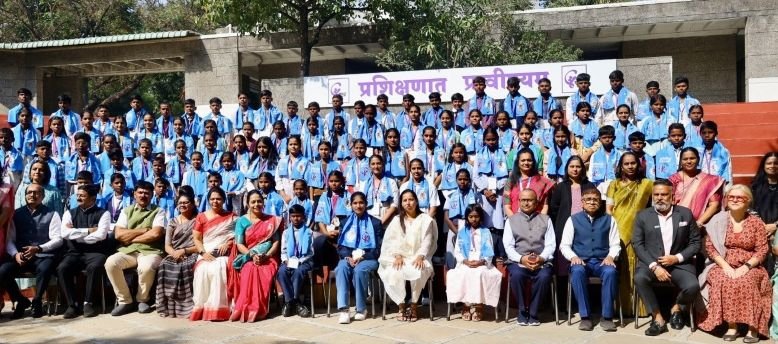
More than 100 children from across Maharashtra turned the spotlight on issues affecting their lives and communities at Maharashtra Bal Sansad 2026, held at YASHADA, Pune, on World Children’s Day (Nov 20). The Sansad 2026 was organised by the Maharashtra State Commission for Protection of Child Rights (MSCPCR), YASHADA and UNICEF Maharashtra, with the Rural Development Department, Government of Maharashtra.
Representing 102 Child-Friendly Gram Panchayats across 34 Zilla Parishad and, students from Classes 4 to 10 participated in a spirited parliamentary session, raising questions on education, water scarcity, child labour, child marriage, school infrastructure, health, safety and child protection. They also put forward their ideas and aspirations for Viksit Maharashtra 2047.
The Bal Sansad gave children an opportunity to experience democratic processes first-hand. Taking on the roles of Chief Minister, Speaker, Leader of the Opposition and ministers, they raised questions, sought explanations and pressed for responses to concerns from their communities.
The exchanges were candid. When answers did not satisfy them, children asked follow-up questions. At one point, a student reminded a respondent to“look at me and speak”, while another warned that elected representatives would be held accountable if commitments made to their constituencies were not fulfilled.
Children from Marathwada spoke about recurring water scarcity, challenges faced by farming families and the impact of drought on education. They called for measures including fee support for children from drought-affected families and hostel facilities for children from sugarcane-cutter families.
Children from Nanded highlighted how poverty can push children into labour and out of education, while participants also questioned the availability of government schools and affordable junior college education.
Children from Dhule raised the issue of safe drinking water in schools. Participants from Chhatrapati Sambhajinagar highlighted dilapidated school buildings and inadequate playgrounds. Those from Gondia drew attention to poor road connectivity in tribal areas and concerns about wildlife encounters affecting children’s journeys to school.
Together, the questions illustrated how challenges facing children vary across Maharashtra, and why children’s experiences and perspectives need to be heard when solutions are designed.
Responding to questions on child marriage and child labour, Minister Aditi Tatkare, who was the Chief Guest of the programme, spoke about government initiatives to address these issues, including enforcement of existing laws, Balika Panchayats and community awareness efforts.
She said UNICEF and the Women and Child Development Department had worked together to prevent 2,700 child marriages and encouraged children to speak up and seek support when they became aware of a child marriage.
On child labour and children living and working on the streets, Minister referred to monitoring efforts by the Maharashtra State Commission for Protection of Child Rights (MSCPCR) and the Phirate Pathak initiative. She said the initiative had identified 10,000 children, of whom 3,000 had subsequently been re-enrolled in schools.
Responding to concerns about violence against children, Minister highlighted mechanisms including Child Helpline 1098, Child Welfare Committees and departmental child-protection functionaries. She said concerns raised during the Bal Sansad would be taken up with the relevant departments and Hon Chief Minister Govt. of Maharashtra.
Describing the interaction as an opportunity for government to learn directly from children, Ms Aditi Tatkare said “We have seen youth parliaments, but today’s children have demonstrated a remarkable understanding of their roles and responsibilities. Their questions have made us look at issues from their perspective.”
Sanjay Singh, Chief of UNICEF Maharashtra, described the Bal Sansad as an important platform for children to exercise their right to participation.
“Investing in children is investing in the future of the country. Every child has the right to survive and develop to their full potential, to be protected, and to express their views on matters that affect them. The Children’s Charter presented today captures issues and aspirations directly articulated by children. We hope these voices continue from the Bal Sansad into the institutions and decisions that shape their lives.”
The Children’s Charter emerging from the initiative is particularly significant. In his message to the Bal Sansad, Chief Minister Devendra Fadnavis highlighted the value of introducing students to democratic processes and expressed confidence that the Charter could help guide future decisions and policies concerning children.
Sanjay Puranik, Chairperson, Maharashtra State Commission for Protection of Child Rights (MSCPCR), said: “Every child has the right to be heard and to participate in decisions that affect their future. Maharashtra Bal Sansad gave children an opportunity to exercise this right and bring the concerns of their communities before policymakers.”