
The Central Board of Secondary Education (CBSE) is urging its 29000 plus affiliated schools to become aware of the ongoing and impending systemic reforms and their processes in the wake of the NEP 2020 implementation in the country’s school system. In particular the board wants the schools to take serious note of recent circulars regarding NCF Foundational Stage implementation, Lab provision including dedicated lab for secondary classes, Digital infrastructure to mainstream the digital architecture, Rules for special needs children, School Quality Assessment and Assurance (SQAA) and fresh affiliations.
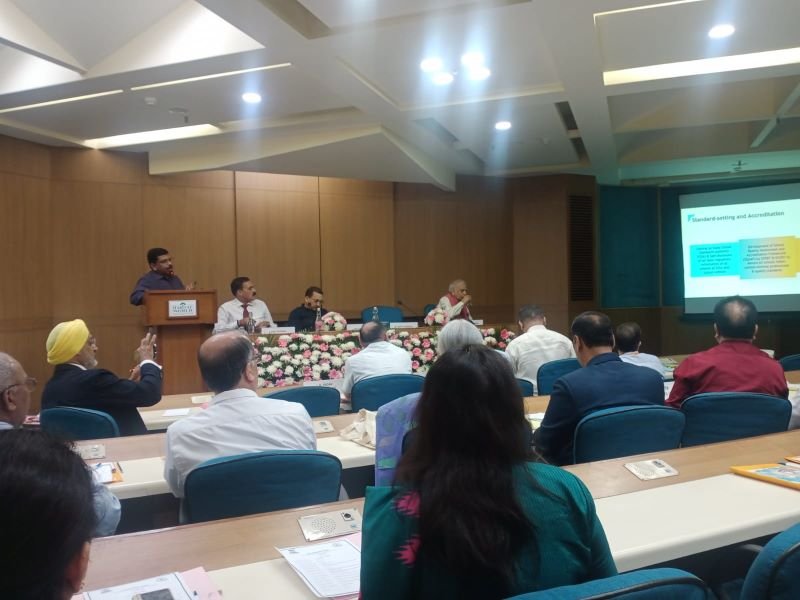
Speaking at the IPSC Workshop on NEP titled, ‘The implementation of NEP in IPSC member schools’, CBSE secretary, Anurag Tripathi, illustrated the CBSE roadmap to transform school system as per NEP mandate and recommendations. Indian Public Schools’ Conference (IPSC, esb 1939) is the association od residential schools in India and has 79 member schools spread across the country. Tripathi said the clear goal of the policy is to shift from understanding and knowledge-based schooling to competencies and skill-based schooling and that too with a view of changing the culture to learning for life. “The difference between best school systems across the world and us has been we become status quoists and therefore oblivious to the needs of change. Our experiments in labs in schools for decades remain same; we can’t list even a page of innovations. We still educate through distribution of notes and content for understanding and remembering by students just like robots. No doubt, all this translates into poor rating of our graduates,” he added. Speaking from his own experience, he said that bulk of school leaders, teachers and other stakeholders, in the past didn’t read through important national documents like National Education Policy, NCF 2005, etc., and as such these fine documents have remained out of pedagogical narrative and a role in transformation of school education.

Tripathi said now is the opportunity before India’s schools to undertake flight of becoming better places for 21st century classrooms as the NEP reforms are very much defined and it is up to schools themselves to become part of the process.
Dr Joseph Emmanuel, Director Academics, CBSE, who made a detailed presentation about various initiatives undertaken by CBSE to lead this transformation process, said CBSE is aware of the challenges for schools and is making online resources available to them in its ongoing mission of bringing a cultural change in schooling in its schools catering to over two crore children through 15 lakh teachers. Dr Emmanuel took the opportunity to dwell on reasons behind India’s poor performance in PISA of 2009. “We made our student to understand and remember so that they can crack exams but didn’t make them understand how they can apply this knowledge, create and grow. The gap in conceptual understanding through lack of application in real life scenario cost us,” he said while adding that by 2026 CBSE question papers will be 100% competency based. With a gradual increase from past a few years coming to 40-50% at present.
Director Academics said that assessment and classroom practices/priorities have developed a kind of direction relationship to evolve into marks culture and now the same route has to make this equation become harbinger of a new culture. He talked about Structured Assessment for Analyzing Learning (SAFAL) and Holistic Progress Card (HPC) initiatives that will help student and parent to realize thier potential, aptitude and interests. “My hope is people will start accepting these changes and through this a new culture will emerge to make schools better for children,” he added. He went on to emphasize that the changes coming are all compassing from curriculum to Teaching/learning, assessment, capacity building, systemic reforms.
Dr Emmanuel revealed that CBSE in coming years will go completely digital as a descriptive component is being added to online assessments and with most processes moving to digital, schools need to augment their IT infrastructure. He urged teachers to improve thinking and use CBSE’s resources and interactive courses to evolve in this process. He also referred to CBSE launching its own TV channel under PM eVidya scheme to reach the unreached.
Director Academics dismissed the fears about the impact of AI like ChatGPT on schooling and education saying that it will be enabler and in future it is creativity that will dominate over everything and as such like any technology it can be put to good and bad use.

The workshop was also addressed by Dr Manoj Srivastav, Director, Special Exams, Dr Ram Shankar, Director Training and J K Yadav, Director, CTET. Earlier Anil Sharma, Secretary, IPSC & Principal, Birla Vidya Mandir, Nainital, talking about the ideation this workshop with CBSE team said that a number of parents, schools and teachers from their member schools had raised several questions with regard to NEP reforms in conversations with him, so he approached CBSE for clarification and in this conversation, CBSE top brass was gracious enough to bring the whole team of directors to this workshop. “I am thankful to secretary CBSE for spending his valuable time with us today,” he said.
Speaking on the occasion, Pramod Sharma, Vice President, Genesis Global School and President of IPSC Trust said, “The NEP policy is a visionary step towards ensuring accessibility of quality education to all and heavily focuses on inclusive model of education. We at GGS believe that its implementation will re-strengthen our already existing education system. India is riding on a wave of growth and development and there is no doubt that we are heading toward a very bright future. But in order to capitalize on it, we will have to raise our education standards. We are hopeful that this workshop will help in clearing the doubts regarding the implementation of NEP in IPSC member schools”.
CBSE secretary, Anurag Tripathi, also answered a range of questions from the participants ranging from doubts on age for class 1 to syllabus rationalization, NEET/CUET questions coming beyond class 12 syllabus, allegations of liberal markings and results of this year’s board exams. He said the evaluation process is moving as per plan and CBSE is hoping to declare results by the end of May as per schedule as this a normal year post-covid.