
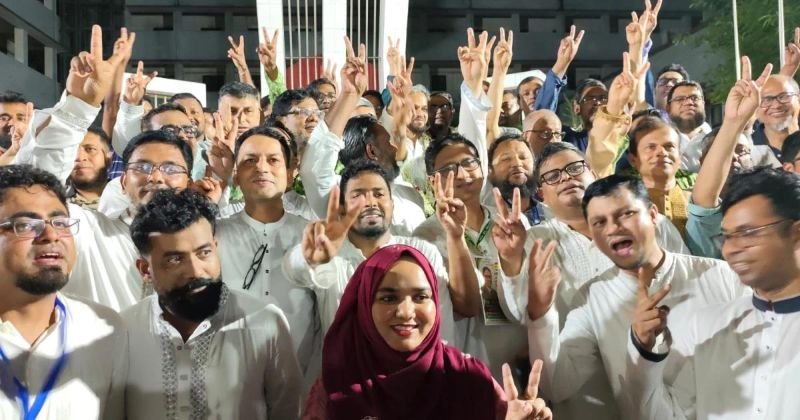
After an eight-year hiatus, electoral democracy returned to the Aligarh Muslim University (AMU) campus on November 5, with students voting to elect their representatives to the Aligarh Muslim University Students’ Union (AMUSU) for the 2026–27 academic session. The elections, whose results were declared on November 6, witnessed an important milestone in the university’s student politics, with Nashra Naim becoming the first woman to be elected Vice-President of the Students’ Union in its 105-year history. These elections have achieved two important outcomes: the revival of an elected student body after years of agitation and a historic breakthrough in women’s representation.
Women candidates secured six of the 13 elected positions, including five of the ten cabinet member seats, signalling a significant expansion of women’s representation in the university’s student leadership. The election also saw two women elected as faculty representatives to the AMU Court, the university’s highest governing body.
Mohammad Noman Ashraf was elected President, securing 7,797 votes and defeating Mohammad Intkhab, who received 3,676 votes, by a margin of 4,121. Nashra Naim, a fourth-year BA LLB student, polled 7,091 votes to defeat her nearest rival, Saqib Ali Khan, who received 5,818 votes. Mohammad Hamdan was elected Honorary Secretary with 8,385 votes.
The university-wide polling recorded a turnout of 74.65%, while the Women’s College Students’ Union registered 62.05%. Around 25,000 students were reported eligible to participate in the elections, which were conducted through ballot papers across the university’s faculties.
The return of the Students’ Union was preceded by weeks of student agitation. The university had not held union elections since 2018, when the last elected body served during the 2018–19 academic session.
Students had been demanding restoration of the union for several years, arguing that the absence of an elected representative body had deprived them of an institutional platform to raise academic, administrative and campus-related concerns.
The agitation intensified on September 21, 2026, with students demanding a definite election date and the removal of the then Proctor, Professor Mohammad Naveed Khan. Student leader Yasir Fahad undertook an indefinite hunger strike that continued for 19 days, while demonstrations and protests were organised at Duck Point, which students began referring to as their ‘Mini Jantar Mantar’.
Following negotiations between student representatives and Vice-Chancellor Professor Naima Khatoon, the university administration agreed to hold elections. On October 9, the university formally announced November 5 as the polling date. It also replaced Professor Mohammad Naveed Khan with Professor Mohammad Nafees Ahmad Ansari of the Department of Political Science as the new Proctor.
The election schedule was subsequently issued under Clause 15 of the university’s amended 2019 regulations governing Students’ Union elections.
The election campaign involved nine candidates for President, seven for Vice-President and three for Honorary Secretary, besides 46 candidates eligible to contest the ten cabinet positions. Elections were also held for student representatives to the AMU Court.
While campus-specific concerns remained central to the contest, reports from the university indicated that the campaign also touched upon wider national issues, including questions concerning the Muslim community. A senior faculty member, quoted anonymously in a PTI report, observed that the political discourse had expanded beyond the traditional campus agenda.
Unlike elections involving formal political party panels, the contest largely revolved around individual candidates and student groups.
The university administration described the peaceful conduct of the elections as a reflection of AMU’s democratic traditions. Vice-Chancellor Professor Naima Khatoon congratulated the newly elected representatives and welcomed the increased participation of women. University officials reported no incidents of violence during the campaign.
A milestone for women’s representation
Naim’s election is particularly significant in an institution where women had previously participated in student politics but had never occupied one of the three principal AMUSU positions—President, Vice-President or Honorary Secretary.
Her victory was accompanied by the election of five women to the ten-member cabinet. The successful candidates included Hania Khan (8,266 votes), Areeba Dilshad (7,091), Shazia Shamim (6,332), Anika Rumman Rahi (4,498) and Shaheen Parween (4,098).
Two women, Amina Faizan from the Faculty of Unani Medicine and Ilma Mashroof from the Faculty of Commerce, were also elected as representatives to the AMU Court.
Separately, the Women’s College Students’ Union elected Anam Riyaz as President, Ayesha Khan as Vice-President and Maryam Jan as Honorary Secretary. Eight students were also elected to its cabinet, with Juveriya Rehman topping the list with 1,485 votes.
The participation of women was also visible in the contest for the AMUSU President’s post, where research scholar Amina Irshad was the lone woman among nine candidates. Although she did not win, her candidature marked another step towards greater women’s participation in campus electoral politics.
The restoration of the Students’ Union is significant beyond the election of a new set of office-bearers. For a university with a long tradition of student participation in public and political life, the absence of an elected union for eight years had left a substantial gap in institutional student representation.
The new office-bearers will now be expected to provide an organised platform for addressing students’ concerns, including hostel facilities, academic issues, campus infrastructure and student welfare, while maintaining constructive engagement with the university administration.