
Student teams from across India launched 43 CanSats and 18 model rockets at two national student space competitions organised by IN-SPACe from October 31 to November 3, 2026, in Kushinagar, Uttar Pradesh.
The competitions—the 3rd CAN-7USAT India Student Competition and the 2nd National Model Rocketry India Student Competition, also known as the IN-SPACe Narayani Rocketry Cup 2026—brought together 76 teams to design, build and test their own hardware. Their projects were evaluated by expert committees comprising representatives from the Indian Space Research Organisation (ISRO), the Defence Research and Development Organisation (DRDO), IN-SPACe, industry and academia.
Dr. M.G.R. Educational and Research Institute, Chennai, emerged as the winner of the 3rd CAN-7USAT India Student Competition, followed by C.V. Raman Global University, Bhubaneswar, in second place and BMS College of Engineering, Bengaluru, in third. Central University of Jammu received the Best Team Award, while BITS Pilani – Hyderabad Campus won the Best Design Award.
In the 2nd National Model Rocketry India Student Competition, the IN-SPACe Narayani Rocketry Cup 2026, Nirma University, Ahmedabad, secured first place, followed by Karunya Institute of Technology and Sciences, Coimbatore, and Delhi Technological University, Delhi. Dwarkadas J. Sanghvi College of Engineering, Mumbai, won the Best Team Award, while Pimpri Chinchwad College of Engineering, Pune, received the Best Design Award.
Dr. Pawan Goenka, Chairman, IN-SPACe, said, “Every CanSat and rocket that flew this week was designed, built and tested by students, and that hands-on experience is exactly what India’s space industry needs from its next generation of engineers. As private companies take on a larger role in India’s space programme, the demand for people who have built and flown real hardware will only grow. Holding these competitions in Kushinagar also shows that talent for the space sector exists well beyond our metros, and IN-SPACe will keep creating opportunities for it to be discovered.”
Addressing the gathering, Shri Shashank Mani Tripathi said, “We aspire to establish a permanent space experimentation centre in the region, enabling young people to participate in rocketry and other scientific activities throughout the year. India’s youth must translate their knowledge into innovation, entrepreneurship and nation-building.”
The student-built CanSats were designed around a 7U satellite bus format, enabling teams to accommodate payloads and Guidance, Navigation and Control (GNC) systems. Equipped with sensors, the CanSats recorded parameters such as temperature and atmospheric pressure during flight. Some teams also incorporated cameras to capture images and videos of the terrain and designated landing zones, while exploring applications such as vegetation monitoring.
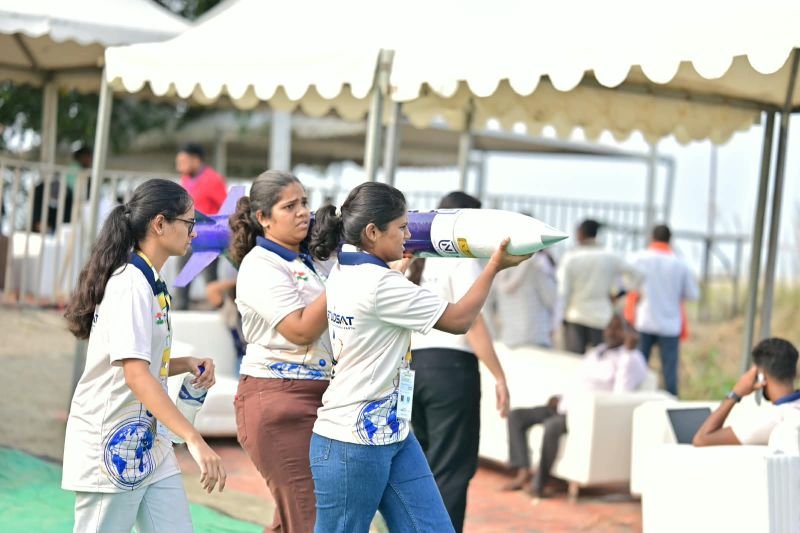
In the model rocketry competition, 18 student-built rockets were launched. Teams were evaluated on the design, development and testing of their rockets, with emphasis on innovation, precision and system performance.
Dr. Vinod Kumar, Director, Promotion Directorate, IN-SPACe, said, “The dedication and year-long efforts of the students have resulted in a successful edition, with 43 CanSat launches and 18 model rocket flights, surpassing last year’s figures of 24 CanSats and 13 rockets. These competitions provide valuable opportunities for students to test their capabilities, learn through practical experience and contribute to India’s growing space ecosystem.”