
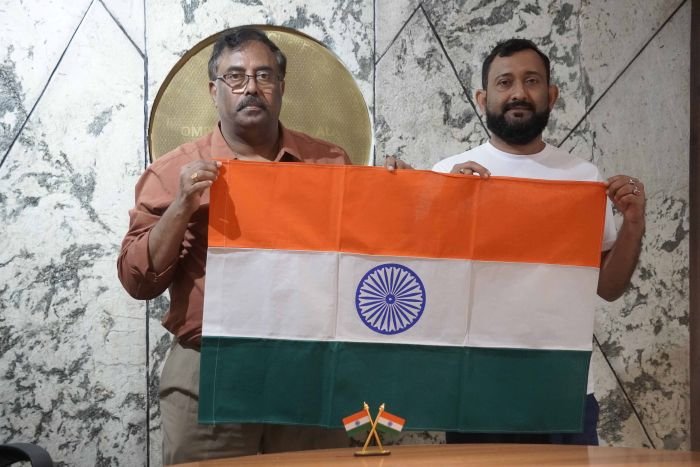
PR CommUNITY, a platform of public relations and corporate communications professionals, invited Sarkar to Hyderabad as part of an awareness initiative carrying the message: “Celebration Ends. Respect Continues.”
As part of the initiative, representatives of PR CommUNITY and Sarkar plan to visit schools to engage with students and create awareness about the correct display, handling and respectful disposal of the National Flag. The objective is to make respect for the Tricolour a habit rather than a once-a-year sentiment. Organisers said the programme is only the beginning of a larger and sustained public-awareness campaign.
A childhood experience that became a lifelong mission
Sarkar, 39, is a contract employee with the Government of West Bengal’s Irrigation and Water Works Directorate and a resident of Bally, Howrah. For the past 14 years, he has collected abandoned, discarded and damaged National Flags and ensured that they are treated with dignity and respect.
His unusual and deeply personal mission has brought him widespread recognition. His story was featured in National Geographic India’s Independence Day special documentary Tiranga. He has also previously been nominated for the Padma Shri.
Sarkar’s journey began during his childhood when he saw his mother pick up a National Flag that had been discarded among a pile of rags. When he asked her why she had done so, she told him that the Tricolour represents the soil of the country and deserves the same respect as one’s own mother. Those words stayed with him.
What began as a personal response to seeing discarded flags has evolved into a 14-year mission to collect National Flags abandoned after public celebrations and create greater awareness about respecting the Tricolour even after its ceremonial use is over.
Over the years, Sarkar says he has collected around one lakh discarded Tricolours, many of them found on roadsides, in drains and other places following Independence Day and Republic Day celebrations.
Some of the flags have been soiled or severely damaged. “I have had to discard many since they were picked from sewage lines. I usually bury such pieces together as they emanate a strong stench when kept at home,” he has said.
His work is now supported by around 50 volunteers, popularly known as “Maa er Prerona”, who assist him in collecting discarded flags and spreading awareness.
Patriotism does not end when the flag is lowered
Sarkar believes patriotism should not be confined to Independence Day and Republic Day celebrations.
“People can show respect to their motherland by picking up even one discarded Tricolour. They do not have to collect thousands,” is the message he seeks to convey.
He has also appealed to citizens to avoid the indiscriminate use of plastic National Flags, which can become waste once celebrations are over.
According to Philip Joshua, Dr Ankit Bhatnagar and D. Ramchandram, the group has reached out to several individuals and organisations associated with promoting respect for the National Flag, including Naveen Jindal, the Flag Foundation of India, defence personnel, Sarkar and others.
The initiative seeks to bring together knowledgeable individuals and experts for a day-long public-awareness workshop on the National Flag, covering its history, significance, proper display, respectful handling and dignified disposal.
“We intend to continue this public-awareness effort for at least the next two to three years. Our objective is to gradually build greater awareness and encourage citizens, schools, institutions, organisations and communities to understand not only the pride of flying the Tiranga, but also the responsibility of respecting it,” the organisers said.
The group is now planning a full-day public-awareness workshop around Republic Day, bringing together experts, defence personnel, educators, institutions and others associated with the subject.
The proposed programme is expected to cover:
- The history and significance of the Indian National Flag
- The Flag Code of India
- Proper display and hoisting
- Important dos and don’ts
- Respectful handling of the Tiranga
- Awareness among children and young citizens
- Frequently asked questions
- Care, collection and dignified disposal of flags after celebrations
To reinforce the message, the organisers displayed placards carrying simple but powerful messages such as “Don’t throw the Tiranga on the ground” and “Follow the Flag Code of India and Ministry of Home Affairs guidance.”
What the Flag Code says
The Ministry of Home Affairs states that the display, use and hoisting of the National Flag are governed by the Flag Code of India, 2002 and the Prevention of Insults to National Honour Act, 1971.
Among the key provisions and official guidance are:
Who can display the National Flag?
A member of the public, private organisation or educational institution may hoist or display the National Flag on all days and occasions, ceremonial or otherwise, provided its dignity and honour are maintained.
Can the Tiranga be flown at night?
Yes. When displayed in the open or on the house of a member of the public, the National Flag may be flown day and night.
What is the correct proportion?
The National Flag is rectangular, with a length-to-height ratio of 3:2.
What materials may be used?
The Flag may be made of hand-spun and hand-woven or machine-made cotton, polyester, wool, silk or khadi bunting.
Can a damaged Flag be displayed?
No. A damaged or dishevelled National Flag should not be displayed.
Where should the Tiranga be placed?
Whenever displayed, the National Flag should occupy the position of honour and be distinctly placed.
Can another flag be placed above the Tiranga?
No. No other flag or bunting should be placed higher than or above the National Flag.
Can the Tiranga touch the ground?
No. The National Flag should not be allowed to touch the ground or floor or trail in water.
Can the Tiranga be used as decoration?
No. It should not be used as a festoon, rosette, bunting or for decoration.
Can I write a slogan or message on the Flag?
No. There should be no lettering on the National Flag.
Can the Tiranga be used on clothing?
The Flag should not be used as a portion of costume, uniform or accessory worn below the waist, nor should it be embroidered or printed on cushions, handkerchiefs, napkins, undergarments or dress material.
Can I display the Tiranga on my car?
The privilege of displaying the National Flag on motor cars is restricted to the dignitaries specified under the Flag Code.
How should a damaged Flag be disposed of?
A damaged National Flag should be destroyed as a whole in private, preferably by burning or by another method consistent with its dignity.
What about small paper flags used by the public?
They should not be discarded on the ground. They should be disposed of privately, keeping in mind the dignity of the National Flag.
Dos and don’ts for the Tiranga
Do:
- Display the National Flag with dignity and honour.
- Give it the position of honour.
- Ensure that it is clean and in good condition.
- Follow the Flag Code of India, 2002.
- Collect discarded paper flags after celebrations.
- Dispose of damaged flags privately and respectfully.
Don’t:
- Allow the Flag to touch the ground or floor.
- Allow it to trail in water.
- Display a damaged or dishevelled Flag.
- Use it as decoration, bunting or a festoon.
- Write letters, slogans or messages on it.
- Place another flag above or higher than it.
- Use it to cover a speaker’s desk or platform.
- Use it as clothing below the waist.
- Use it to wrap, receive or deliver things.
- Use it to cover a vehicle.
The message from the “Flag Man” and the Hyderabad initiative is simple: patriotism does not end when the celebrations do. The responsibility to respect the Tiranga continues.