
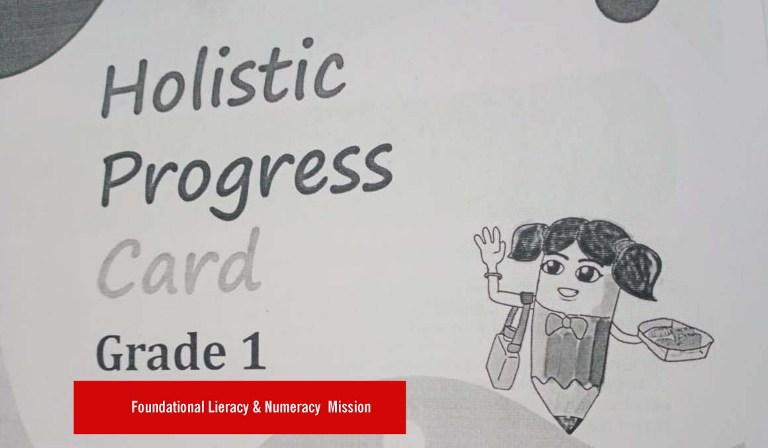
The much awaited Holistic Progress Card (HPC) for foundational school grades (till class III) under NIPUN Bharat is being put to test as it pilots in 72 schools this July
The Holistic Progress Card (HPC), the assessment component of the mission on Foundational Literacy and Numeracy (FLN) under the National Initiative for Proficiency in Reading with Understanding and Numeracy (NIPUN BHARAT) is ready and will be piloted in 72 schools across the country from July this year. The pilot programme is expected to validate the design and provide feedback from hands on experience of using HPC for further fine tuning before it is launched nationwide later this year. The sample of the schools has been chosen from government as well private schools affiliated to CBSE.
NIPUN Bharat Mission launched in August 2021 was the first major announcement under the National Education Policy (NEP) 2020, which has set the target of universal foundational literacy and numeracy in primary schools by 2026-27. The policy says: “Our highest priority must be to achieve universal foundational literacy and numeracy in primary schools by 2026-27. The rest of this Policy will be largely irrelevant for such a large portion of our students if this most basic learning (i.e., reading, writing, and arithmetic at the foundational level) is not first achieved.”
Broadly, NIPUN Bharat envisages that every child achieves the desired learning competencies in reading, writing and numeracy at the end of Grade III and develops phonological awareness and sound discrimination, visual perception, and visual association to make them better reader and writers. Tracking the progress of every child in achieving learning outcomes is an important component in this process and will be done through HPCs. HPC is part of Samagra Shiksha Scheme.
As part of transforming assessment of student development, NEP recommends preparation of Holistic Progress Card to provide 360 degree multidimensional report of progress that reflects in detail the progress as well as the uniqueness of each learner in the cognitive, affective, socio-emotional and psychomotor domains.
As per the HPC that has been prepared by the mission in which NCERT and CBSE along with KVS is playing a major role, there are three levels of attainment—the beginner, progressive and proficient. The levels correspond to requiring a great deal of support and handholding in case of beginner. Needs some support and handholding for progressive and in proficient the child has met the target without any support. This card will include child’s own expression of self as well as the teacher’s assessment of the child on the mentioned standards. Peer reflection on the basis of some tasks of activity based or experiential learning and a section of parental feedback is also part of this HPC.
Learning outcomes are to be recorded on parameters of prosocial behaviour, health and hygiene, motor skills, first language skills, second language skills, sensory development, environmental awareness, sequence and concept formation, numeracy, financial literacy and technology skills. The children have to fill up a feedback sheet on activity and his or her difficulty perception.
So, is this the discarded Continuous and Comprehensive Evaluation (CCE) in a new avatar? Educators who are engaged in capacity building for this roll out don’t think so. “It is a radical reform where child is at the centre of teaching learning process. It focuses on assessment for and as learning. HPC is a pedagogical tool which will facilitate teachers to attain highest potentiality in children by mapping competencies and learning outcomes with developmental goals of health and wellbeing, effective communicator and as an involved learner,” says Dr Sudha Acharya, principal of ITL Public School Dwarka and president National Progressive Schools Conference having 195 member schools. Her school is one of the pilot program schools.
While FLN under the NEP 2020 is applicable to first five years under the 5+3+3+4 new school structure, almost all government schools begin from class 1. Pre-primary a component in the new system is being integrated by way of improving angawadi centres or shifting them to schools. As an interim measure to deal with the situation, NCERT has prepared a three-month learning module for those children who are entering schools without attending preschooling. With budget private schools accounting for 80% of schools in the country and most offering kindergarten, the implication of the impending change is likely to be huge mostly in terms of teacher capacity.
“Our kind of schools will need incentives in the form of handholding, necessary training and other resources and hopefully a support ecosystem will be provided by the governments,” says Dr Lakshya Chhabaria, President Affordable Private Schools’Association, Delhi, and director of S R Capital Public School, Naveen Shahdra.
The underlining of the FLN in the journey of education for every child has been established in government documents, now its progress on ground has just commenced.
By Autar Nehru