

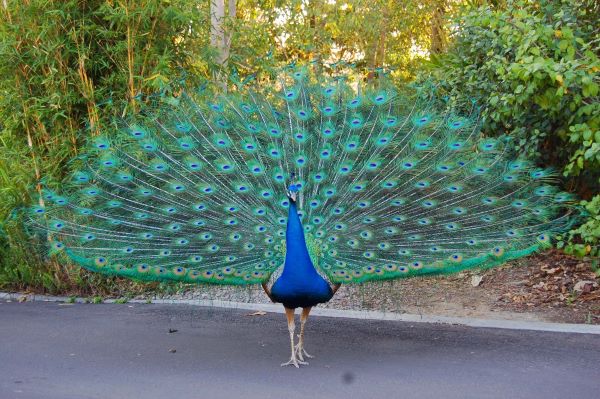
Blue Peafowl displays higher genetic adaptability, shedding light on the contrasting population sizes of Asian peafowl species
The ornate features of the peacock’s tail have always fascinated scientists and nature enthusiasts. Charles Darwin expressed bewilderment over the paradoxical grand display of the male peafowl, which made it more vulnerable to predators. Darwin resolved this puzzle with the theory of sexual selection, suggesting that such ornamental traits play a crucial role in attracting mates and enhancing reproductive success. Despite such understanding, the underlying genetic basis for these spectacular birds has always remained a mystery.
Now, Indian Institute of Science Education and Research Bhopal (IISER Bhopal) Researchers from the MetaBioSys Group have for the first time constructed a high-quality genome assembly to decipher the genetic secrets of Peacock, India’s national bird. In an earlier study, the research team had constructed the first draft assembly of this bird species to perform a comprehensive genome-wide analysis, comparing the peacock genome with those of five other bird species.
The recent findings have been published in the journal Heliyon. The paper has been co-authored by Dr. Vineet Sharma, Associate Professor, Department of Biological Sciences, and his research scholars Abhisek Chakraborty, Samuel Mondal, and Shruti Mahajan from IISER Bhopal.
IISER Bhopal team focused on the Blue Peafowl, also known as the Indian Peacock, native to the Indian subcontinent, and the Green Peafowl, found in Southeast Asia. These two species of birds were chosen because despite being the only two species from the Pavo genus, the Blue Peafowl is classified as a species of “Least Concern,” while the Green Peafowl faces endangerment due to a decline in population size. They sought to understand the evolutionary and genetic reasons for their differential adaptability that makes the Blue Peafowl less endangered than the Green.
Researchers found that genes related to nervous system development, immunity, and skeletal muscle development have undergone adaptive evolution in both bird species. However, the Blue Peafowl has more pronounced adaptive evolution, possessing a higher number of expanded gene families, segmentally duplicated genes, species-specific gene clusters, and genes with evolutionary signatures.
Dr. Vineet K. Sharma, Associate Professor, Department of Biological Sciences, IISER Bhopal, said, “Our findings highlight the distinct genomic divergence between the two Asian peafowl species and provide valuable genomic clues to explain their contrasting population sizes.”
Further, Dr. Vineet K. Sharma added, “The green peafowl population appears to be more vulnerable to the consequences of habitat loss and human exploitation for food and commercial use. These activities have had a greater impact on their numbers, as they are less tolerant to human disturbances. The reduction in their population has resulted in decreased gene flow, increased inbreeding, and lower genetic diversity, ultimately raising the risk of extinction for this species.
The study conducted by the IISER Bhopal researchers has brought us one step closer to unravelling the genetic basis for the enigmatic bird’s characteristics. The research not only deepens our appreciation for the peacock’s ornamental allure but also broadens our knowledge of evolutionary biology and the genomic underpinnings of nature’s wonders.