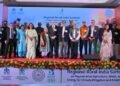

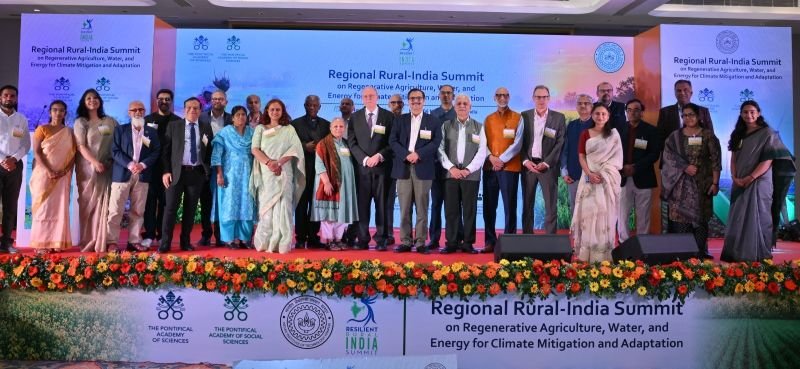
The Indian Institute of Technology Kanpur (IIT Kanpur), in partnership with the Pontifical Academy of Sciences (PAS) and the Pontifical Academy of Social Sciences (PASS), Vatican City, organised a two-day Regional Rural-India Summit on regenerative agriculture, water and energy for climate mitigation and adaptation in Lucknow on November 3–4, 2026.
Organised through IIT Kanpur’s Kotak School of Sustainability, the summit brought together scientists, policymakers, administrators and practitioners from India and abroad to explore strategies for climate resilience and sustainable rural development.
Discussions focused on regenerative agriculture, water conservation, clean energy transitions and community-led climate adaptation. Speakers highlighted the vulnerability of small and marginal farmers, who account for nearly 80% of India’s farming community, and the projected impact of climate change on agricultural productivity. Rainfed rice and wheat yields could decline by 20% and 19%, respectively, by 2050.
The summit also examined the role of district administrations, traditional knowledge and local leadership in strengthening climate resilience. Public health risks arising from extreme heat, deteriorating air quality and water stress were discussed, alongside the potential of scientific research and policy interventions to address these challenges.
Prof. Sachchida Nand Tripathi, Dean, Kotak School of Sustainability, IIT Kanpur, and Conference Chair, said addressing climate change required a coordinated approach centred on “System, Scale and Speed”, bringing together science, technology and policy. He said the summit’s joint declaration would take forward collective recommendations and commitments to strengthen climate resilience across the Global South.
The inaugural plenary was attended by Uttar Pradesh Agriculture Minister Surya Pratap Shahi, Minister of State for Horticulture Dinesh Pratap Singh, and Minister of State for Cooperation Jayendra Pratap Singh Rathore, along with IIT Kanpur Director Prof. Manindra Agrawal and Prof. Joachim von Braun, President of PAS.
Prof. von Braun emphasised the importance of scientific research, technological innovation and societal participation in translating climate knowledge into practical solutions.
A spotlight session featuring Dr. Anil Prakash Joshi, Prof. Ashok Gulati and Dr. Rajendra Singh highlighted the need to restore soil health, strengthen rainwater harvesting and groundwater recharge, and promote sustainable farming practices.
The summit also featured discussions on community-led initiatives, climate-induced migration and youth participation in adaptation. A youth-led consultation focused on Uttar Pradesh’s challenges, including water scarcity, heat stress, soil health and digital agricultural extension.
Grassroots initiatives highlighted at the event included regenerative farming programmes reaching more than 8,000 farmers across 5,000 acres, and data-driven irrigation solutions that have helped conserve approximately 13 million litres of groundwater across 150 farms.