
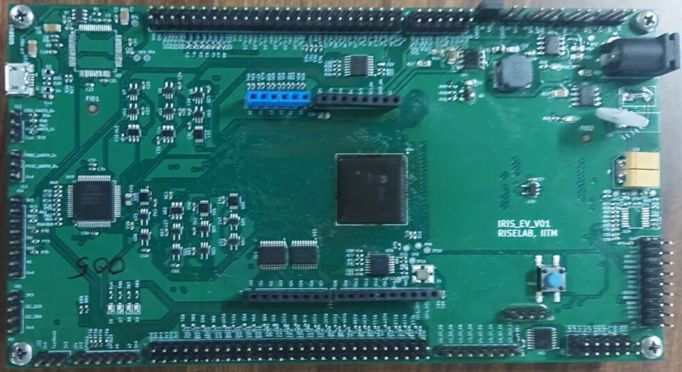
A joint effort with ISRO Inertial Systems Unit, Thiruvananthapuram, the chip was manufactured at Semiconductor Laboratory Chandigarh & packaged at Tata Advanced Systems, Karnataka, showcasing a major step towards ‘Atmanirbhar Bharat’ in addressing computing needs for Space and other sectors
Indian Institute of Technology Madras (IIT Madras) and ISRO have led the way in developing and successfully booting an Atmanirbhar aerospace quality SHAKTI-based Semiconductor Chip.
The SHAKTI microprocessor project is led by Prof. V. Kamakoti at Prathap Subrahmanyam Centre for Digital Intelligence and Secure Hardware Architecture (PSCDISHA) in Department of Computer Science and Engineering, IIT Madras.
The SHAKTI class of systems are based on RISC-V, an open-source Instruction Set Architecture (ISA), for designing custom processors. ‘SHAKTI’ is backed by Ministry of Electronics and Information Technology, Government of India, under its ‘Digital India RISC-V’ initiative (DIRV). It aims to promote indigenous development of microprocessor based products that offer best-in-class security and visibility for users adopting RISC-V technology.
The ‘IRIS’ (Indigenous RISCV Controller for Space Applications) Chip was developed from ‘SHAKTI’ processor baseline. It can be used in diverse domains from IoT and compute systems for strategic needs. This development was part of the effort to indigenize semiconductors used by ISRO for its applications, Command and Control Systems and other critical functions aligning with its march towards ‘Atmanirbhar Bharat’ in Space Technologies.
The ISRO Inertial Systems Unit (IISU) in Thiruvananthapuram proposed the idea of a 64bit RISC-V-based Controller and collaborated with IIT Madras in defining the specifications and designing of the semiconductor chip.
The chip configuration was arrived at addressing the common functional and computing requirements of existing sensors and systems used in ISRO missions. Fault-tolerant internal memories were interfaced to SHAKTI core, enhancing the reliability of the design.
Custom functional and peripheral interface modules being used in multiple space systems like CORDIC, WATCHDOG Timers and advanced serial buses were integrated. Provisions for expandability to future missions also implemented through multiple boot modes and hybrid memory/device extension interfaces. The finalised design underwent software and hardware testing, targeting a high-reliability, high-performance product.
What makes this semiconductor effort important for the Nation is that it was done completely in India and is a great example of ‘Atmanirbhar Bharat’ – conceived by IISU Thiruvananthapuram, designed and implemented by IIT Madras, manufactured by SCL, Chandigarh, packaged by Tata Advanced Systems, Ltd at Perjenahalli, Karnataka, Motherboard PCB (Printed Circuit Board) manufactured by PCB Power, Gujarat, motherboard assembled and mounted by Syrma SGS, Chennai, software developed by IIT Madras and successfully booted at IIT Madras.
Highlighting the importance of this new microprocessor, Prof. V. Kamakoti, Director, IIT Madras, said, “After RIMO in 2018 and MOUSHIK in 2020, this is the third SHAKTI chip we have fabricated at SCL Chandigarh and successfully booted at IIT Madras. That the chip design, chip fabrication, chip packaging, motherboard design and fabrication, assembly, software and boot – all happened inside India, is yet another validation that the complete semiconductor ecosystem and expertise exists within our country.”
Appreciating this joint effort Dr. V Narayanan, Chairman, ISRO, said, “We at ISRO are very happy that IRIS Controller conceived by IISU based on SHAKTI processor of IIT Madras could be successfully developed end-to-end with Indian resources. This marks truly a milestone in “Make in India” efforts in semiconductor design and fabrication. I congratulate all the teams involved, especially the IISU Team led by Sri Padmakumar ES and the IIT Madras team led by Prof. V. Kamakoti. I am sure that this high-performance controller, realized as per our requirements, will contribute significantly to future embedded controllers for space mission-related applications. It is planned to flight test a product based on this controller shortly and performance will be confirmed.”
Commenting on the third consecutive successful manufacturing of SHAKTI series of chip, Shri Kamaljeet Singh, Director General of SCL Chandigarh, stated, “SCL is proud to be associated with IIT Madras and ISRO in the successful development of IRIS-LV Processor. IRIS-LV Processor is fully indigenous and fabricated in SCL’s 180 nm technology node encompassing mask frame design, GDS preparation and testing. Post silicon design validation & extensive electrical testing on wafer-level was conducted at SCL in close collaboration with the IIT Madras team. SCL is committed and continually working in association with academia and startups to facilitate and achieve Atmanirbharta in the realization of niche products.”