
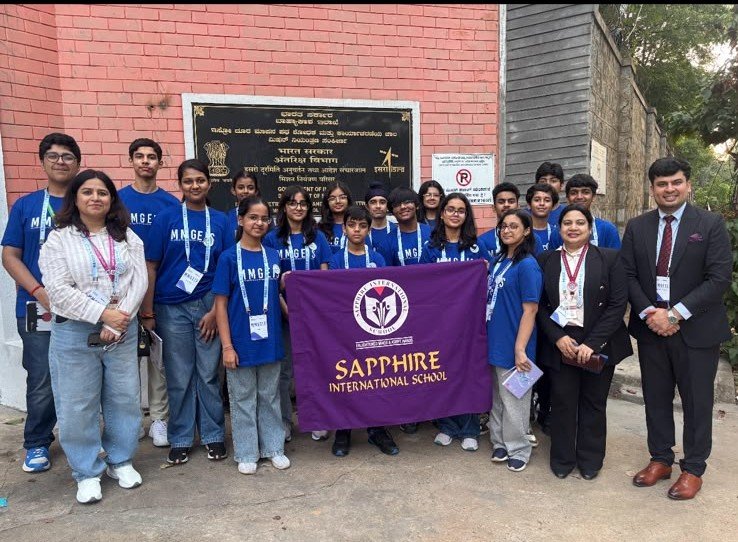
A group of 19 students from Sapphire International School, Noida, recently undertook an educational visit to the Mission Operations Complex (MOX) of the Indian Space Research Organisation’s (ISRO) Telemetry, Tracking and Command Network (ISTRAC) in Peenya, Bengaluru. The students were accompanied by Saurabh Sehgal, Director, Sapphire International School; Ekta Soni, Head of School, Crossings Republik; and class teacher Shraddha Sarkar.
Designed to take learning beyond the classroom, the visit offered students first-hand exposure to India’s space exploration ecosystem. It provided insights into how complex space missions are planned, monitored and operated, highlighting the science, technology and human ingenuity behind the country’s landmark achievements in space.
A key highlight was an interaction with A. S. Kiran Kumar, former Chairman of ISRO and former Secretary, Department of Space. He engaged with the students on India’s journey in space science and technology, the evolution of its space programme, and the opportunities ahead for young people interested in science, technology, engineering and mathematics (STEM).
The students also interacted with B. Sankar Madaswamy, Scientist/Engineer-SG and Division Head, HRLD, ISTRAC, gaining insights into the technical and operational aspects of India’s space missions.
During the visit, the group toured the Mission Control Room (MCR) and MOX-2, learning about mission operations and satellite monitoring. They also explored satellite models and the Moon Globe area, connecting classroom concepts with real-world scientific and technological applications.
The sessions introduced students to several landmark Indian space missions, including Chandrayaan-3, the Mars Orbiter Mission (MOM), NISAR and SpaDeX. The exposure helped them appreciate not only the scientific objectives of these missions but also the innovation, precision, technological capabilities and collaborative effort required to execute complex space programmes.
Commenting on the visit, Saurabh Sehgal, Director, Sapphire International School, said, “Education becomes truly transformative when learners are able to see, experience and engage with the ideas they encounter in the classroom. The visit to ISRO gave our students a rare opportunity to step into the world of mission operations and witness how science, technology and human curiosity come together to achieve extraordinary outcomes. More importantly, it encouraged them to ask questions, think beyond conventional boundaries and see STEM not simply as a subject, but as a pathway to solving some of the most complex challenges of the future.”
The visit reflected the school’s emphasis on experiential, real-world and future-ready learning, enabling students to connect academic concepts with practical applications while inspiring curiosity about space science, innovation and future careers in STEM.