
With Australia leading the world by banning nine major social media platforms — Facebook, Instagram, Snapchat, TikTok, X, YouTube, Reddit, Kick, and Threads — for children under 16, debates over restricting under-16 access are gaining global momentum. Governments are beginning to respond. New York State now requires platforms with algorithm-driven feeds, such as TikTok and Instagram, to display mental-health risk warnings for children and teens, akin to cigarette warnings. India, too, is increasingly part of this conversation, mirroring international policy efforts such as the proposed US Kids Off Social Media Act, which seeks to prohibit accounts for children under 13 and restrict algorithmic feeds for those under 17.
Two recent developments in India suggest that children’s social media use has firmly entered public discourse. The Madras High Court, while hearing a 2018 Public Interest Litigation concerning minors’ access to pornographic content, recommended that the Union Government consider legislation similar to Australia’s under-16 ban. The bench, comprising Justices G. Jayachandran and K.K. Ramakrishnan, suggested a targeted restriction on platforms such as Instagram, Facebook, and Snapchat.
At the policy level, the Uttar Pradesh Education Department issued a directive on December 23, 2025, making daily newspaper reading mandatory in all government primary and secondary schools. At least ten minutes — typically during morning assembly — must be set aside to cultivate reading habits, reduce excessive screen exposure, broaden awareness of current affairs, and strengthen vocabulary, comprehension, and critical thinking. While not a digital ban, the move reflects a conscious effort to rebalance children’s daily routines away from screens.
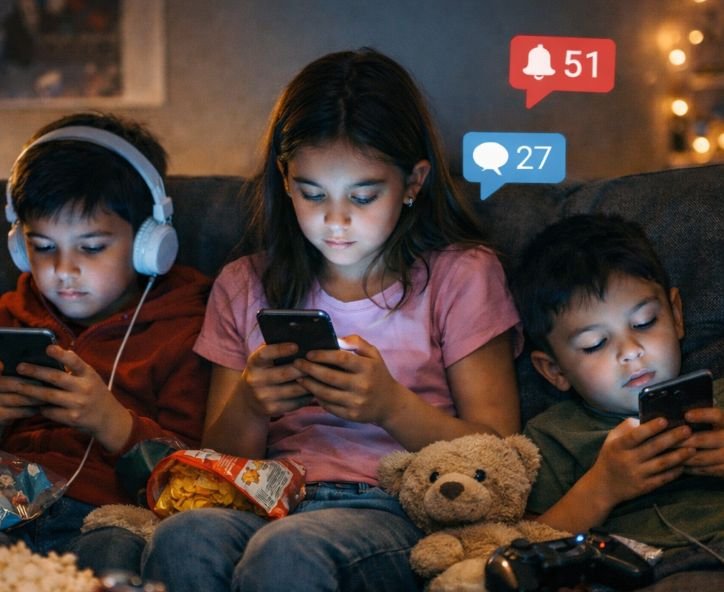
Scientific evidence continues to validate long-standing concerns about social media’s impact on young minds. The European Commission has launched an EU-wide inquiry into the effects of social media on well-being, with particular focus on the addictive design of online services. Studies indicate that even about 30 minutes a day of social media use can reduce focus and attention among children aged 9 to 14. Excessive use has also been linked to disrupted sleep, weaker academic performance, and reduced real-world social interaction compared with traditional screen media.
Children’s developing brains are especially vulnerable to social media’s reward-and-punishment cycles. Age-inappropriate content — including violent material and AI-generated sexual imagery — is increasingly prevalent. Constant notifications and algorithmic feeds may heighten anxiety and could even contribute to long-term structural changes in the amygdala. The consequences range from addiction and emotional distress to broader psychological and physical harm. In the US, a widely reported case of a 13-year-old girl punished after retaliating against classmates who circulated AI-generated nude images of her underscored the severity of cyberbullying and gaps in institutional protection.
Australia’s legislation, described as world-leading, came into effect on December 10, 2025 — almost a year after it passed Parliament — but has faced sustained scepticism. Under the law, children under 16 cannot hold social media accounts. While they may still view content without logging in (where platforms allow), they cannot post, comment, or message others. To comply, platforms are expected to deploy layered safeguards, broadly categorised as age verification, age estimation, and age inference.
Critics argue the ban risks severing vital lifelines for marginalised groups who rely on online communities for connection and support. Social media is deeply embedded in the lives of a generation that grew up with it — alongside parents who, often unknowingly, model the same compulsive smartphone behaviour. UNICEF has warned that outright bans may push young users toward riskier, unregulated corners of the internet. Academics point out that the law does little to curb the production of harmful content or the algorithms that amplify it. Others caution that removing young teenagers from social media may eliminate a crucial channel for emotional support, while giving parents a false sense of security that weakens efforts to build digital awareness at home.
Many experts argue that digital literacy, trust-based parenting, and age-appropriate online education must complement regulation, much as academic learning accompanies formal schooling.
The debate, therefore, is moving beyond abstraction toward actionable choices. As evidence mounts and policy experimentation intensifies, 2026 may well be the year when governments shift from discussion to firmer, more coordinated action to safeguard children in the digital age.