
Dr. Bipin Sony, Assistant Professor, Vidyashilp University
The trinity of smartphone, affordable internet and EdTech platforms has fundamentally altered the academic landscape. For teachers who received most of their training in pre-digital or early digital era, it can often be challenging to engage with students who are tech-savvy and seeking quick information. The conventional role of the teacher as the primary knowledge source is disrupted as students can instantly fact-check and gather information from a variety of interactive and visual sources.
The significant disruption arises from AI tools such as ChatGPT, Gemini or Claude, which are increasingly utilized by students thereby complicating the teaching process. The use of AI tools for completing traditional assignments has become common, prompting me to reconsider the approach to student tasks. The assignments have become more specific and involve critical thinking and problem-solving. Often, they are accompanied by questions designed to assess whether students understand the concepts clearly.
While the sophisticated language produced by AI tools and AI content checkers aids in identifying AI usage, I recognize that teachers must evolve into facilitators who guide students in effectively utilizing these tools while fostering analytical thinking skills. Put simply; while teaching programming using Python or R, I tell them the workflow and suggest ways to make use of AI tools effectively to write the codes.
Further, the short attention span of Gen Z and their need for immediate answers and information often pose challenges to the faculty. While they are tech-savvy and self-driven learners, the presence of mobile phones can complicate the learning process and contribute to distractions.
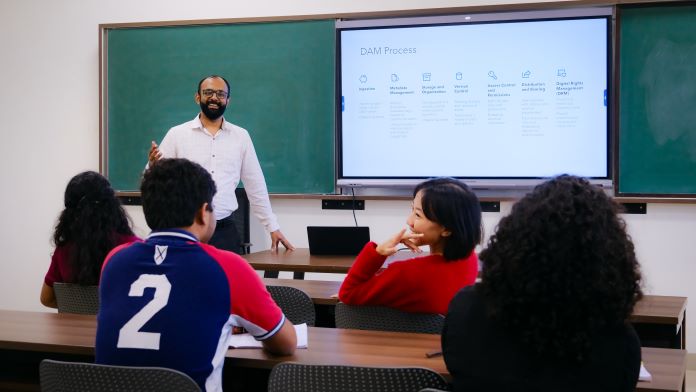
As an engaging strategy, I have begun breaking sessions into focused segments, incorporating multimedia elements, and integrating interactive activities that discuss real-world applications. Interactive learning enhances students’ ability to retain information, making these engagement strategies essential for learning.
Future of jobs report by World Economic Forum suggests that approximately 25% of jobs are expected to be disrupted in five years. This forecast has profound implications: by the time current first-year undergraduate students complete their master’s degrees, a quarter of the roles they initially targeted may have transformed. Importantly, the key skill sets required by companies have undergone significant transformation.
Employers now prioritize a complex blend of competencies like analytical acumen, critical thinking, problem- solving, and resilience. They look for candidates who show learning agility, adaptability, and meticulous attention to detail. These changes represent a dramatic departure from the traditional education system’s focus, emphasizing the need for the teachers to adapt to these evolving demands to prepare students for a digital future. The classroom environment needs to foster these skills and the teaching-learning experience needs a transition.
The modern workplace requires better interpersonal competencies across both physical and digital platforms. Classrooms must therefore evolve into experiential laboratories where students cultivate team collaboration skills, develop cross-cultural communication proficiency, and enhance their emotional intelligence through interactions. Further, ethical considerations are integrated into the teaching to ensure that the students can make informed and responsible decisions
My Own Learnings
The teaching methodologies I employ today bear little resemblance to those that shaped my own academic journey. Few years of teaching have solidified my belief that the classroom should be transformed into a dynamic learning laboratory that integrates traditional wisdom with modern teaching methodologies. This evolution, which is student centric, demands incorporating real-world problem-solving scenarios into the curriculum and fostering critical thinking through interactive discussions.
The teacher’s role shifts from a traditional lecturer to that of a facilitator, empowering students to think creatively, analytically, and beyond the confines of conventional wisdom. To reap the benefits of the demographic dividend we need to equip teachers with the skills and resources needed to guide students in this digital age.
India is home to the largest youth population in the world, estimated at 26% of the total population, or roughly 37.4 crore people in the age group of 10-24, surpassing the population of the USA (State of World Population, UNFPA – 2024). If we add the age group of 0-14, which constitutes 24% of the population, India holds the title for the largest young population globally. This circumstance places India at a crucial juncture where the demographic dividend offers an extraordinary growth opportunity. However, the benefits of the demographic dividend can be reaped only if we train the youngsters adequately for the requirements of the digital age.
With technology rapidly transforming traditional job roles and creating entirely new ones, the Indian education system, specifically teachers who face the challenge of preparing students for a future, can no longer rely solely on conventional methods of information dissemination. This message must sink in.