
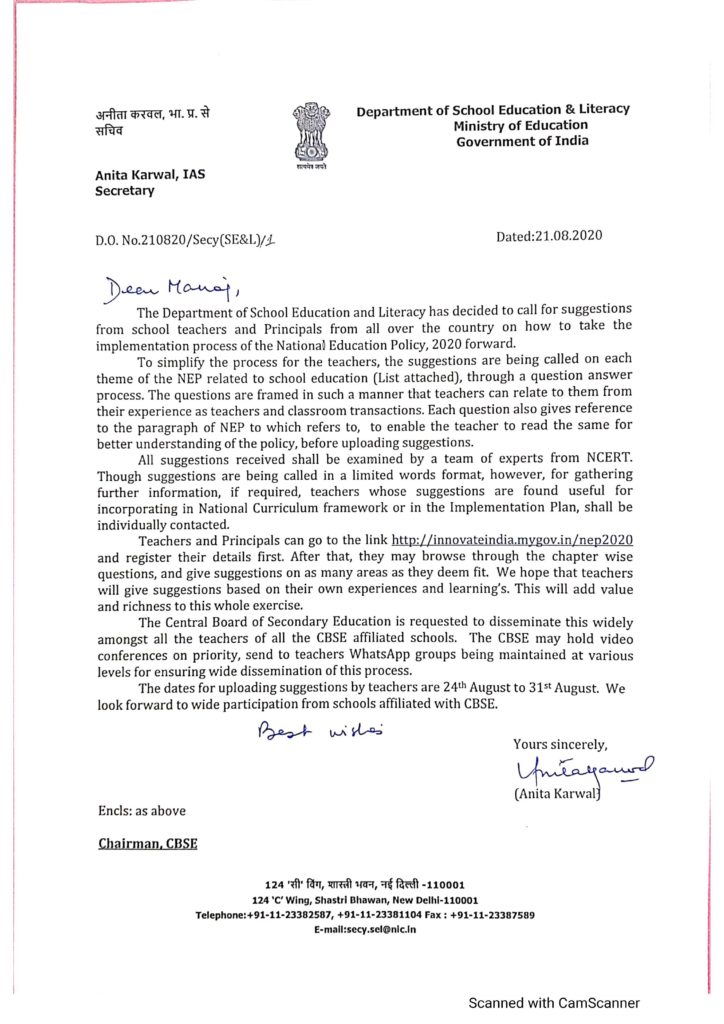
Suggestions can be submitted online between Aug 24 and Aug 31. Secretary, Department School Education & Literacy asks CBSE to disseminate it widely
About the Discussion:
NEP recognizes the importance of teachers as teachers truly shape the future of our children – and, therefore, the future of our nation. The successful implementation of NEP requires participation of teachers at all stages. Therefore, keeping in view the critical and crucial role of teachers, Ministry of Education decided to get the views/suggestions/comments of Principals/ Head Teachers/Teachers on implementation of various recommendations of NEP. The views/suggestions/comments received will form an integral part of the implementation plan of NEP-2020. This underlines the importance of the teachers in the system and the role they are expected to play for providing 21st century skills and holistic education to children.
Participation Guidelines:
- All Principals/Head Teachers/Teachers from Government/Government Aided/Private unaided schools may participate in this humongous exercise.
- Suggestions can be given on various themes/subjects. In order to make it simple, MOE has prepared theme-wise questions on important recommendations of NEP.
- The suggestions/views/comments so received from grassroot level will help in making an effective implementation plan for NEP 2020.
- Participants are required to register themselves on the platform by filling a simple registration form.
Important Dates:
- Start Date: 24th August 2020
- End Date: 31st August 2020 (11.59 PM)
Introduction
The National Education Policy (NEP), 2020 has been approved by the Union Cabinet on 29th July 2020. NEP 2020 is the first education policy of the 21st century, which aims to address the many growing developmental imperatives of our country and is aligned to the 2030 Agenda for Sustainable Development. The National Education Policy, 2020 is built on the foundational pillars of Access, Equity, Quality, Affordability and Accountability.
NEP 2020 recommends many transformational ideas for school education. The New Education Policy emphasized to ensure universal access to high-quality ECCE across the country in a phased manner. Special attention and priority will be given to districts and locations that are particularly socio-economically disadvantaged.
A 5+3+3+4 curricular and pedagogical structure based on cognitive and socio-emotional developmental stages of children has been proposed:
- Foundational Stage (age 3-8 years): 3 years of pre-primary plus Grades 1-2
- Preparatory Stage (8-11 years): Grades 3-5
- Middle Stage (11-14 years): Grades 6-8
- Secondary Stage (14-18 years): Grades 9-12.
It also seeks to ensure foundational literacy and numeracy in a mission mode and a host of curricular changes and reduced content load in school education curriculum as well assessment reforms for holistic development of students. There will be no hard separations between arts and sciences, between curricular and extra-curricular activities, between vocational and academic streams, etc.
NEP 2020 promotes active pedagogy, development of core capacities and life skills, including 21st century skills, experimental learning at all stages, low stake board exams, holistic progress card, transformation in assessment to promote critical and higher order thinking among students, mainstreaming of vocational education and reforms in teacher education. NEP also puts focus on empowerment of teachers and improving their recruitment, service conditions, transfer policy and career progression opportunities at all levels. The National Professional Standards for Teachers (NPST) will specify norms and standards for different levels of teachers. Recommendations are also made for using un-utilized capacity of school infrastructure to promote social, intellectual, and volunteer activities for the community and to promote social cohesion during non-teaching / schooling hours and schools to be used as a “Samajik Chetna Kendra”. NEP 2020 recommends mother tongue/home language/local language, as medium of instruction at least till Grade 5 and at later stages, wherever possible. Policy envisages separation of regulatory, administrative and policy making functions to eliminate conflicts of interest and setting up of a State School Standards Authority. There is also a greater emphasis on technology to improve multiple aspects of education including learning, assessment, planning and administration.