
The words holistic, evolution and change are frequently invoked in discussions on education—both in relation to classroom learning and the governance of education as a critical social sector with far-reaching political and economic consequences. Yet, the unfolding crisis surrounding the NEET examination this year has demonstrated that reform in education is ultimately judged not by rhetoric but by leadership and accountability.
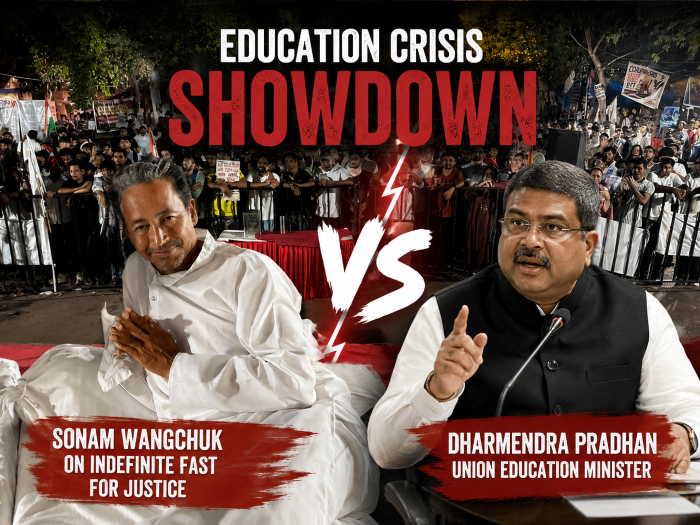
Since the NEET examination controversy erupted in June 2026, demands for accountability quickly transformed into calls for the resignation of Union Education Minister Dharmendra Pradhan. As those demands went unanswered, protests steadily intensified, culminating in educationist and climate activist Sonam Wangchuk’s Gandhian-style indefinite hunger strike that began on June 28 at Delhi’s Jantar Mantar. With his health deteriorating after more than three weeks of fasting, he has been shifted to a hospital under medical supervision on July 18 morning.
As Parliament’s Monsoon Session is set to begin on July 20, attention is firmly focused on the continuing protest at Jantar Mantar, spearheaded by the Cockroach Janta Party and supported by several student organisations, civil society groups and ordinary citizens. A few days ago, speculation about a Cabinet reshuffle briefly fuelled hopes that the crisis could be defused by moving Pradhan to another ministry. However, Prime Minister Narendra Modi appears to be standing firmly behind his Education Minister, raising the possibility of a prolonged political confrontation.
The Prime Minister and the BJP appear to view the NEET controversy as an unfortunate aberration in what they regard as Dharmendra Pradhan’s otherwise significant contribution to Indian education. As the principal political architect overseeing the implementation of the National Education Policy (NEP) 2020, Pradhan has presided over a period of substantial reform. Even many critics acknowledge that the past decade has witnessed transformative changes that disrupted long-standing inertia in the sector.
The expansion of medical education, growth in public higher education institutions, digitalisation, renewed emphasis on foundational literacy and numeracy, promotion of skill development, multidisciplinary higher education, and greater recognition of Indian languages and mother-tongue instruction have all altered the education landscape. Whether one agrees with every reform or not, the government has undeniably shifted both the system and the national conversation on education.
Yet education is unlike most other ministries. It demands not merely administrative efficiency but intellectual leadership, institutional sensitivity and the ability to inspire trust across a wide spectrum of stakeholders. This is where the Modi government faces its sharpest criticism.
Its opponents argue that many ministers, including Pradhan, have functioned more as executors of the ruling dispensation’s ideological agenda than as independent custodians of the education system. They contend that education has increasingly become an arena for ideological contestation, with the Rashtriya Swayamsevak Sangh (RSS) exerting growing influence over appointments, curriculum and knowledge production. According to this view, India is witnessing a shrinking space for independent scholarship, declining international academic standing and the appointment of vice-chancellors whose ideological alignment often appears to outweigh academic distinction.
Critics also point to systemic deficiencies that, they argue, require far greater policy attention than they have received. India continues to face a shortage of nearly one million teachers, while more than 110,000 government schools reportedly function with a single teacher. The National Testing Agency (NTA), entrusted with conducting some of the country’s most consequential examinations, reportedly operates with only about 25 permanent employees supported by around 130 outsourced staff—a striking mismatch between institutional responsibility and administrative capacity.
The government’s critics further cite concerns over a Gross Enrolment Ratio (GER) of around 58.4 per cent at the secondary level, an estimated 2.2 crore out-of-school children, and the merger or closure of over 94,000 schools across the country. They argue that while NEP 2020 offers flexibility through alternative modes of learning, such approaches may inadvertently disadvantage economically weaker students by limiting access to the holistic educational experience that physical campuses provide.
Student organisations and sections of academia have also criticised what they describe as the ideological reinterpretation of knowledge under the banner of the Indian Knowledge System (IKS). Some accuse the government of allowing higher education institutions to become increasingly subservient to political and corporate interests. Questions have also been raised about research quality. Instances of fake peer review, research misconduct and paper retractions have damaged the credibility of Indian institutions, while excessive emphasis on rankings and accreditation has, according to critics, encouraged manipulation of publication metrics rather than genuine academic excellence.
Whether one agrees with these allegations or not, they reflect anxieties that cannot simply be dismissed as partisan rhetoric. Education thrives on trust, intellectual freedom and institutional credibility. Once these are questioned, rebuilding confidence becomes a long and difficult process.
The NEET controversy has also exposed deeper structural weaknesses in India’s examination system. Between 2002 and 2025, documented records show 45 major examination paper leaks involving tests with over one lakh candidates, affecting nearly 3.86 crore aspirants. Only two cases have resulted in convictions. Such statistics underline that examination integrity is not an episodic problem but a chronic institutional failure demanding comprehensive reform.
None of this diminishes Dharmendra Pradhan’s stature within the BJP. He is widely regarded as one of the party’s most effective organisational strategists, possessing considerable political management skills and an impressive record of executing government priorities. Those qualities undoubtedly make him an important member of the Cabinet.
However, political competence alone cannot be the sole criterion for leading a ministry as sensitive and consequential as education. The sector requires exceptional public credibility, intellectual authority and the confidence of students, teachers, universities and society at large. When that confidence begins to erode, governments must weigh not only the political costs of change but also the institutional costs of continuity.
The worsening geopolitical environment has already made economies and societies more uncertain. India can ill afford prolonged unrest on its campuses or a deepening crisis of confidence in its education system. A change of leadership, if it helps restore trust and allows the government to pursue its reform agenda with renewed legitimacy, deserves serious consideration.