
The future of work across professions is moving towards AI-integrated systems, and medicine is no exception. With more than 820 medical colleges and several healthcare education and skilling institutions, India’s medical education ecosystem is increasingly adapting to this shift through faculty training, curriculum redesign, simulation centres, competency-based education and the integration of artificial intelligence.
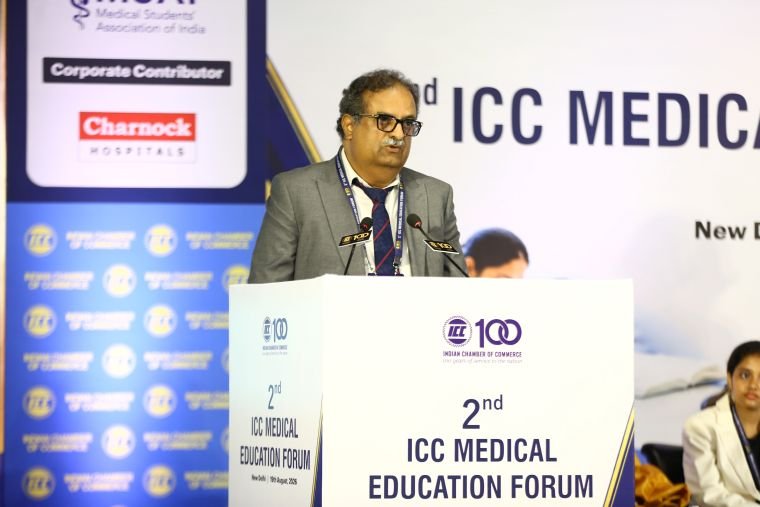
This was stated by Dr Abhijat Chandrakant Seth, Chairperson, National Medical Commission (NMC), at the 2nd ICC Medical Education Forum, organised by the Indian Chamber of Commerce (ICC) in association with the Medical Students Association of India (MSAI) in New Delhi on August 19.
Citing data from the National Board of Examinations in Medical Sciences (NBEMS), Dr Seth said nearly 50,000 doctors had completed structured online AI training in 2026, while the board’s CPR programme reached approximately 20 lakh healthcare professionals in 2023.
“Modern education must prepare students not merely to use AI, but to understand it as well. AI should never replace professional responsibility and accountability. The doctor must remain accountable for decisions made in the care of patients. That is where technology ends and humanity begins,” he said, drawing a distinction between the use of AI and the exercise of professional judgement.
Dr T. Dileep Kumar, President, Indian Nursing Council (INC), highlighted the growing role of simulation-based learning in nursing education, comparing it with pilot training, where simulated environments are used extensively before trainees operate aircraft.
Citing a study by the National Council of State Boards of Nursing, he said up to 50% of a BSc Nursing curriculum could be delivered through simulation. He said the INC, in collaboration with Jhpiego, Laerdal Medical India and SGT University, Gurugram, had established India’s first National Reference Simulation Centre, followed by a second centre at Sajjalashree Institute of Nursing Sciences, Bagalkot.
Dr Kumar said the INC had trained nearly 2,000 nursing faculty members in structured simulation programmes, signed an MoU with the Digital Health Academy for a six-month AI nursing course and expanded the Nurse Practitioner Critical Care programme to around 66 institutions.
He also noted that India had been elected for the first time to the board of the International Council of Nurses (ICN) and had submitted a shortlisted bid to host the ICN Congress in 2029.
Dr Chaitra B.A., President, Medical Students Association of India (MSAI), brought the student perspective to the forum, opening with an account of the exhaustion experienced by students during internship postings.
“A larger workforce doesn’t necessarily mean a stronger workforce. We have to ask where these professionals are going, what conditions they are working in, whether they are adequately trained, whether they can afford to stay in the system,” she said, referring to MSAI’s policy paper on human resources for health.
On AI, Dr Chaitra said, “The question is not whether AI belongs in medicine, it already does. The question is whether our medical education is preparing students to use it responsibly.”
She called for greater student participation in curriculum design and assessment. “Exhaustion is not a competency, and burnout should definitely not be a workforce strategy,” she said.
Dr Ritika Sud, Professor of Medicine, Lady Hardinge Medical College, outlined the evolution of Competency-Based Medical Education (CBME), introduced nationally in 2019. She said CBME brought more than 2,600 defined competencies into the MBBS curriculum, along with the Demonstrate-Observe-Assist-Perform (DOAP) method and the Attitude, Ethics and Communication (AETCOM) module.
She explained that AETCOM is taught through methods including role play and standardised patient encounters, with students assessed continuously as part of the competency-based approach.