
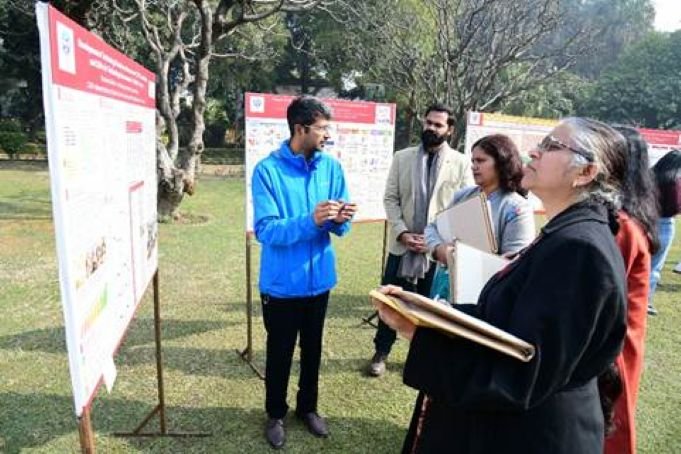
Commemorating its 5th Foundation Day, the CSIR-National Institute of Science Communication and Policy Research (CSIR-NIScPR) launched its SVASTIK (Scientifically Validated Societal Traditional Knowledge) web portal on Jan 14 at the hands of Dr. Shivkumar Kalyanaraman, CEO, ANRF.
The portal is a national initiative implemented by CSIR-NIScPR upon the clarion call of Prime Minister Narendra Modi, aimed at communicating India’s scientifically validated traditional knowledge to the society. Dissemination is being done through SVASTIK channels in English and 19 Indian languages, along with 5 foreign languages.
This web portal will not only provide access to all SVASTIK content at one place but will also strengthen the outreach, accessibility, and sustained engagement of various stakeholders with India’s scientifically validated traditional knowledge.
Earlier setting the tone for the event Dr. Geetha Vani Rayasam, Director, CSIR-NIScPR, highlighted the institute’s strong science communication legacy in her welcome address. “We need to engage global institutions. We are working on how to leverage AI in regional language communication”.
Dr. Viswajanani J. Sattigeri, Head, CSIR-Traditional Knowledge Digital Library (TKDL) Unit, emphasized TKDL’s global recognition. She further added, “Traditional knowledge is very important, and we are the only lab that validates traditional knowledge. Policy research at NIScPR has huge potential—previously, our policy document was released by the Former President of India. TKDL is now fully digitized, so we can research more relevant tools.”
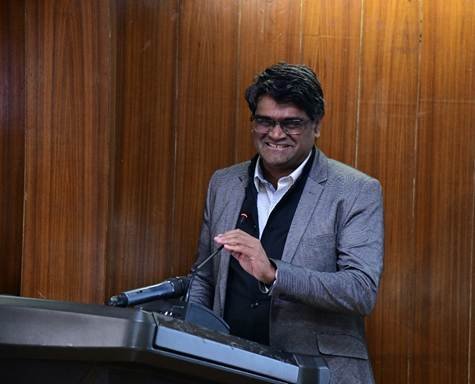 The event also featured a distinguished lecture by the Chief Guest Dr. Shivkumar Kalyanaraman, CEO, Anusandhan National Research Foundation (ANRF), Govt. of India. He praised NIScPR’s alignment with ANRF’s vision of catalysing India’s rise as a research and innovation powerhouse. “I praise the idea of NIScPR going global—we need to think global. NIScPR uses policy to solve societal problems, and we need to become world-class; the institute has the potential to do that. Our scientists and engineers should work with AI specialists and we can partner with NIScPR on pioneering new formats.”
Dr. Kalyanaraman also invited NIScPR to use ANRF’s Saral AI tool to simplify research and amplify impact through social media.