
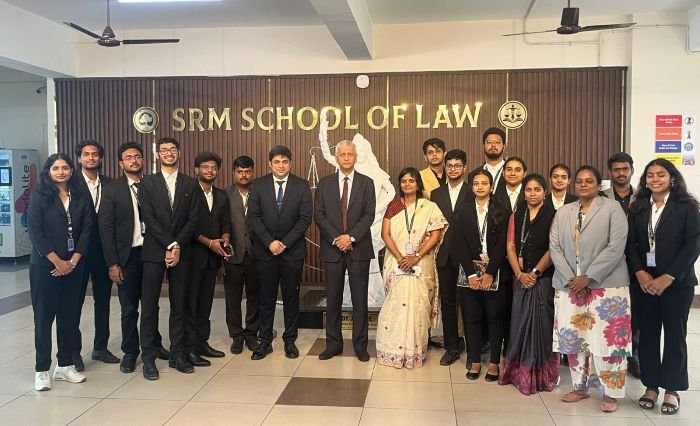
Mr. Justice Uday Umesh Lalit, former Chief Justice of India, has been appointed as Professor Emeritus at the School of Law, SRM Institute of Science and Technology. Widely regarded for his contributions to constitutional jurisprudence and for being one of the few distinguished jurists elevated directly from the Bar to the Supreme Court, Justice Lalit has played a pivotal role in shaping modern Indian legal discourse through landmark rulings on individual rights, gender justice, and institutional accountability.
Notably, he was part of the Constitution Bench in Shayara Bano v. Union of India, which declared instant triple talaq unconstitutional, and the ruling in Joseph Shine v. Union of India, which struck down the offence of adultery, reaffirming the values of dignity, equality and personal autonomy.
During his visit to the SRMIST campus, Justice Lalit delivered a lecture on “Parliamentary Privileges,” focusing on their constitutional basis and contemporary relevance. He traced the origins of parliamentary privileges to the evolution of the British Parliament and explained how these principles were adopted and adapted within the Indian constitutional framework.
He said parliamentary privileges are essential to ensuring the independence and effective functioning of legislative bodies, allowing them to discharge their duties without undue interference.
“Parliamentary privileges are not personal advantages, but institutional safeguards designed to preserve the dignity, independence, and effectiveness of legislative bodies,” Justice Lalit noted.
Referring to Article 194 of the Constitution, which deals with the powers, privileges and immunities of State Legislatures, he noted that while the Constitution lays down the framework, the contours of these privileges have been shaped over time through judicial interpretation. He underlined the need to view legislative privileges in harmony with fundamental rights and constitutional principles.
Justice Lalit also discussed key rulings that have defined the scope of parliamentary privileges in India. Referring to M.S.M. Sharma v. Sri Krishna Sinha, he highlighted the tension between legislative privilege and freedom of the press. He also cited Tej Kiran Jain v. N. Sanjiva Reddy, which upheld immunity for statements made by legislators within the House.
He further referred to the advisory opinion in In Re: Powers, Privileges and Immunities of State Legislatures, where the Supreme Court examined the balance between legislative autonomy, judicial review and fundamental rights. He noted that these decisions continue to guide the interpretation of privileges in a constitutional democracy.
Emphasising the importance of legal reasoning, Justice Lalit urged students to read judgments in their entirety and understand the context in which legal principles are developed. He said a fragmented reading of case law often leads to incomplete or incorrect interpretations.
“At SRM, we believe the law is best learned from those who have shaped it. It is a profound honour to welcome Hon’ble Justice U.U. Lalit as our Professor Emeritus. His presence transforms textbook theory into living inspiration, mentoring our students to become the thoughtful, principled leaders our legal system needs”, commented Prof. P. Sree Sudha, Dean, SRM School of Law, SRMIST-KTR on the new appointment.
An interactive session followed, with students raising questions on constitutional interpretation, legislative powers and judicial oversight. Responding to the queries, Justice Lalit stressed the need for clarity of thought, consistency in legal reasoning and adherence to professional ethics.
He also encouraged students to cultivate disciplined reading habits and approach the study of law with analytical rigour and a sense of responsibility. He noted that a strong grounding in constitutional principles is essential for navigating complex legal issues.