


If you have read the NABARD Grade A notification, you will know that current affairs are not just a side topic that is given on this exam; rather, it is the backbone of the exam.
Every year, I meet students who score decently in Quant or English but struggle with the General Awareness and current-based ESI/ARD questions. And that’s exactly where toppers pull ahead, not because they read more, but because they read smart.
Let’s break down how to prepare current affairs for the NABARD Grade A exam: simply, effectively, and in a way that actually works.
-
Why Current Affairs Matter So Much
In NABARD, your current affairs knowledge doesn’t stay confined to Phase 1. It travels with you all the way till the interview.
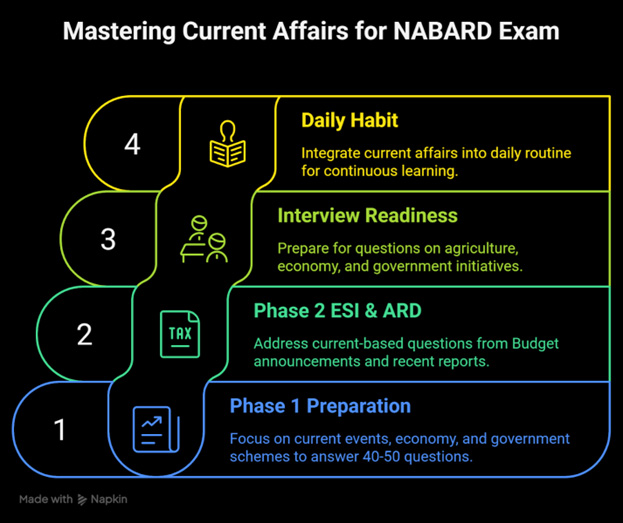
- In Phase 1, around 40–50 questions come from current events, economy, and government schemes.
- In Phase 2, the ESI and ARD papers directly include current-based questions from Budget announcements to recent reports.
- And during the interview, questions on agriculture, economy, or government initiatives are almost guaranteed.
So, if you’re serious about clearing the NABARD Grade A exam, current affairs have to become a daily habit, not a last-month crash course.
-
How Far Back Should You Study?
If you’re reading this right after the NABARD Grade A notification 2025, start from October 2024 and cover everything up to the exam month.
Ideally, 6–8 months of current affairs is enough. But here’s what I’ve observed while analysing past papers: the most weightage is given to the last 3 months before the exam.
So, don’t ignore older months, but revise the recent ones multiple times.
-
Which Sources to Rely On
The biggest mistake aspirants make is collecting 10 PDFs and finishing none.
You don’t need quantity. You need consistency. Here are a few dependable sources that actually work:
- Monthly current affairs compilations from EduTap which are concise and exam-specific.
- PIB for authentic government updates.
- Yojana and Kurukshetra magazines for agriculture and rural topics.
- Official websites of the Ministry of Agriculture, Rural Development, and Finance.
- Economic Survey and Union Budget Summary for macro data and schemes.
Pick two sources you trust and stick with them. It’s better to revise one PDF five times than read five PDFs once.
-
Daily, Weekly, and Monthly Routine
This is where discipline wins.
If you spread your effort smartly across the week, revision becomes effortless.
- Daily (30–40 mins): Read and highlight 10–12 important events. Focus on schemes and reports.
- Weekly (1–1.5 hrs): Revisit your notes. Attempt quizzes. Mark recurring themes (agriculture, economy, environment).
- Monthly (3–4 hrs): Revise one monthly compilation fully. Make a one-page summary for quick recall.
Doing this for even 3 months builds a strong, exam-ready foundation.
-
Connect Current Affairs with ESI and ARD
This is where most aspirants lose marks. They study current affairs separately.
In reality, NABARD doesn’t test “GK”; it tests the application.
When you study current affairs:
- Link economic news to ESI topics like inflation, GDP, or government expenditure.
- Link agriculture updates to ARD topics like irrigation, cropping patterns, or animal husbandry.
- When writing descriptive answers, back your points with recent data or schemes.
This small shift turns your preparation from average to exam-oriented.
-
How to Revise Effectively
Reading isn’t enough. You have to retain it.
Here’s a pattern that works:
- Create a monthly revision sheet with just scheme names, ministries, objectives, and years.
- Use sticky notes or digital flashcards for tricky facts.
- Revise your notes every 20 days.
- In the final month, focus only on the most recent 4 months.
The goal is to make recall automatic. You should be able to remember a scheme’s name the second you see the question.
-
Mistakes You Must Avoid
- Starting after the notification: The best candidates start 3–4 months before it drops.
- Changing sources midway: Stick with one trusted compilation.
- Neglecting revision: Reading once never works; revising thrice does.
- Ignoring agriculture updates: At least 30–40% of questions have rural or agri-angle.
- Overloading with facts: Understand the purpose behind a scheme instead of memorising every number.
-
Role of PYQs and Mocks
If you ever feel lost about what to study, go back to previous year papers.

You’ll immediately see a pattern:
Most questions are factual, but based on conceptual awareness — “Which ministry launched this scheme?” or “Under which mission was this initiative introduced?”
Attempting mock tests not only improves your speed but also trains your brain to filter relevant information quickly.
Final Thoughts
Current affairs for NABARD Grade A aren’t tough. You don’t need to memorise every fact; you need to understand what NABARD asks and how it frames questions.
Stay consistent for 6 months, revise regularly, and use curated resources like EduTap’s monthly compilations. They’ll not only save you time but also keep your preparation laser-focused.
If you build this one habit right, you’ll find both Phase 1 and Phase 2 much easier to crack.