
In a pioneering study published in Hydrological Processes, researchers led by IIT Roorkee have, for the first time, conducted a full-scale isotopic analysis of the Ganga River from its Himalayan origin to its deltaic end, including its major tributaries. The study offers a paradigm shift in understanding how the Ganga is sustained during the hot and dry summer months.
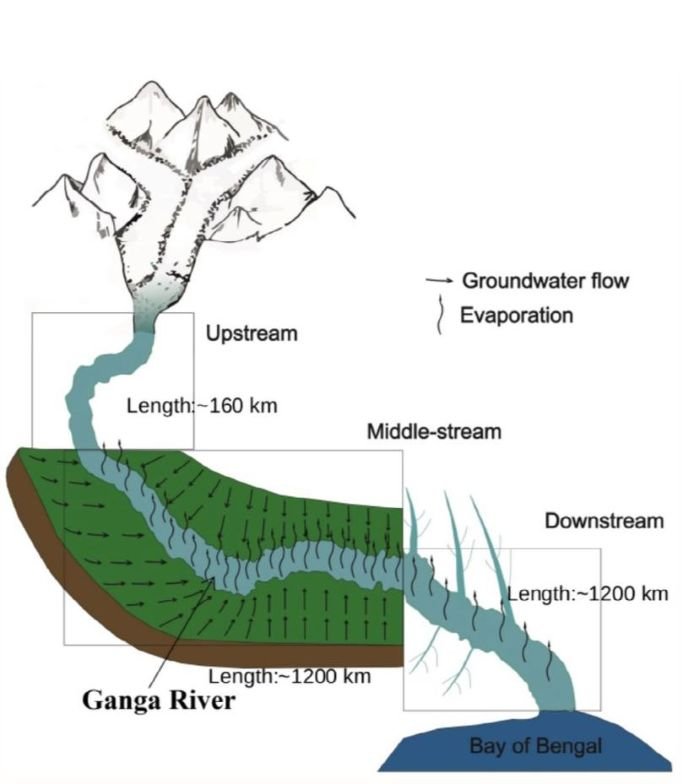
The study dismantles long-held assumptions by clearly establishing that up to Patna, the Ganga is primarily sustained by groundwater discharge, not glacial melt as widely believed. This natural underground contribution boosts the river’s volume by nearly 120% along the middle stretch. Meanwhile, more than 58% of the river’s water is lost to evaporation during summer—an alarming yet overlooked component of the river’s water budget.
Contrary to prior satellite-based studies warning of severe groundwater depletion across North India, the new findings based on two decades of in-situ data indicate largely stable groundwater levels across the central Ganga Plain. In fact, consistent flows from shallow hand pumps across decades reinforce the evidence of a resilient aquifer system that continues to feed the Ganga during non-monsoon periods.
Another striking revelation is the negligible role of glacial melt in maintaining Ganga’s flow in the Indo-Gangetic plains during summer. The study quantifies that beyond the Himalayan foothills, the glacier-fed input is virtually absent and does not influence the summer discharge up to Patna. Post-Patna, tributaries like Ghaghara and Gandak become the dominant contributors.
This research adds valuable scientific weight to several ongoing national missions such as Namami Gange, Atal Bhujal Yojana, and Jal Shakti Abhiyan, which aim to rejuvenate rivers and improve groundwater management. The findings strongly support reviving tributaries, increasing environmental flow releases from barrages, and protecting local water bodies to recharge aquifers.
“Our analysis shows that the Ganga is not drying because groundwater is depleting, but due to over-extraction, excessive diversion, and neglect of tributaries. Groundwater is still the hidden lifeline of the Ganga,” said Prof. Abhayanand Singh Maurya, lead author and faculty at the Department of Earth Sciences, IIT Roorkee.
Prof. K.K. Pant, Director of IIT Roorkee, said, “This research redefines how can we understand the Ganga’s summer flow. It should prove a sustainable future river rejuvenation strategy, not just for the Ganga but for all major Indian rivers.”
The study concludes with a compelling message: If India wants a sustainable Ganga, it must protect and recharge its aquifers, release adequate water into the main river channel, and revive the lost tributary networks. The future of the Ganga depends not on glaciers alone but on how we manage the water beneath our feet.